Hoppus, Willard Henry (Warrant Officer 2nd Class)
Killed in Action 1944-January-14
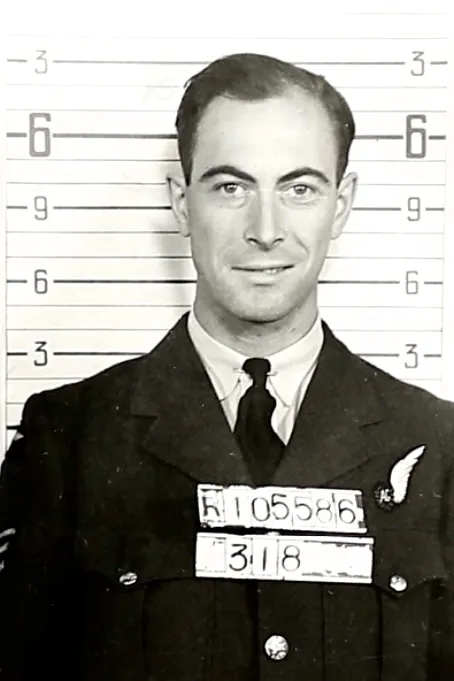

Birth Date: 1918-August-01
Born:
Parents: Son of Clarence Leroy Hoppus and Lottie Amanda Hoppus, of Lacombe, Alberta, Canada.
Spouse:
Home: Lacombe, Alberta
Enlistment:
Enlistment Date: unkown date
Service
RCAF
Unit
432 (B) Sqn- Squadron
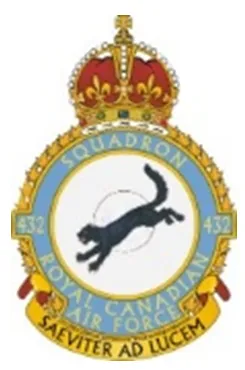
Saeviter Ad Lucem Ferociously toward the light
Base
East Moor
Rank
Warrant Officer 2nd Class
Position
Air Gunner (Rear)
Service Numbers
R/105586
Home
 Lacombe, Alberta
Target
Brunswick Germany
Temporary Burial
Cemetery at Imbshausen, Germany, near crash site
Remains were later exhumed from this location and reburied
 Canadian Virtual War Memorial
 Commonwealth War Graves Commission
 Finadagrave.com
 Library and Archives Canada Service Files (may not exist)
Crew or Other Personnel
Lancaster DS740


Mission
Lancaster Mk.II DS740
Bombing Brunswick Germany 1944-January-14 to 1944-January-14
432 (B) Sqn (RCAF) East Moor
Battle of Berlin
496 Lancasters and 2 Halifaxes on the first major raid to Brunswick of the war. 38 Lancasters Jost, 7·6 per cent of the force. The German running commentary was heard following the progress of the bomber force from a position only 40 miles from the English coast and many German fighters entered the bomber stream soon after the German frontier was crossed near Bremen. The German fighters scored steadily until the Dutch coast was crossed on the return flight. Ir of the lost aircraft were Pathfinders.
Brunswick was smaller than Bomber Command's usual targets and this raid was not a success. The city report describes this only as a 'light' raid, with bombs in the south of the city which had only ro houses destroyed and 14 people killed. Most of the attack fell either in the countryside or in Wolfenbiittel and other small towns and villages well to the south of Brunswick.
source: The Bomber Command War Diaries, Martin Middlebrook and Chris Everitt
Lancaster BII aircraft DS 740 QO-Z missing while engaged in an operation against targets in Brunswick, Germany. It is believed that the Lancaster was shot down by a night fighter and crashed at Lagershausen, NE of Northeim, Germany with the loss of the entire crew
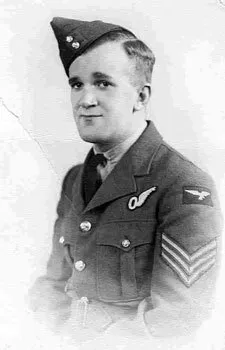
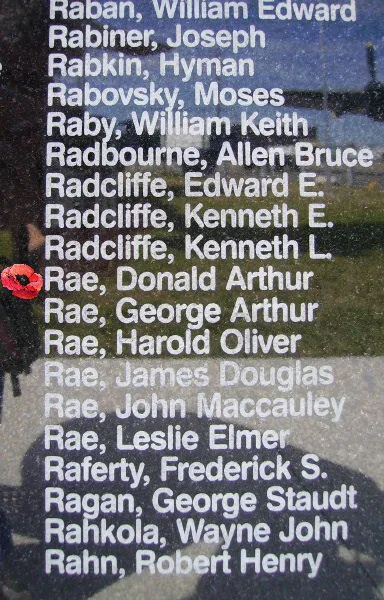
Pilot Officer DT Lyng (RCAF), Pilot Officer DA Rae (RCAF),Warrant Officer WH Hoppus (RCAF), Sergeant KE Evans (RAFVR), Sergeant CF Tarr (RAFVR), FS EF Howe (RAFVR), and Flying Officer BV Holmes (RAFVR) were all killed in action
There were two 432 Lancaster II aircraft lost on this operation. Please see Rainville, GH for information on Lancaster DS 850 QO-M
Lancaster serial: DS740
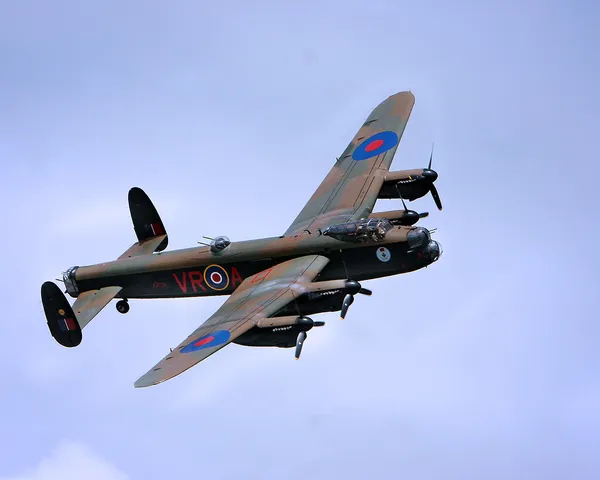
Avro Lancaster Mk. X RCAF Serial FM 213
Canadian Warplane Heritage Museum
Canadian Warplane Heritage Museum
The Avro Lancaster is a British Second World War heavy bomber. It was designed and manufactured by Avro as a contemporary of the Handley Page Halifax, both bombers having been developed to the same specification, as well as the Short Stirling, all three aircraft being four-engined heavy bombers adopted by the Royal Air Force (RAF) during the same wartime era.
The Lancaster has its origins in the twin-engine Avro Manchester which had been developed during the late 1930s in response to the Air Ministry Specification P.13/36 for a capable medium bomber for "world-wide use". Originally developed as an evolution of the Manchester (which had proved troublesome in service and was retired in 1942), the Lancaster was designed by Roy Chadwick and powered by four Rolls-Royce Merlins and in one version, Bristol Hercules engines. It first saw service with RAF Bomber Command in 1942 and as the strategic bombing offensive over Europe gathered momentum, it was the main aircraft for the night-time bombing campaigns that followed. As increasing numbers of the type were produced, it became the principal heavy bomber used by the RAF, the Royal Canadian Air Force (RCAF) and squadrons from other Commonwealth and European countries serving within the RAF, overshadowing the Halifax and Stirling. Wikipedia
 Lancaster Bomber
 Wikipedia
Unit Desciption
432 (B) Sqn Saeviter Ad Lucem ("Leaside")
History of the Squadron during World War II (Aircraft: Wellington X, Lancaster II, Halifax III, VII)
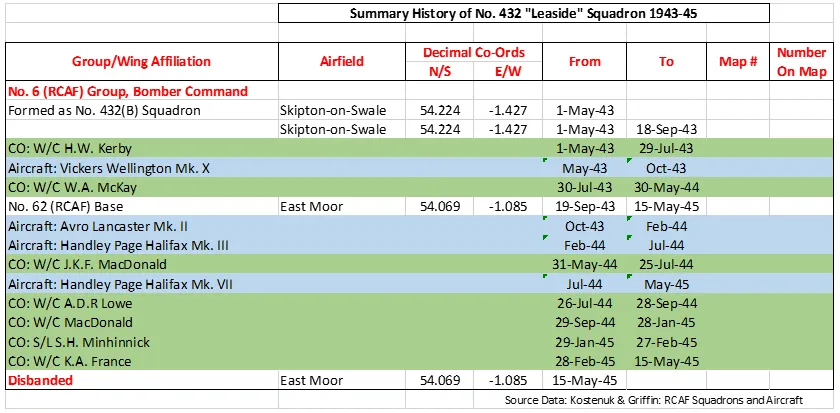
The Squadron was the twelfth RCAF bomber squadron to be formed overseas in WWII. It was formed on May 1, 1943 at Skipton-on-Swale, Yorkshire, UK as a unit of No 6 (RCAF) Group of RAF Bomber Command: indeed, it was the first bomber squadron to be formed directly into No 6 Group. Using the squadron identification letters QO it flew Vickers Wellington Mk X medium bombers until it moved to East Moor, Yorkshire on 19th September 1943, when it re-equipped with Avro Lancaster Mk II aircraft. East Moor was part of No 62 (RCAF) Base. The squadron re-equipped with Handley Page Halifax Mk III aircraft in February 1944, and with Halifax Mk VII in July of that year, and continued with them until the squadron was disbanded at East Moor on May 15, 1945.
In the course of operations the squadron flew 246 missions, involving 3130 individual sorties, for the loss of 73 aircraft. 8980 tons of bombs were dropped. Awards to squadron members included 2 DSOs, 119 DFCs,1 Bar to DFC, 1 CGM, 20 DFMs and 1 Croix de Guerre (France). Battle Honours were: English Channel and North Sea 1943, Fortress Europe 1943-44, France and Germany 1944-45, Biscay Ports 1944, Ruhr 1943-45, Berlin 1943-44, German Ports 1943-45, Normandy 1944, Rhine, Biscay 1943.Moyes, Kostenuk and Griffin
Squadron History (Bomber Command Museum PDF)
Maps for Movements of 432 Squadron 1943-45
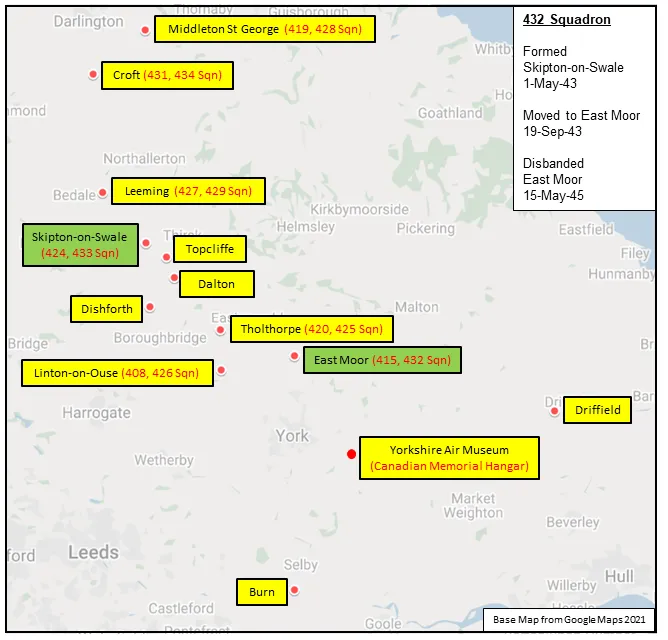
MAP 1: 432 Squadron Bases 1943-45 (marked in green). Right-click on image to display enlarged in new tab
432 Squadron History Summary 1943-45
History of the Squadron Post-WWII (Aircraft: Canuck)
The squadron was re-formed at Bagotville, Quebec as an All-Weather Fighter unit on 1 October 1954. The squadron flew Avro CF-100 Canuck aircraft on North American Air Defence until it was disbanded on 15 October 1961.
Lancaster DS740 Mk.II - Bombing Brunswick Germany - 1944-01-14 to 1944-01-14
Squadron: 432 (B) Sqn (RCAF)
Start Date: 1944-01-14
Completion Date: 1944-01-14
Mission: Bombing
Operation: Battle of Berlin
Target City: Brunswick Germany
Target Specific:
Base: East Moor
Take Off Time: 17.02
Squadron Code: QO Z
Radio Code:
Return Base:
Return Time:
Crash City: Lagershausen 6 km NE of Northeim.
Crash Specifics:
Crash Latitude: 0.00000000
Crash Longitude: 0.00000000
Crash Reason: fighter
Flak Battery:
Enemy Claim:
War Diary Unavailable
6 Group Unavailable
496 Lancasters and 2 Halifaxes on the first major raid to Brunswick of the war. 38 Lancasters Jost, 7·6 per cent of the force. The German running commentary was heard following the progress of the bomber force from a position only 40 miles from the English coast and many German fighters entered the bomber stream soon after the German frontier was crossed near Bremen. The German fighters scored steadily until the Dutch coast was crossed on the return flight. Ir of the lost aircraft were Pathfinders.
Brunswick was smaller than Bomber Command's usual targets and this raid was not a success. The city report describes this only as a 'light' raid, with bombs in the south of the city which had only ro houses destroyed and 14 people killed. Most of the attack fell either in the countryside or in Wolfenbiittel and other small towns and villages well to the south of Brunswick.
source: The Bomber Command War Diaries, Martin Middlebrook and Chris Everitt
Lancaster BII aircraft DS 740 QO-Z missing while engaged in an operation against targets in Brunswick, Germany. It is believed that the Lancaster was shot down by a night fighter and crashed at Lagershausen, NE of Northeim, Germany with the loss of the entire crew
Pilot Officer DT Lyng (RCAF), Pilot Officer DA Rae (RCAF),Warrant Officer WH Hoppus (RCAF), Sergeant KE Evans (RAFVR), Sergeant CF Tarr (RAFVR), FS EF Howe (RAFVR), and Flying Officer BV Holmes (RAFVR) were all killed in action
There were two 432 Lancaster II aircraft lost on this operation. Please see Rainville, GH for information on Lancaster DS 850 QO-M
 War Cemetery - Hanover-Ahlem, Lower Saxony, Germany
