Gilmore, Francis Ormond (Flying Officer)
Killed in Action 1944-August-03


Birth Date: 1916-February-05
Born: Toronto, Toronto Municipality, Ontario, Canada
Parents: Son of Francis "Frank" Gilmore and Florence (nee Cudahy) Gilmore of Toronto, Ontario
Spouse:
Home: Toronto, Ontario
Enlistment: Toronto, Ontario
Enlistment Date: 1942-April-13
Service
RCAF
Unit
61 (B) Sqn- Squadron (RAF)
Per Purum Tonantes Thundering through the clear air
Base
RAF Skellingthorpe
Rank
Flying Officer
Position
Pilot
Service Numbers
J/25797
 Toronto, Ontario
 Canadian Virtual War Memorial
 Commonwealth War Graves Commission
 Finadagrave.com
 Library and Archives Canada Service Files (may not exist)
Crew or Other Personnel
Lancaster PA162



Mission
Lancaster Mk.I PA162
Bombing Trossy St Maximin France 1944-August-03 to 1944-August-03
61 (B) Sqn (RAF) RAF Skellingthorpe
61 Squadron (Per Puram Tunantes) RAF Skellingthorpe. Lancaster Mk 1 aircraft PA 162 QR-L missing during a daylight operation against the underground V-1 Rocket storage facilities at Troissy-Saint Maximin, North of Paris, France. Cause of loss not determined but believed to have been from Flak, the Lancaster crashed between Trossy (Saint-Maximin) and Creil, France with the loss of six aircrew
Flying Officer Francis Ormond Gilmore (RCAF), Pilot Officer Ross Edwin Sutherland (RCAF), Pilot Officer Harold David Thomson (RCAF), Flying Officer Wilbert Stephens (RCAF), Pilot Officer Bernard Lawrence Rowland (RAF) and Flying Officer Edward Robinson Durant (RAFVR) were all killed in action
Flying Officer W D Forbes (RCAF), baled safely from the bomber and avoided being taken Prisoner of War, remarkably, so close to Allied lines when landed that he was picked up by in very short order by friendly forces
 Royal Air Force Serial and Image Database
Lancaster serial: PA162
Canadian Warplane Heritage Museum
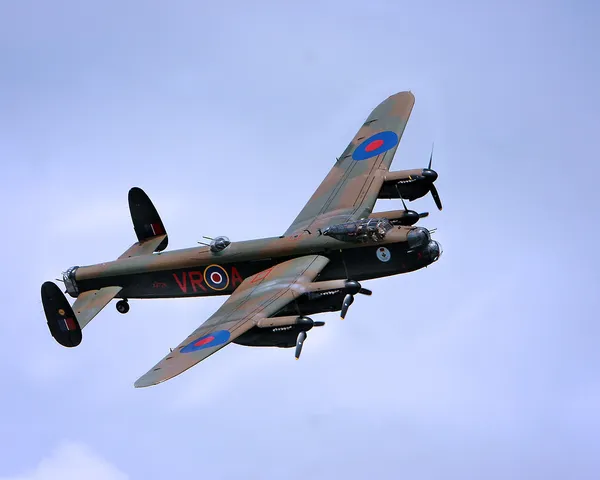
The Avro Lancaster is a British Second World War heavy bomber. It was designed and manufactured by Avro as a contemporary of the Handley Page Halifax, both bombers having been developed to the same specification, as well as the Short Stirling, all three aircraft being four-engined heavy bombers adopted by the Royal Air Force (RAF) during the same wartime era.
The Lancaster has its origins in the twin-engine Avro Manchester which had been developed during the late 1930s in response to the Air Ministry Specification P.13/36 for a capable medium bomber for "world-wide use". Originally developed as an evolution of the Manchester (which had proved troublesome in service and was retired in 1942), the Lancaster was designed by Roy Chadwick and powered by four Rolls-Royce Merlins and in one version, Bristol Hercules engines. It first saw service with RAF Bomber Command in 1942 and as the strategic bombing offensive over Europe gathered momentum, it was the main aircraft for the night-time bombing campaigns that followed. As increasing numbers of the type were produced, it became the principal heavy bomber used by the RAF, the Royal Canadian Air Force (RCAF) and squadrons from other Commonwealth and European countries serving within the RAF, overshadowing the Halifax and Stirling. Wikipedia
 Lancaster Bomber
 Wikipedia
Unit Desciption
61 (B) Sqn Per Purum Tonantes ()
Lancaster PA162 Mk.I - Bombing Trossy St Maximin France - 1944-08-03 to 1944-08-03
War Diary Unavailable
6 Bomber Group August 3, 1944
210 Halifaxes from 408, 425, 420, 424, 425, 426, 427, 429, 431, 432,433, and 434 squadrons were joined by 51 Lancasters from 408, 419 and 428squadrons on an attack of two V-1 storage sites at Foret De Nieppe and Bois De Cassan. The crews were over these targets at between 14,000 and16,000 feet, releasing 2,266,000 lbs. of high explosives. According to reports, the weather was clear and severe damage was caused. Richard Koval (6bombergroup.ca)
61 Squadron (Per Puram Tunantes) RAF Skellingthorpe. Lancaster Mk 1 aircraft PA 162 QR-L missing during a daylight operation against the underground V-1 Rocket storage facilities at Troissy-Saint Maximin, North of Paris, France. Cause of loss not determined but believed to have been from Flak, the Lancaster crashed between Trossy (Saint-Maximin) and Creil, France with the loss of six aircrew
Flying Officer Francis Ormond Gilmore (RCAF), Pilot Officer Ross Edwin Sutherland (RCAF), Pilot Officer Harold David Thomson (RCAF), Flying Officer Wilbert Stephens (RCAF), Pilot Officer Bernard Lawrence Rowland (RAF) and Flying Officer Edward Robinson Durant (RAFVR) were all killed in action
Flying Officer W D Forbes (RCAF), baled safely from the bomber and avoided being taken Prisoner of War, remarkably, so close to Allied lines when landed that he was picked up by in very short order by friendly forces
Royal Air Force Serial and Image Database
