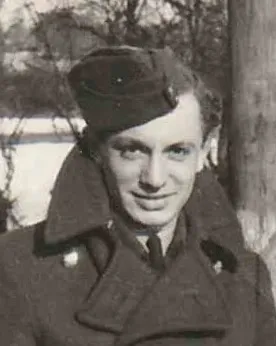
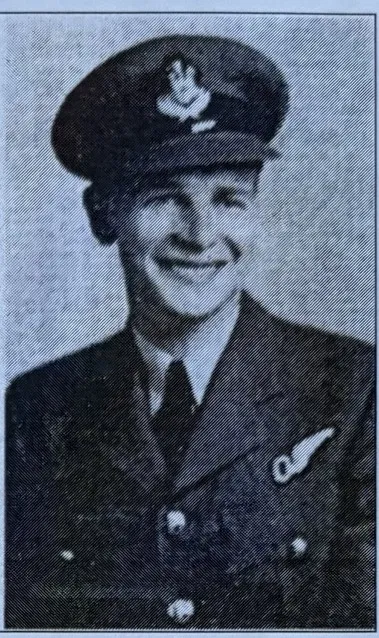
Judson, Donald (Sergeant)
Killed in Action 1944-July-29


Birth Date: 1923
Born:
Parents: ALFRED AND AMY JUDSON, OF SOWERBY, YORKSHIRE.
Spouse:
Home:
Enlistment:
Enlistment Date: unkown date
Service
RAFVR
Unit
100 (B) Sqn- Squadron (RAF)
Sarang Tebuan Jangan Dijolok Malay
Base
Grimsby
Rank
Sergeant
Position
Flight Engineer
Service Numbers
1594312
Target
 Stuttgart Germany
Crew or Other Personnel
Lancaster PB172



Mission
Lancaster Mk.I/III PB172
Bombing Stuttgart Germany 1944-July-29 to 1944-July-29
100 (B) Sqn (RAF) Grimsby
The Mission to Stuttgart involved 461 Lancasters and 153 Halifaxes. 17 Lancasters lost and 4 Halifaxes lost. 4.6% of the force.
This was the first of 3 heavy raids on Stuttgart in 5 nights and the only report available is a composite of one of the 3 raids. The raids caused the most serious damage of the war in the central districts of Stuttgart which being situated in a series of narrow valleys had eluded Bomber Command for several years. They were now devastated and most of Stuttgarts public and cultural buildings were destroyed. The second of the 3 raids, on the night of July 25/26, was the most successful. Total casualties in Stuttgart during this series of raids were 1,171 people killed and 1,600 injured.The Bomber Command War Diaries by Martin Middlebrook and Chris Everitt
On the night of the 28th of July, 1944, Lancaster III PB172 took off from RAF Grimsby along with other Lancasters from 100 sqn to bomb targets at Stuttgart, Germany. It was reported by returning crews that there was fighter activity over the target but none reported any attacks. German documents record that the aircraft crashed on the 29th, July 1944 at about 01:55 hrs near to Durmersheim and Obereweier, some 70km west of Stuttgart. It was likely that the aircraft was hit by flak and disintegrated in mid-air. The aircraft wreckage fell to the ground within a radius of at lest 8km. Parts of the aircraft were found at the last inhabited house in Oberweier in the direction of Winkel, which is about 1.5km to the SSE.Traugott Vitz and Ralph Snape, provided by Andy Charvat
Killed: Sergeant Donald Judson RAF KIA Durnbach War Cemetery Ref : Coll. grave 11. H. 8-11. Pilot Officer Steve Lawrence Krawchuk RCAF J/90763 Durnbach War Cemetery Ref : Coll. grave 11. H. 8-11. Pilot Officer Conrad William Martens RCAF J/90764 KIA Durnbach War Cemetery Ref : 3. H. 3. Sergeant Kenneth Ernest Nottage RAF KIA Durnbach War Cemetery Ref : Coll. grave 11. H. 8-11. Flying Officer Hewitt Harold Robinson Reid RCAF J/26681 Pilot Durnbach War Cemetery Ref : Coll. grave 11. H. 8-11. Flying Officer Wilfred James Smith RCAF J/27489 KIA Durnbach War Cemetery Ref : 3. H. 4.
POW: Flight Sergeant William Archibald MacDonald RCAF R/176660 POW Stalag Luft L7 Bankau near Kreuzburg, Upper Silesia.
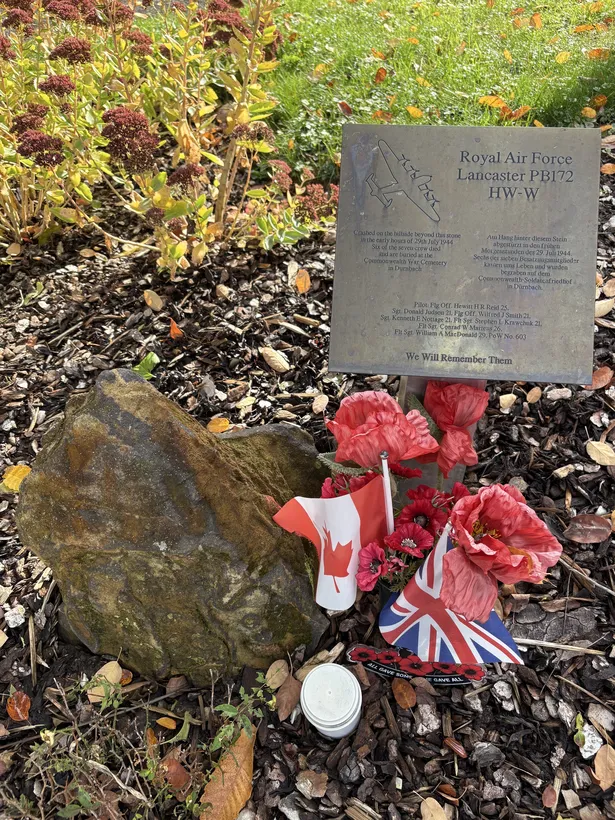
Memorial to the crew of Lancaster PB172 in Oberweier, near Gaggenau
Lancaster serial: PB172
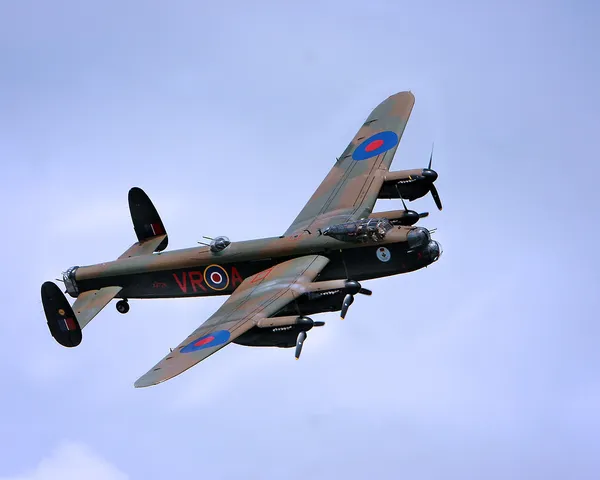
Avro Lancaster Mk. X RCAF Serial FM 213
Canadian Warplane Heritage Museum
Canadian Warplane Heritage Museum
The Avro Lancaster is a British Second World War heavy bomber. It was designed and manufactured by Avro as a contemporary of the Handley Page Halifax, both bombers having been developed to the same specification, as well as the Short Stirling, all three aircraft being four-engined heavy bombers adopted by the Royal Air Force (RAF) during the same wartime era.
The Lancaster has its origins in the twin-engine Avro Manchester which had been developed during the late 1930s in response to the Air Ministry Specification P.13/36 for a capable medium bomber for "world-wide use". Originally developed as an evolution of the Manchester (which had proved troublesome in service and was retired in 1942), the Lancaster was designed by Roy Chadwick and powered by four Rolls-Royce Merlins and in one version, Bristol Hercules engines. It first saw service with RAF Bomber Command in 1942 and as the strategic bombing offensive over Europe gathered momentum, it was the main aircraft for the night-time bombing campaigns that followed. As increasing numbers of the type were produced, it became the principal heavy bomber used by the RAF, the Royal Canadian Air Force (RCAF) and squadrons from other Commonwealth and European countries serving within the RAF, overshadowing the Halifax and Stirling. Wikipedia
 Lancaster Bomber
 Wikipedia
 Harold A Skaarup Web Page
Lancaster PB172 Mk.I/III - Bombing Stuttgart Germany - 1944-07-29 to 1944-07-29
Squadron: 100 (B) Sqn (RAF)
Start Date: 1944-07-29
Completion Date: 1944-07-29
Mission: Bombing
Operation: unspecified
Target City: Stuttgart Germany
Target Specific:
Base: Grimsby
Take Off Time: 21:31:00
Squadron Code: HW-H
Radio Code:
Return Base:
Return Time:
Crash City: Germany
Crash Specifics:
Crash Latitude: 0.00000000
Crash Longitude: 0.00000000
Crash Reason: flak
Flak Battery:
Enemy Claim:
War Diary Unavailable
6 Group Unavailable
The Mission to Stuttgart involved 461 Lancasters and 153 Halifaxes. 17 Lancasters lost and 4 Halifaxes lost. 4.6% of the force.
This was the first of 3 heavy raids on Stuttgart in 5 nights and the only report available is a composite of one of the 3 raids. The raids caused the most serious damage of the war in the central districts of Stuttgart which being situated in a series of narrow valleys had eluded Bomber Command for several years. They were now devastated and most of Stuttgarts public and cultural buildings were destroyed. The second of the 3 raids, on the night of July 25/26, was the most successful. Total casualties in Stuttgart during this series of raids were 1,171 people killed and 1,600 injured.The Bomber Command War Diaries by Martin Middlebrook and Chris Everitt
On the night of the 28th of July, 1944, Lancaster III PB172 took off from RAF Grimsby along with other Lancasters from 100 sqn to bomb targets at Stuttgart, Germany. It was reported by returning crews that there was fighter activity over the target but none reported any attacks. German documents record that the aircraft crashed on the 29th, July 1944 at about 01:55 hrs near to Durmersheim and Obereweier, some 70km west of Stuttgart. It was likely that the aircraft was hit by flak and disintegrated in mid-air. The aircraft wreckage fell to the ground within a radius of at lest 8km. Parts of the aircraft were found at the last inhabited house in Oberweier in the direction of Winkel, which is about 1.5km to the SSE.Traugott Vitz and Ralph Snape, provided by Andy Charvat
Killed: Sergeant Donald Judson RAF KIA Durnbach War Cemetery Ref : Coll. grave 11. H. 8-11. Pilot Officer Steve Lawrence Krawchuk RCAF J/90763 Durnbach War Cemetery Ref : Coll. grave 11. H. 8-11. Pilot Officer Conrad William Martens RCAF J/90764 KIA Durnbach War Cemetery Ref : 3. H. 3. Sergeant Kenneth Ernest Nottage RAF KIA Durnbach War Cemetery Ref : Coll. grave 11. H. 8-11. Flying Officer Hewitt Harold Robinson Reid RCAF J/26681 Pilot Durnbach War Cemetery Ref : Coll. grave 11. H. 8-11. Flying Officer Wilfred James Smith RCAF J/27489 KIA Durnbach War Cemetery Ref : 3. H. 4.
POW: Flight Sergeant William Archibald MacDonald RCAF R/176660 POW Stalag Luft L7 Bankau near Kreuzburg, Upper Silesia.
Memorial to the crew of Lancaster PB172 in Oberweier, near Gaggenau
