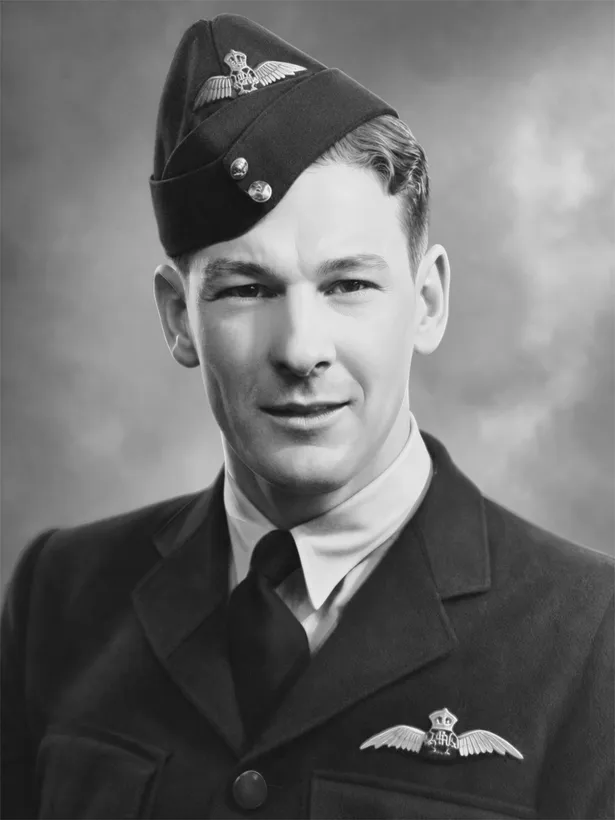
Sergeant Frame survived the crash—stating later that he was thrown clear of the exploding aircraft rather than baling out—and was taken as a Prisoner of War (POW).
Frame, David (Sergeant)
Prisoner of War 1944-February-20


Birth Date: unkown date
Born:
Parents:
Spouse:
Home:
Enlistment:
Enlistment Date: unkown date
Service
RAFVR
Unit
15 (B) Sqn- Squadron (RAF)
Aim Sure
Base
RAF Mildenhall
Rank
Sergeant
Position
Flight Engineer
Service Numbers
1573230
Target
 Leipzig Germany
Crew or Other Personnel
Lancaster R5739



Mission
Lancaster Mk.I R5739
Bombing Leipzig Germany 1944-February-20 to 1944-February-20
15 (B) Sqn (RAF) RAF Mildenhall
Lancaster Mk.l R5739 Took off from Mildenhall at 00:06 in Lancaster Mk I (Sqn code LS-K Bomber Command) on an operation to Leipzig Germany. Home-bound, the aircraft was damaged by a night fighter and crashed.near Jena in east-central Germany,approximately 20 km (12 mi) east of Weimar and about 40 km (25 mi) east of Erfurt, the state capital of Thuringia
823 aircraft- 561 Lancasters, 255 Halifaxes, 7 Mosquitoes. 78 aircraft= 44 Lancasters and 34 Halifaxes - lost, 9·5 per cent of the force. The Halifax loss rate was 13·3 per cent of those dispatched and 14·9 per cent of those Halifaxes which reached the enemy coast after 'early returns' had turned back. The Halifax Ils and Vs were permanently withdrawn from operations to Germany after this raid.
This was an unhappy raid for Bomber Command. The German controllers only sent part of their force of fighters to the Kiel minelaying diversion. When the main bomber force crossed the Dutch coast, they were met by a further part of the German fighter force and those German fighters which had been sent north to Kiel hurriedly returned. The bomber stream was thus under attack all the way to the target. There were further difficulties at the target because winds were not as forecast and many aircraft reached the Leipzig area too early and had to orbit and await the Pathfinders. 4 aircraft were lost by collision and approximately 20 were shot down by Flak.
Leipzig was cloud-covered and the Pathfinders had to use sky-marking. The raid appeared to be concentrated in its early stages but scattered later. There are few details of the effects of the bombing. No report is available from Germany and there was no immediate post-raid reconnaissance flight. When photographs were eventually taken, they included the results of an American raid which took place on the following day.The Bomber Command War Diaries, Martin Middlebrrok and Chris Everitt
Lancaster serial: R5739
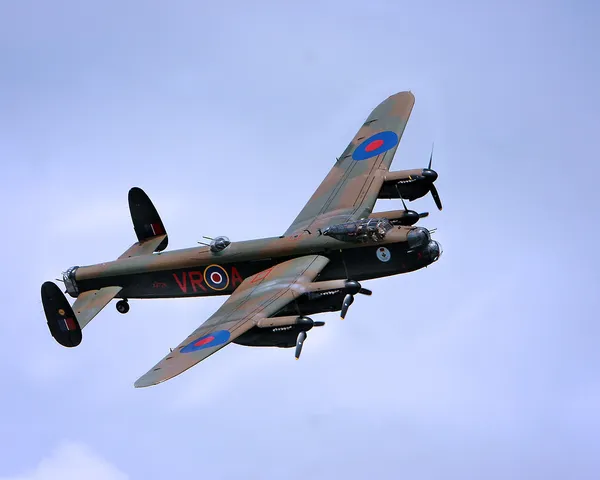
Avro Lancaster Mk. X RCAF Serial FM 213
Canadian Warplane Heritage Museum
Canadian Warplane Heritage Museum
The Avro Lancaster is a British Second World War heavy bomber. It was designed and manufactured by Avro as a contemporary of the Handley Page Halifax, both bombers having been developed to the same specification, as well as the Short Stirling, all three aircraft being four-engined heavy bombers adopted by the Royal Air Force (RAF) during the same wartime era.
The Lancaster has its origins in the twin-engine Avro Manchester which had been developed during the late 1930s in response to the Air Ministry Specification P.13/36 for a capable medium bomber for "world-wide use". Originally developed as an evolution of the Manchester (which had proved troublesome in service and was retired in 1942), the Lancaster was designed by Roy Chadwick and powered by four Rolls-Royce Merlins and in one version, Bristol Hercules engines. It first saw service with RAF Bomber Command in 1942 and as the strategic bombing offensive over Europe gathered momentum, it was the main aircraft for the night-time bombing campaigns that followed. As increasing numbers of the type were produced, it became the principal heavy bomber used by the RAF, the Royal Canadian Air Force (RCAF) and squadrons from other Commonwealth and European countries serving within the RAF, overshadowing the Halifax and Stirling. Wikipedia
 Lancaster Bomber
 Wikipedia
 Harold A Skaarup Web Page
Lancaster R5739 Mk.I - Bombing Leipzig Germany - 1944-02-20 to 1944-02-20
Squadron: 15 (B) Sqn (RAF)
Start Date: 1944-02-20
Completion Date: 1944-02-20
Mission: Bombing
Operation: unspecified
Target City: Leipzig Germany
Target Specific:
Base: RAF Mildenhall
Take Off Time: 00:06
Squadron Code: LK-S
Radio Code:
Return Base:
Return Time:
Crash City: Jena, Germany
Crash Specifics:
Crash Latitude: 0.00000000
Crash Longitude: 0.00000000
Crash Reason:
Flak Battery:
Enemy Claim:
War Diary Unavailable
6 Group Unavailable
Lancaster Mk.l R5739 Took off from Mildenhall at 00:06 in Lancaster Mk I (Sqn code LS-K Bomber Command) on an operation to Leipzig Germany. Home-bound, the aircraft was damaged by a night fighter and crashed.near Jena in east-central Germany,approximately 20 km (12 mi) east of Weimar and about 40 km (25 mi) east of Erfurt, the state capital of Thuringia
823 aircraft- 561 Lancasters, 255 Halifaxes, 7 Mosquitoes. 78 aircraft= 44 Lancasters and 34 Halifaxes - lost, 9·5 per cent of the force. The Halifax loss rate was 13·3 per cent of those dispatched and 14·9 per cent of those Halifaxes which reached the enemy coast after 'early returns' had turned back. The Halifax Ils and Vs were permanently withdrawn from operations to Germany after this raid.
This was an unhappy raid for Bomber Command. The German controllers only sent part of their force of fighters to the Kiel minelaying diversion. When the main bomber force crossed the Dutch coast, they were met by a further part of the German fighter force and those German fighters which had been sent north to Kiel hurriedly returned. The bomber stream was thus under attack all the way to the target. There were further difficulties at the target because winds were not as forecast and many aircraft reached the Leipzig area too early and had to orbit and await the Pathfinders. 4 aircraft were lost by collision and approximately 20 were shot down by Flak.
Leipzig was cloud-covered and the Pathfinders had to use sky-marking. The raid appeared to be concentrated in its early stages but scattered later. There are few details of the effects of the bombing. No report is available from Germany and there was no immediate post-raid reconnaissance flight. When photographs were eventually taken, they included the results of an American raid which took place on the following day.The Bomber Command War Diaries, Martin Middlebrrok and Chris Everitt
