Miller, J A (Warrant Officer Class 2)
Survived 1944-January-08


Birth Date: unkown date
Born:
Parents:
Spouse:
Home:
Enlistment:
Enlistment Date: unkown date
Service
RCAF
Unit
147 (BR) Sqn- Squadron
Base
RCAF Station Tofino, British Columbia
Rank
Warrant Officer Class 2
Position
Wireless Operator/Air Gunner
Service Numbers
87915
This incident involved multiple aircraft:
- Bolingbroke Mk. IV Serial: 9031
- Bolingbroke Mk. IV Serial: 9121
All the above aircraft in the above list are referenced in this report.
Accident Card - Bristol Bolingbroke Mk. IV serial:9121
This accident involved 2 aircraft on 1944-January-08. They are: Bolingbroke IV s/n 9031, Bolingbroke IV s/n 9121.
This accident involved 6 people. Frey JH, Hyde HJ, Jean GJ, Miller JA, Norton JA, Toner WJ
This accident had 4 fatalities. Warrant Officer 2 Henry John Hyde RCAF Killed in Flying Accident service no:R/123526 Bolingbroke 9031, Warrant Officer 1st Class William Joseph Toner RCAF Killed in Flying Accident service no:R/122725 Bolingbroke 9031, Warrant Officer 2nd Class James Andrew Horton RCAF Killed in Flying Accident service no:R/86627 Bolingbroke 9031, Private Gerald Joseph Jean Army Killed in Flying Accident service no:A/607426 Bolingbroke 9031
Mission
Bolingbroke Mk. IV 9121
Operational 1944-January-08 to 1944-January-08
147 (BR) Sqn (RCAF) RCAF Station Tofino, British Columbia
147 Bomber Reconnaissance Squadron (Determined To Defend), RCAF Station, Tofino, British Columbia. Bolingbroke IV aircraft 9121 collided in mid-air with Bolingbroke 9031 during formation flying practice.
Bolingbroke 9121 survived the crash with damage to the port wing and landed safely with no crew lost. Warrant Officer Class 2 J. H. Frey (RCAF) and Warrant Officer Class 2 J. A. Miller (RCAF) were uninjured
Bolingbroke 9131 crashed into the sea. Warrant Officer Class 2 James Andrew Horton (RCAF) (pilot), Warrant Officer, Class 2 William Joseph Toner (RCAF), Warrant Officer Class 2 Henry John Hyde (RCAF), and passenger Private Gerald Joseph Jean (Canadian Army) were all missing, presumed killed in this flying accident
The Accident Investigation concluded that the pilot of Bolingbroke 9031 was to blame for the collision. After repairs to Bolingbroke 9121 were completed the aircraft was sent into storage with Western Air Command
Quietus Last Flight, Accident Proneness in WWII, Wartime Aviation Stories on the Canadian Home Front by Anne Gafiuk, Chapter 15
Bolingbroke serial: 9121
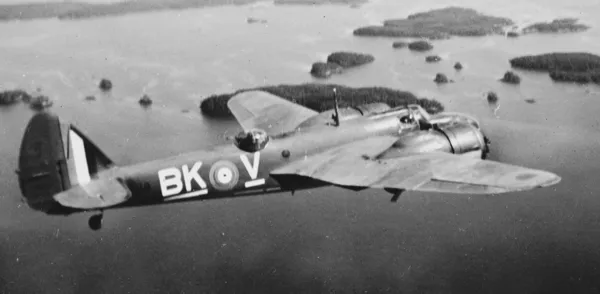
(Umeyou Photo)
Fairchild Bolingbroke Mk. IV, RCAF (Serial No. 9118), coded BK-V, No. 115 (Bomber Reconnaissance) Squadron, Patricia Bay, British Columbia, 1942.
Fairchild Bolingbroke Mk. IV, RCAF (Serial No. 9118), coded BK-V, No. 115 (Bomber Reconnaissance) Squadron, Patricia Bay, British Columbia, 1942.
The Bristol Fairchild Bolingbroke was a maritime patrol aircraft and trainer used by the Royal Canadian Air Force during the Second World War. Built by Fairchild-Canada, it was a license-built version of the Bristol Blenheim Mk IV bomber.
In 1935, the British Air Ministry issued Specification G.24/35 to procure a coastal reconnaissance/light bomber to replace the Avro Anson. Bristol proposed the Type 149, based on its Blenheim Mk I, with Bristol Aquila engines to give greater range. While the Air Ministry rejected this proposal, a Blenheim Mk I, retaining its Mercury VIII engines, was converted as a Type 149 (Blenheim Mk III) for the general reconnaissance role.The nose was lengthened to provide more room for the bombardier, with the upper left surface of the nose being scooped out to maintain pilot visibility during takeoff and landing.
The longer range also fulfilled a Canadian requirement for a maritime patrol aircraft. Consequently, Fairchild Aircraft Ltd. (Canada) of Quebec started production of the Blenheim Mk IV as the Bolingbroke (the originally intended name for the Blenheim IV). This type was nicknamed the "Bolly". After a small run of aircraft constructed to British specifications, as the Bolingbroke Mk I, Fairchild switched production to the Bolingbroke Mk IV with Canadian and American instruments and equipment. These versions also included anti-icing boots and a dinghy. One of the early Mk IV variants was the Bolingbroke Mk IVW which was powered by two 825 hp (615 kW) Pratt & Whitney SB4G Twin Wasp Junior engines. Incapable of maintaining altitude on one engine, the normal bomb load was reduced to 500 pounds on these aircraft to compensate for the low engine power. The most-produced variant was the Bolingbroke Mk IVT trainer, of which 457 were completed. A total of 626 Bolingbrokes were produced. Wikipedia
 Wikipedia Bolingbroke Bomber
 Harold A Skaarup Web Page
 Bolingbroke Bomber WWII
 Bolingbroke - Kestrel Publications
Aircraft Images
Bolingbroke 9031
Bolingbroke Mk. IV 9031
First used by No. 8 (BR) Squadron at RCAF Station Sydney, NS. Still with 8 Squadron when it transferred to Western Air Command, stationed at RCAF Station Sea Island, BC on 12 January 1942. To Canadian Pacific Airlines at Vancouver, 25 September 1942 to 20 January 1943. to Western Air Command when completed. Assigned to 147 (BR) Sqn. On 8 Jan 1944, this a/c collided with #9121 during formation flying practice, and crashed into the sea. The crew, Warrant Officer Class 2 J. Horton (pilot), Warrant Officer Class 2 W. Toner, Warrant Officer H. Hyde, and Pte G. Jean (an Army passenger) were all killed. # 9121 was damaged but landed safely; Warrant Officer Class 2 J. Frey and Warrant Officer Class 2 J. Miller were uninjured Lost at sea on 8 January 1944. Assigned to No. 3 Repair Depot on 1 April 1944 for write off.{{link,canadaprimary,https://heritage.canadiana.ca/view/oocihm.lac_reel_c5933/1239,RCAF - Accident Investigation File}}
1941-08-28 Taken on Strength Eastern Air Command 2019-08-20
1943-October-23 Accident: 147 Squadron Loc: Rcaf Stnorth Tofino British Columbia Names: Anderson | Macnabb | Robb | Robb
1944-January-08 Accident: 147 Squadron Loc: Aerodrome Names: Frey | Hyde | Jean | Miller | Norton | Toner
1944-04-01 Struck off Strength Written off by No. 3 Repair Depot at Vancouver 2019-08-20
Bolingbroke 9121
Bolingbroke Mk. IV 9121
Delivered to storage at RCAF Station Yarmouth, NS. By 3 February 1942 on the books of No. 4 Repair Depot at Scoudouc, NB. Issued from storage on 26 May 1942, to No. 119 (BR) Squadron at RCAF Station Sydney, NS. To Western Air Command on 20 June 1942, for use by No. 147 (BR) Squadron, which formed at Sea Island in July 1942. To Canadian Pacific Airlines for repairs following a Category B crash, 22 January to 21 August 1944. To storage with Western Air Command when completed. Issued from storage on 28 February 1945. Category C damage at Port Hardy, BC on 30 May 1945. Pending disposal from 20 August 1945. By 1 May 1946 on the books of No. 10 Repair Depot, stored at Patricia Bay, where it was noted with 631:20 total time.1941-12-30 Taken on Strength Eastern Air Command 2019-08-20
1942-October-13 Accident: 147 Squadron Loc: Sea Island Names: Harradance | Jones | Wilson
1944-January-08 Accident: 147 Squadron Loc: Aerodrome Names: Frey | Hyde | Jean | Miller | Norton | Toner
1945-May-30 Accident: 122 (COMPOSITE) Squadron Loc: Aerodrome Names: Barkhouse | Tatton
1946-09-06 Struck off Strength Struck off, to War Assets Corporation for disposal 2019-08-20
Bolingbroke 9121 Mk. IV - Operational - 1944-01-08 to 1944-01-08
Squadron: 147 (BR) Sqn (RCAF)
Start Date: 1944-01-08
Completion Date: 1944-01-08
Mission: Operational
Operation: unspecified
Target City:
Target Specific:
Base: RCAF Station Tofino, British Columbia
Take Off Time:
Squadron Code:
Radio Code:
Return Base:
Return Time:
Crash City:
Crash Specifics:
Crash Latitude: 0.00000000
Crash Longitude: 0.00000000
Crash Reason:
Flak Battery:
Enemy Claim:
War Diary Unavailable
6 Group Unavailable
147 Bomber Reconnaissance Squadron (Determined To Defend), RCAF Station, Tofino, British Columbia. Bolingbroke IV aircraft 9121 collided in mid-air with Bolingbroke 9031 during formation flying practice.
Bolingbroke 9121 survived the crash with damage to the port wing and landed safely with no crew lost. Warrant Officer Class 2 J. H. Frey (RCAF) and Warrant Officer Class 2 J. A. Miller (RCAF) were uninjured
Bolingbroke 9131 crashed into the sea. Warrant Officer Class 2 James Andrew Horton (RCAF) (pilot), Warrant Officer, Class 2 William Joseph Toner (RCAF), Warrant Officer Class 2 Henry John Hyde (RCAF), and passenger Private Gerald Joseph Jean (Canadian Army) were all missing, presumed killed in this flying accident
The Accident Investigation concluded that the pilot of Bolingbroke 9031 was to blame for the collision. After repairs to Bolingbroke 9121 were completed the aircraft was sent into storage with Western Air Command
Quietus Last Flight, Accident Proneness in WWII, Wartime Aviation Stories on the Canadian Home Front by Anne Gafiuk, Chapter 15
