Fisher, Ronald Victor (Flying Officer)
Killed in Action 1943-October-09


Birth Date: 1920-August-29
Born: Brighton, Brighton and Hove Unitary Authority, East Sussex, England
Parents: Son of Albert Victor and Adelaide Annie Fisher, of Brighton, Sussex
Spouse:
Home: Brighton, Sussex, England
Enlistment:
Enlistment Date: unkown date
Service
RAFVR
Unit
421 (B) Sqn- Squadron
Bellicum Cecinere They have sounded the war trumpet
Base
RAF Tholthorpe
Rank
Flying Officer
Position
Navigator
Service Numbers
124316
Target
 Hanover Germany
Temporary Burial
Furhberg Civil Cemetery, Germany, near crash site
Remains were later exhumed from this location and reburied
 Commonwealth War Graves Commission
 Finadagrave.com
Crew or Other Personnel
Halifax LK657

Mission
Halifax B/Met.Mk.V LK657
Bombing Hannover Germany 1943-October-08 to 1943-October-09
431 (B) Sqn (RCAF) RAF Tholthorpe
Battle of Berlin
504 aircraft- 282 Lancasters, 188 Halifaxes, 26 Wellingtons, 8 Mosquitoes. This was the last Bomber Command raid in which Wellingtons took part. 300 (Polish) and 432 (Canadian) Squadrons provided the 26 Wellingtons which operated on this night; they all returned safely. The German controller guessed correctly that Hannover was the target and many night fighters arrived before the attack was over. 27 aircraft- 14 Lancasters and 13 Halifaxes - were lost, 5.4 per cent of the force.
Conditions over Hannover were clear and the Pathfinders were finally able to mark the centre of the city accurately; a most concentrated attack followed with a creepback of only 2 miles, all within the built-up area. This was probably Hannover's worst attack of the war. The local report describes extensive damage in the centre of. the city and in many other parts except the west. The telephone system and electricity supply failed at the beginning of the raid and many water mains were quickly broken. A large area of fire quickly developed in the centre and south-central districts. Acting upon instructions from the Party Headquarters and from district air-raid posts, the population were shepherded to collecting places in open areas between the fires. This action is believed to have saved many lives but 1,200 people were killed and 3,345 were injured, 449 seriously so. A further 6,000-8,000 people received eye injuries because of smoke and heat. 3,932 buildings were completely destroyed and more than 30,000 were damaged in varying degree, but no individual buildings are named. R.A.F. reconnaissance, however, showed that the important Continental rubber factory and the Hanomag machine works were badly hit.
source: The Bomber Command War Diaries, Martin Middlebrook and Chris Everitt
431 (Iroquois) Squadron RCAF (The hatiten ronteriios), RAF Tholthorpe. Halifax V aircraft LK 657 SE-K was coned by searchlights from 2/Reserve Flakscheinwerfer Abteilung 139 (Werfer 59) and shot down by Flak batteries 1, 2,& 4 Schwere Abteilung 801, during an operation against targets in Hanover, Germany. The Halifax crashed at Klein-Burgwedel, NE of Hanover at 1:46 AM with the loss of all but one aircrew member
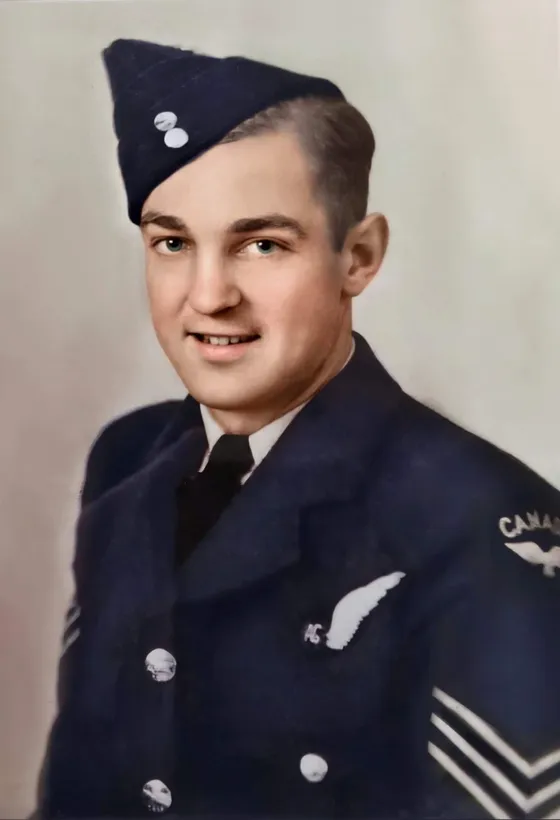
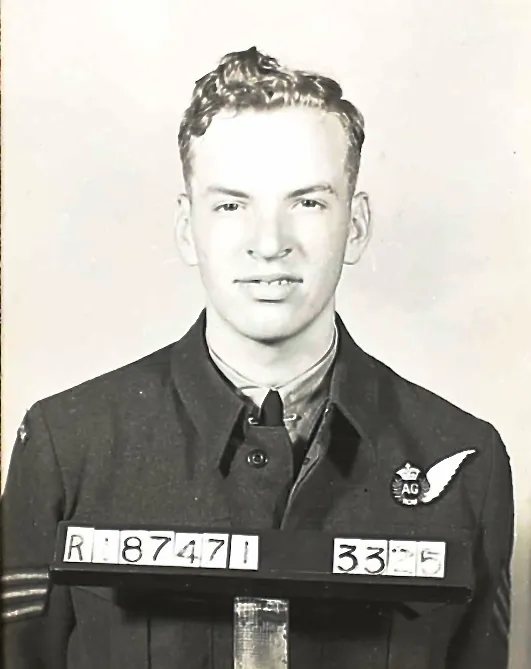
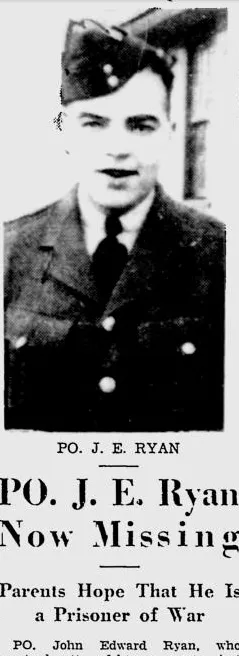
Warrant Officer 1st Class John Edward Ryan (RCAF), Sergeant Francis Rudd (RCAF), Sergeant Donald Albert Adams (RAFVR), Sergeant Thomas Alfred Ashcroft (RAFVR), Flying Officer Robert Edward Baker (RAFVR), Flying Officer Ronald Victor Fisher (RAFVR) and Warrant Officer Peter John Hay (RAFAAF) were all killed in action.
Canadian Flying Officer Albin Rollack (RCAF) was the lone survivor from the crew and survived to become a Prisoner of War
There were two 431 Squadron aircraft lost on this date. Please see aircraft serial DK 265 SE-C for information regarding the other aircraft and crew.
Nachtjagd Combat Archive, 1943 Part 3, 23 September - 31 December by Theo Boiten, page 38
 Royal Air Force Serial and Image Database
Halifax serial: LK657
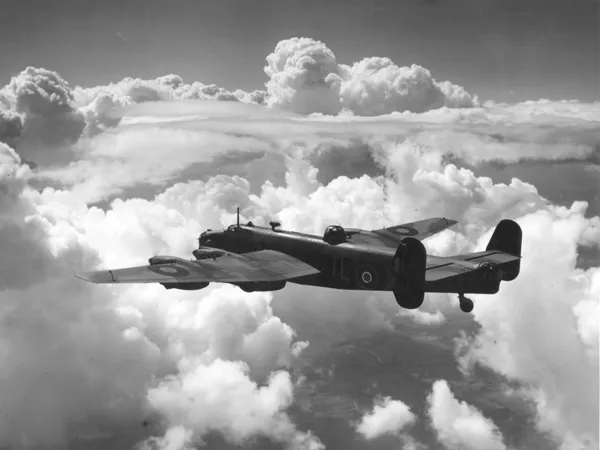
(RAF Photo, 1942)(Source Harold A Skaarup Web Page)
A Royal Air Force Handley Page Halifax Mk. II Series I (Serial No. W7676), coded TL-P, of No. 35 Squadron, RAF, based at Linton-on-Ouse, Yorkshire in the UK, being piloted by Flight Lieutenant Reginald Lane, (later Lieutenant-General, RCAF), over the English countryside. Flt Lt Lane and his crew flew twelve operations in W7676, which failed to return from a raid on Nuremberg on the night of 28/29 August 1942, when it was being flown by Flt Sgt D. John and crew.
The Handley Page Halifax is a British Royal Air Force (RAF) four-engined heavy bomber of the Second World War. It was developed by Handley Page to the same specification as the contemporary twin-engine Avro Manchester.
The Halifax has its origins in the twin-engine HP56 proposal of the late 1930s, produced in response to the British Air Ministry's Specification P.13/36 for a capable medium bomber for "world-wide use." The HP56 was ordered as a backup to the Avro 679, both aircraft being designed to use the underperforming Rolls-Royce Vulture engine. The Handley Page design was altered at the Ministry to a four-engine arrangement powered by the Rolls-Royce Merlin engine; the rival Avro 679 was produced as the twin-engine Avro Manchester which, while regarded as unsuccessful mainly due to the Vulture engine, was a direct predecessor of the famed Avro Lancaster. Both the Lancaster and the Halifax would emerge as capable four-engined strategic bombers, thousands of which would be built and operated by the RAF and several other services during the War.
On 25 October 1939, the Halifax performed its maiden flight, and it entered service with the RAF on 13 November 1940. It quickly became a major component of Bomber Command, performing routine strategic bombing missions against the Axis Powers, many of them at night. Arthur Harris, the Air Officer Commanding-in-Chief of Bomber Command, described the Halifax as inferior to the rival Lancaster (in part due to its smaller payload) though this opinion was not shared by many of the crews that flew it, particularly for the MkIII variant. Nevertheless, production of the Halifax continued until April 1945. The operational statistics from the Bomber Command War Room Manual, state 82,773 operational sorties 2,232 aircraft lost of which 1,833 were missing, in addition there were 365 anti submarine patrols with 4 aircraft lost. Halifax laid 9,572 mines according to the war manual, daily reports total 9,550 being 851x1000, 6,450x1500 and 2,248x1850 pound mines.. The Halifax was also flown in large numbers by other Allied and Commonwealth nations, such as the Royal Canadian Air Force (RCAF), Royal Australian Air Force (RAAF), Free French Air Force and Polish forces. Wikipedia
 Halifax Heavy Bomber WWII
 Wikipedia Halifax Bomber
 National Air Force Museum of Canada
Unit Desciption
421 (B) Sqn Bellicum Cecinere ("Red Indian")
History of the Squadron during World War II (Aircraft: Spitfire VA, VB, IX, IXB, XVI)
The squadron was the 20th squadron and the last of the eight Fighter squadrons formed overseas by the RCAF in WWII. It was initiated at Digby, Lincolnshire, England on April 9, 1942, It flew on defensive operations over Britain, as well as offensive operations over Europe, before D-Day. After the invasion, the squadron moved to France on 16 June 1944 and thereafter provided air and ground support to the Allied ground forces as they moved through France, the Low Countries and Germany. The squadron was disbanded at Utersen, Germany on July 10, 1945.
In the course of its operations, the squadron flew some 10,900 sorties and claimed 79 enemy aircraft destroyed, 2 probables and 27 damaged, for the loss of 34 aircraft and 33 pilots, of whom 4 were killed, 25 missing and 4 injured. The squadron had 2 aces, Squadron Leader R.W McNair, DFC and 2 Bars, and Flight Lieutenant P.G. Johnson. The squadron members were awarded 1 second Bar to DFC, 2 Bars to DFC and 5 DFCs. Battle Honours were: Defence of Britain 1942-43, Fortress Europe 1942-44, France and Germany 1944-45, Normandy 1944, Arnhem, RhineWikipedia, Kostenuk and Griffin
Maps for Movements of 421 Squadron 1942-45
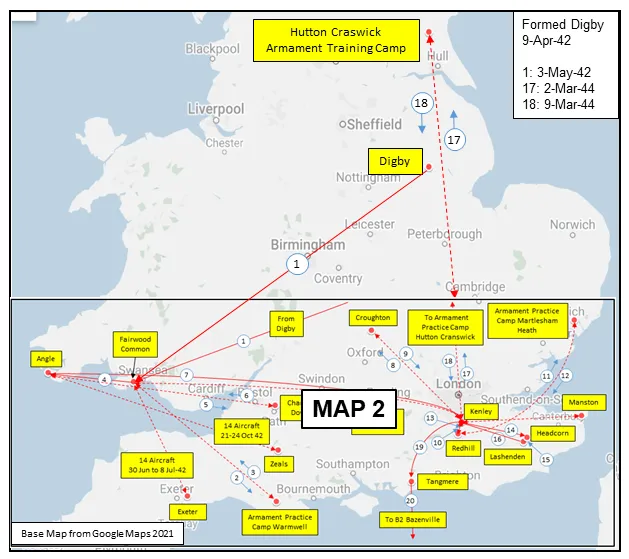
MAP 1: 421 Squadron Movements in England 1942-44 (right-click on image to display enlarged in new tab)
|
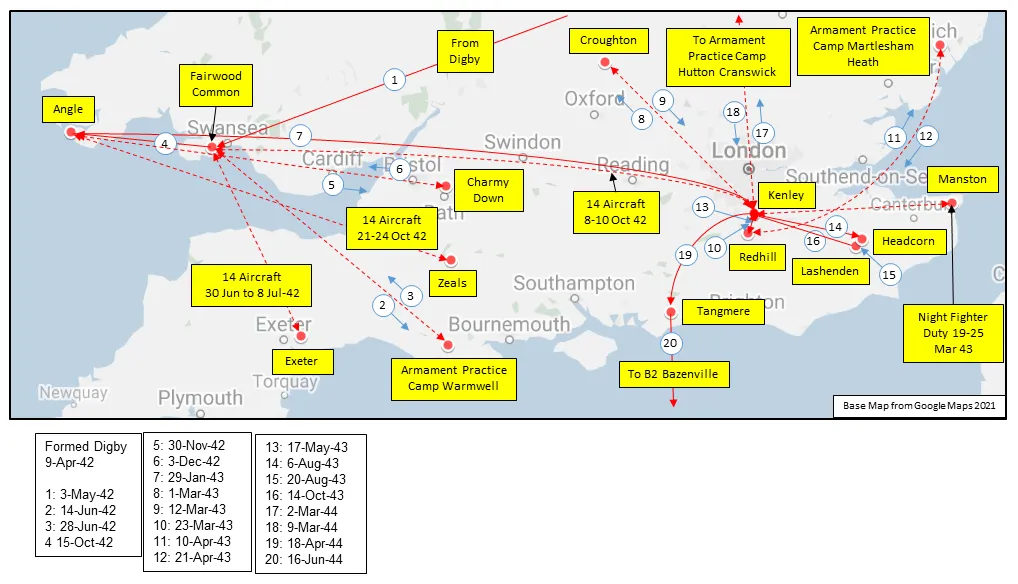
MAP 2: 421 Squadron Movements, detail of Map 1
|
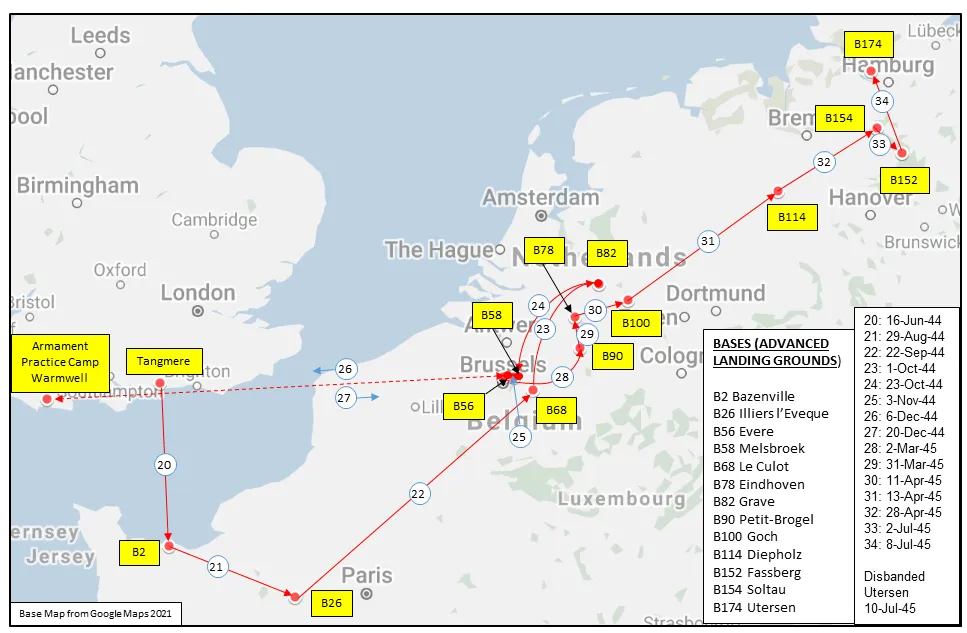
MAP 3: 421 Squadron Movements in Europe 1944-45
421 Squadron History Summary 1942-45
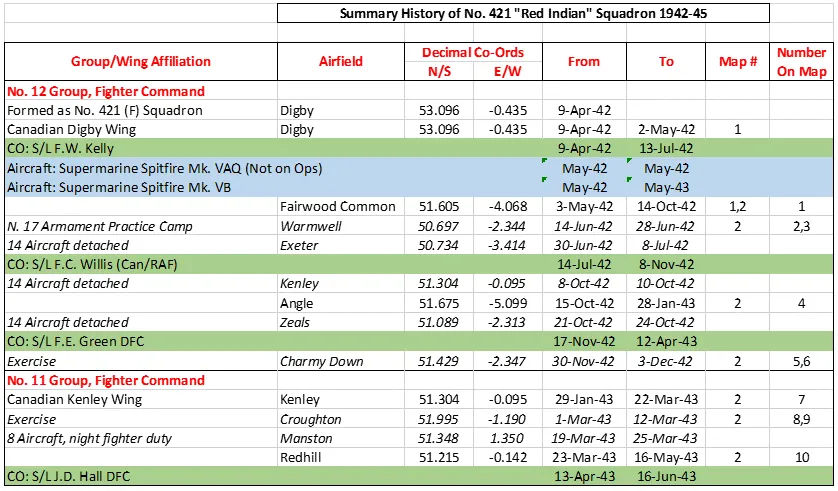
421Squadron History Summary 1942-45 Page 2
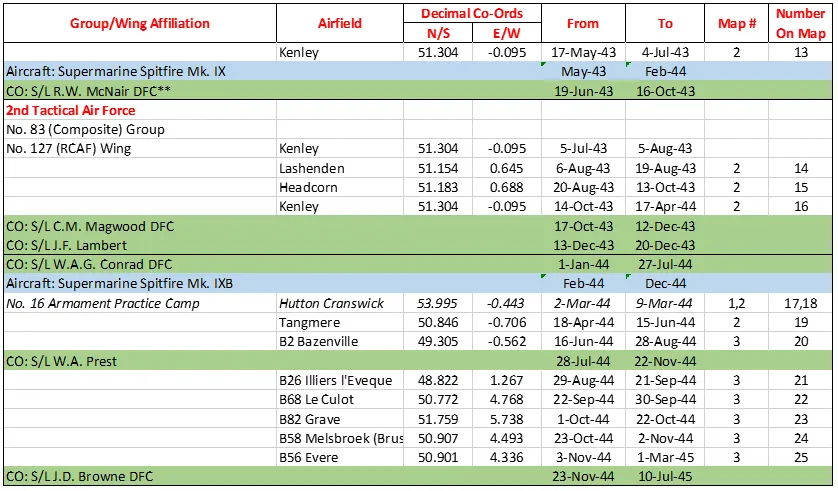
421 Squadron History Summary 1942-45 Page 3
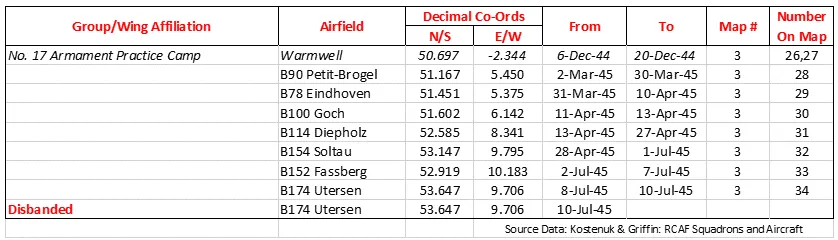
History of the Squadron Post-WWII (Aircraft: Vampire III, 5, Meteor T7, Sabre 2, 5, 6, Starfighter)
The squadron was re-formed as a Fighter unit at Chatham, New Brunswick on 15 September 1949, flying de Havilland Vampire III aircraft and, during 1951, was stationed in the United Kingdom for operational training with the Royal Air Force, flying Gloster Meteor T Mk. 7 training aircraft. In December 1951 it was re-equipped with Sabre aircraft and in October 1952 joined No. 2 (Fighter) Wing at Grostenquin, France . Selected as one of eight Sabre squadrons in No. 1 Air Division Europe to be re-equipped with CF-104 Starfighter aircraft for a nuclear strike role, the squadron was deactivated on 1 August 1963 and was reactivated as Strike Attack on 21 December. When No. 2 Wing was disbanded in February 1964, the squadron joined No. 4 Wing at Baden-Soellingen, Germany . On 1 February 1968 the squadron was integrated into the Canadian Armed Forces. It was redesignated '421 Tactical Fighter Squadron' on 1 January 1972. The squadron was finally disbanded 31 August 1992, as a result of the ending of the Cold War.
Halifax LK657 B/Met.Mk.V - Bombing Hannover Germany - 1943-10-08 to 1943-10-09
Squadron: 431 (B) Sqn (RCAF)
Start Date: 1943-10-08
Completion Date: 1943-10-09
Mission: Bombing
Operation: Battle of Berlin
Target City: Hannover Germany
Target Specific:
Base: RAF Tholthorpe
Take Off Time: 22:43
Squadron Code: SE-K
Radio Code:
Return Base:
Return Time:
Crash City: Germany
Crash Specifics: Klein-Burgwedel, near Hannover
Crash Latitude: 0.00000000
Crash Longitude: 0.00000000
Crash Reason: flak
Flak Battery: 1, 2,& 4 Schwere Abteilung 801
Enemy Claim:
War Diary Unavailable
6 Bomber Group October 8/9, 1943
16 Lancasters from 408 and 426 squadrons were joined by 70 Halifaxes from 419, 427, 428, 429, 431, and 434 squadrons and 14 Wellingtons from 432 squadron on an attack at Hannover. The crews were over the target at between 18,000 and 22,000 feet, releasing 272,000 lbs of high explosives and 294,000 lbs of incendiaries. According to reports, the sky was clear and an accurate attack was made with severe damage being caused. Richard Koval (6bombergroup.ca)
504 aircraft- 282 Lancasters, 188 Halifaxes, 26 Wellingtons, 8 Mosquitoes. This was the last Bomber Command raid in which Wellingtons took part. 300 (Polish) and 432 (Canadian) Squadrons provided the 26 Wellingtons which operated on this night; they all returned safely. The German controller guessed correctly that Hannover was the target and many night fighters arrived before the attack was over. 27 aircraft- 14 Lancasters and 13 Halifaxes - were lost, 5.4 per cent of the force.
Conditions over Hannover were clear and the Pathfinders were finally able to mark the centre of the city accurately; a most concentrated attack followed with a creepback of only 2 miles, all within the built-up area. This was probably Hannover's worst attack of the war. The local report describes extensive damage in the centre of. the city and in many other parts except the west. The telephone system and electricity supply failed at the beginning of the raid and many water mains were quickly broken. A large area of fire quickly developed in the centre and south-central districts. Acting upon instructions from the Party Headquarters and from district air-raid posts, the population were shepherded to collecting places in open areas between the fires. This action is believed to have saved many lives but 1,200 people were killed and 3,345 were injured, 449 seriously so. A further 6,000-8,000 people received eye injuries because of smoke and heat. 3,932 buildings were completely destroyed and more than 30,000 were damaged in varying degree, but no individual buildings are named. R.A.F. reconnaissance, however, showed that the important Continental rubber factory and the Hanomag machine works were badly hit.
source: The Bomber Command War Diaries, Martin Middlebrook and Chris Everitt
431 (Iroquois) Squadron RCAF (The hatiten ronteriios), RAF Tholthorpe. Halifax V aircraft LK 657 SE-K was coned by searchlights from 2/Reserve Flakscheinwerfer Abteilung 139 (Werfer 59) and shot down by Flak batteries 1, 2,& 4 Schwere Abteilung 801, during an operation against targets in Hanover, Germany. The Halifax crashed at Klein-Burgwedel, NE of Hanover at 1:46 AM with the loss of all but one aircrew member
Warrant Officer 1st Class John Edward Ryan (RCAF), Sergeant Francis Rudd (RCAF), Sergeant Donald Albert Adams (RAFVR), Sergeant Thomas Alfred Ashcroft (RAFVR), Flying Officer Robert Edward Baker (RAFVR), Flying Officer Ronald Victor Fisher (RAFVR) and Warrant Officer Peter John Hay (RAFAAF) were all killed in action.
Canadian Flying Officer Albin Rollack (RCAF) was the lone survivor from the crew and survived to become a Prisoner of War
There were two 431 Squadron aircraft lost on this date. Please see aircraft serial DK 265 SE-C for information regarding the other aircraft and crew.
Nachtjagd Combat Archive, 1943 Part 3, 23 September - 31 December by Theo Boiten, page 38
