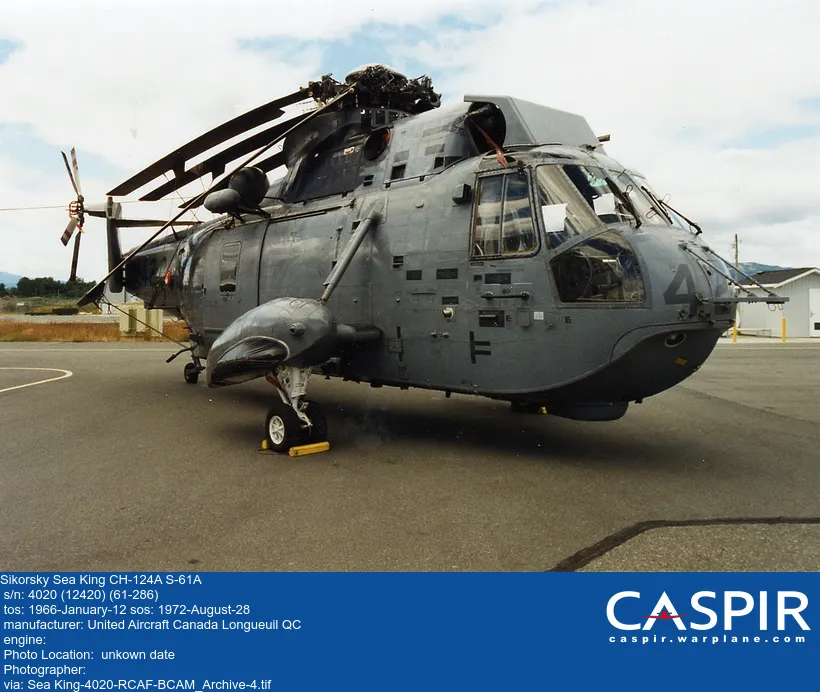
Sea King 1420 experienced a failure in ne engine and crashed killing Dick McCrea and Ostaficiuk.
Accident Sikorsky CH-124A Sea King (S-61B) 12420, 07 Nov 1971 (aviation-safety.net)
Leading Seaman John Osborne Ross McCrea (1938-1971) - Find a Grave Memorial lost at sea
Sailors Memorial Pt Pleasant
McCrea, John Osborne Ross (Leading Seaman)
Killed in Flying Accident 1971-November-07


Birth Date: 1938-December-06
Born: Ottawa, Ontario
Parents: Son of Jean McCrea of Arnprior, Ontario.
Spouse: Husband of Marjorie Marie (nee Clark) McCrea and father of Joanne, Michael, Clay McCrea of Dartmouth, Nova Scotia.
Home: Ottawa, Ontario
Enlistment:
Enlistment Date: unkown date
Service
RCN
Unit
50 (AS) Sqn- Squadron (RCN)
Base
HMCS NIPIGON
Rank
Leading Seaman
Position
Service Numbers
N36150141
Home
 Ottawa, Ontario
 Canadian Virtual War Memorial
Crew or Other Personnel
Sea King 4020
Sea King serial: 4020

Source: Harold A Skaarup Web Page (RCAF Photo)
Sikorsky CH-124 Sea King (Serial No. 4036), during waterbird training at Morris Lake, Dartmouth, Nova Scotia, 2011
The Sikorsky CH-124 Sea King is a twin-engined anti-submarine warfare (ASW) helicopter designed for shipboard use by Canadian naval forces, based on the US Navy's SH-3. It served with the Royal Canadian Navy (RCN) and Canadian Armed Forces from 1963 to 2018.
The advent of nuclear-powered attack submarines in the late 1950s prompted RCN leaders to assess the new threat they posed. Although these craft were noisier than older submarines and could therefore be detected at longer ranges, they were also capable of 30 knots (56 km/h) while submerged, which was faster than the top speed of the RCN's new St. Laurent-class destroyer escorts at 28.5 knots (52.8 km/h). Some RCN leaders harbored serious doubts that the destroyers could effectively pursue and destroy such fast vessels, even when operating in pairs. During a 25 February 1959 meeting of the Naval Board, it was decided that the Navy would counter the new threat by outfitting destroyers for helicopter operation.
The first of 41 helicopters would be delivered in 1963 carrying the designation CHSS-2 Sea King. The airframe components were made by Sikorsky in Connecticut but most CHSS-2s were assembled in Longueuil, Quebec, by United Aircraft of Canada (now Pratt & Whitney Canada), a subsidiary of Sikorsky's parent company, United Aircraft. On 27 November 1963, the new landing platform aboard HMCS Assiniboine was used for the first operational destroyer landing of a production CHSS-2. Upon the unification of Canada's military in 1968, the CHSS-2 was re-designated CH-124.
In the 1960s, the RCN developed a technique for landing the huge helicopters on small ship decks, using a 'hauldown' winch (called a "Beartrap"), earning aircrews the nickname of "Crazy Canucks". The Beartrap allows recovery of the Sea King in virtually any sea state. In 1968, the RCN, Royal Canadian Air Force (RCAF) and Canadian Army unified to form the Canadian Forces; air units were dispersed throughout the new force structure until Air Command (AIRCOM) was created in 1975. Wikipedia
 Wikipedia Sikorsky CH-124 Sea King
 Harold A Skaarup Web Page
 CH-124 Sea King Kestrel Publications
Sea King CH-124A 4020
Operated by HS-50 onboard HMCS Bonaventure in 1969.Crashed and sank on 7 or 8 November 1971. Had been operating from HMCS Nipigon. Engine failure shortly after takeoff at night. Attempted to return on board, low rotor RPM led to loss of control and crash. 3 fatalities. Recovered, not repairable. This accident led to a fleet wide power upgrade, new low rotor RPM warning system, and changes in fuel loads for normal operations.
1966-01-12 Taken on Strength 2022-02-07
1970-08-14 Serial Change 2020-07-12
1972-08-28 Struck off Strength 2020-07-12