Willison, Raymond Phillip (Flying Officer)
Killed in Flying Accident 1944-November-09


Birth Date: 1922-March-15
Born:
Parents: Son of Albert and Ruth Hazel Willison, of Moose Jaw, Saskatchewan, Canada; husband of Jean Catherine Willison, of Moose Jaw.
Spouse: Husband of Jean Catherine Willison, of Moose Jaw.
Home: Moose Jaw, Saskatchewan
Enlistment: Regina, Saskatchewan
Enlistment Date: 1940-June-27
Service
RCAF
Unit
82 (OT) OTU- Operational Training Unit (RAF)
Base
RAF Ossington
Rank
Flying Officer
Position
Pilot
Service Numbers
J/39140
Prev: R61661
 Moose Jaw, Saskatchewan
 Canadian Virtual War Memorial
 Library and Archives Canada Service Files (may not exist)
Crew or Other Personnel
Wellington LP840


Mission
Wellington B. Mk. X LP840
Operational 1944-November-09 to 1944-November-09
(OT) OTU (RAF) RAF Ossington
Wellington LP840 82 OTU took off from RAF Ossington on training and durnping of explosives off off Prestatyn, North Wales — bombing range. At 16.14, LP840 dived vertically out of a thunder cloud, probably due to Icing, crashing at Berrywood Farm, Queens Head, Shrewsbury. Killing the RCAF crew, who were subsequently buried In Blacon Cemetery, Chester OFFICIAL LOSS ENTRY (Shaun Noble + Bomber Command Museum Archive,Nanton Alberta,Canada
The owner of Berrywood Farm was Tony Royle. George Ruscoe (1925-2004) born in Rednal, worked on Berrywood Farm all his life as a cowman. At age 19 in Nov 1944 , he was working on the farm when he heard engines screaming, saw the crash half mile away behind the trees. In the summer of 1978, the site was tracked down by members of the Wartime Aircraft Recovery Group — based at Wem, Shropshire, England. After obtaining permission from the Ministry of Defence and Mr Royle, excavation started to recover the two Bristol Hercules radial engines still in the field where they had been buried since 1944.
The farm offered a digger to retrieve the engines that were buried in 14' of clay. The driver was 53 year old George Ruscoe, and he winched the two Bristol Hercules engines out of the ground. The accompanying photograph and newspaper article shows him with one of the engines.
The Wartime Aircraft Recovery Group Wem / Sleap took both engines away on a lorry and the field was filled in. One engine was donated to the Bomber Command Museum of Canada, Nanton, Alberta. The other went to RAF Cosford, (now RAF Museum Midlands, Cosford, Shropshire) It was on display previously but not on display currently — likely in storage.
The forgoing narrative was compiled by Ian Ruscoe son of George Ruscoe (1925-2004), Rose Cottage, Rednal, recognizing his father's role as both witness to the crash and subsequent involvement with the recovery.
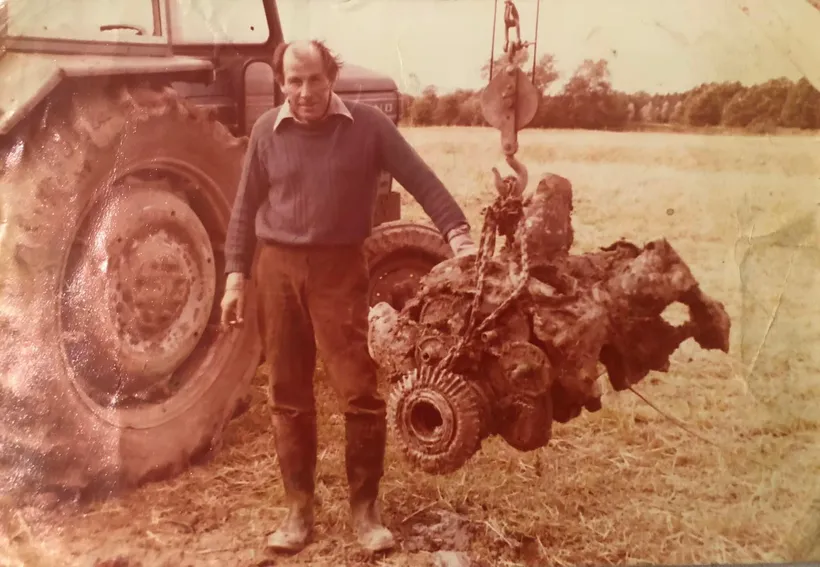
This is the picture of George Ruscoe with one of the Bristol Hercules engines from Wellington LP840
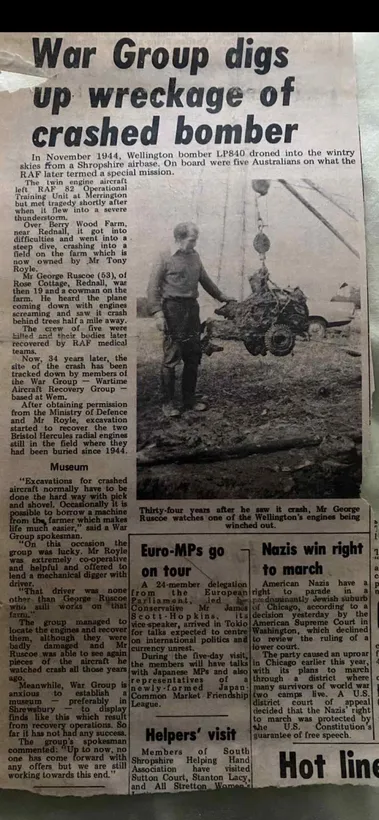
This is the Shropshire Star article containing a picture of George Ruscoe with one of the Bristol Hercules engines from Wellington LP840
Wellington serial: LP840
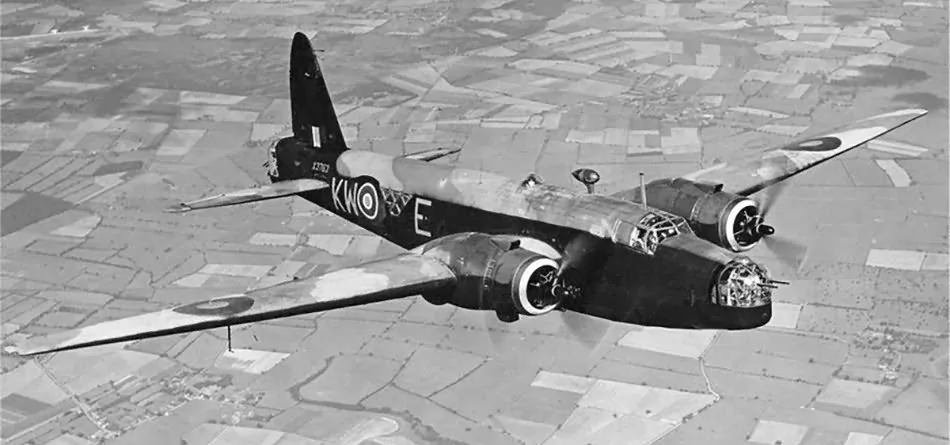
Source: Harold A Skaarup Web Page
Vickers Wellington B. Mk. III (Serial No. X3763), coded KW-E, No. 425 'Alouette' (B) Squadron, RCAF, late summer of 1942
Vickers Wellington B. Mk. III (Serial No. X3763), coded KW-E, No. 425 'Alouette' (B) Squadron, RCAF, late summer of 1942
The Vickers Wellington was a British twin-engined, long-range medium bomber. It was designed during the mid-1930s at Brooklands in Weybridge, Surrey. Led by Vickers-Armstrongs' chief designer Rex Pierson, a key feature of the aircraft is its geodetic airframe fuselage structure, which was principally designed by Barnes Wallis. Development had been started in response to Air Ministry Specification B.9/32, issued in the middle of 1932, for a bomber for the Royal Air Force. This specification called for a twin-engined day bomber capable of delivering higher performance than any previous design.
The Wellington was used as a night bomber in the early years of the Second World War, performing as one of the principal bombers used by Bomber Command. During 1943, it started to be superseded as a bomber by the larger four-engined "heavies" such as the Avro Lancaster. The Wellington continued to serve throughout the war in other duties, particularly as an anti-submarine aircraft.
It holds the distinction of having been the only British bomber that was produced for the duration of the war, and of having been produced in a greater quantity than any other British-built bomber. The Wellington remained as first-line equipment when the war ended, although it had been increasingly relegated to secondary roles. The Wellington was one of two bombers named after Arthur Wellesley, 1st Duke of Wellington, the other being the Vickers Wellesley.
In August 1936, an initial order for 180 Wellington Mk I aircraft, powered by a pair of 1,050 hp (780 kW) Bristol Pegasus radial engines, was received by Vickers; it had been placed so rapidly that the order occurred prior to the first meeting intended to decide the details of the production aircraft. In October 1937, another order for a further 100 Wellington Mk Is, produced by the Gloster Aircraft Company, was issued; it was followed by an order for 100 Wellington Mk II aircraft with Rolls-Royce Merlin X V12 engines. Yet another order was placed for 64 Wellingtons produced by Armstrong Whitworth Aircraft. With this flurry of order and production having been assured by the end of 1937, Vickers set about simplifying the manufacturing process of the aircraft and announced a target of building one Wellington per day.
A total of 180 Wellington Mk I aircraft were built; 150 for the RAF and 30 for the Royal New Zealand Air Force (RNZAF) (which were transferred to the RAF on the outbreak of war and used by 75 Squadron). In October 1938, the Mk I entered service with 9 Squadron. The Wellington was initially outnumbered by the Handley Page Hampden (also ordered by the Ministry to B.9/32) and the Armstrong Whitworth Whitley (to B.34/3 for a 'night' bomber) but outlasted both rival aircraft in service. The Wellington went on to be built in 16 separate variants, in addition to two training conversions after the war. The number of Wellingtons built totalled 11,462 of all versions, a greater quantity produced than any other British bomber. On 13 October 1945, the last Wellington to be produced rolled out. Wikipedia
 Wikipedia Vickers Wellington
 RCAF - Vickers Wellington
 YouTube Vickers Wellington documentary
Unit Desciption
82 (OT) OTU (82 Operational Training Unit)
The Operational Training Unit (OTU) was the last stop for aircrew trainees. They spent 8 to 14 weeks learning to fly operational aircraft. The instructors had experience in actual operations, and often were posted to OTUs after their operational tour.Wellington LP840 B. Mk. X - Operational - 1944-11-09 to 1944-11-09
Squadron: (OT) OTU (RAF)
Start Date: 1944-11-09
Completion Date: 1944-11-09
Mission: Operational
Operation: unspecified
Target City:
Target Specific:
Base: RAF Ossington
Take Off Time: 16:14
Squadron Code:
Radio Code:
Return Base:
Return Time:
Crash City:
Crash Specifics:
Crash Latitude: 0.00000000
Crash Longitude: 0.00000000
Crash Reason:
Flak Battery:
Enemy Claim:
War Diary Unavailable
6 Group Unavailable
Wellington LP840 82 OTU took off from RAF Ossington on training and durnping of explosives off off Prestatyn, North Wales — bombing range. At 16.14, LP840 dived vertically out of a thunder cloud, probably due to Icing, crashing at Berrywood Farm, Queens Head, Shrewsbury. Killing the RCAF crew, who were subsequently buried In Blacon Cemetery, Chester OFFICIAL LOSS ENTRY (Shaun Noble + Bomber Command Museum Archive,Nanton Alberta,Canada
The owner of Berrywood Farm was Tony Royle. George Ruscoe (1925-2004) born in Rednal, worked on Berrywood Farm all his life as a cowman. At age 19 in Nov 1944 , he was working on the farm when he heard engines screaming, saw the crash half mile away behind the trees. In the summer of 1978, the site was tracked down by members of the Wartime Aircraft Recovery Group — based at Wem, Shropshire, England. After obtaining permission from the Ministry of Defence and Mr Royle, excavation started to recover the two Bristol Hercules radial engines still in the field where they had been buried since 1944.
The farm offered a digger to retrieve the engines that were buried in 14' of clay. The driver was 53 year old George Ruscoe, and he winched the two Bristol Hercules engines out of the ground. The accompanying photograph and newspaper article shows him with one of the engines.
The Wartime Aircraft Recovery Group Wem / Sleap took both engines away on a lorry and the field was filled in. One engine was donated to the Bomber Command Museum of Canada, Nanton, Alberta. The other went to RAF Cosford, (now RAF Museum Midlands, Cosford, Shropshire) It was on display previously but not on display currently — likely in storage.
The forgoing narrative was compiled by Ian Ruscoe son of George Ruscoe (1925-2004), Rose Cottage, Rednal, recognizing his father's role as both witness to the crash and subsequent involvement with the recovery.
This is the picture of George Ruscoe with one of the Bristol Hercules engines from Wellington LP840
This is the Shropshire Star article containing a picture of George Ruscoe with one of the Bristol Hercules engines from Wellington LP840
