6 Group Unavailable
Wellington LP840 82 OTU took off from RAF Ossington on training and durnping of explosives off off Prestatyn, North Wales — bombing range. At 16.14, LP840 dived vertically out of a thunder cloud, probably due to Icing, crashing at Berrywood Farm, Queens Head, Shrewsbury. Killing the RCAF crew, who were subsequently buried In Blacon Cemetery, Chester OFFICIAL LOSS ENTRY (Shaun Noble + Bomber Command Museum Archive,Nanton Alberta,Canada
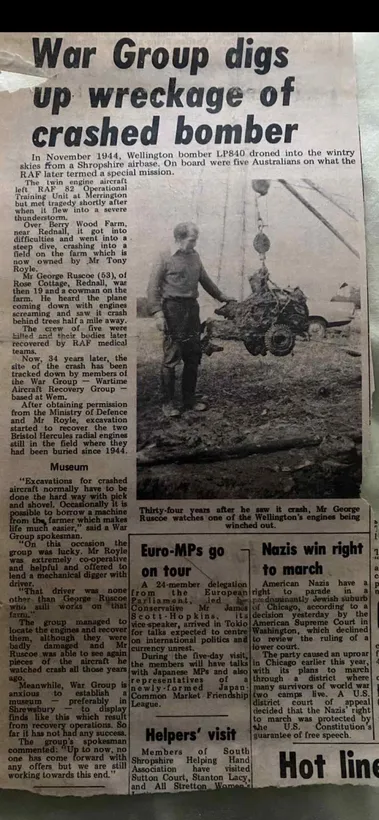
The owner of Berrywood Farm was Tony Royle. George Ruscoe (1925-2004) born in Rednal, worked on Berrywood Farm all his life as a cowman. At age 19 in Nov 1944 , he was working on the farm when he heard engines screaming, saw the crash half mile away behind the trees. In the summer of 1978, the site was tracked down by members of the Wartime Aircraft Recovery Group — based at Wem, Shropshire, England. After obtaining permission from the Ministry of Defence and Mr Royle, excavation started to recover the two Bristol Hercules radial engines still in the field where they had been buried since 1944.
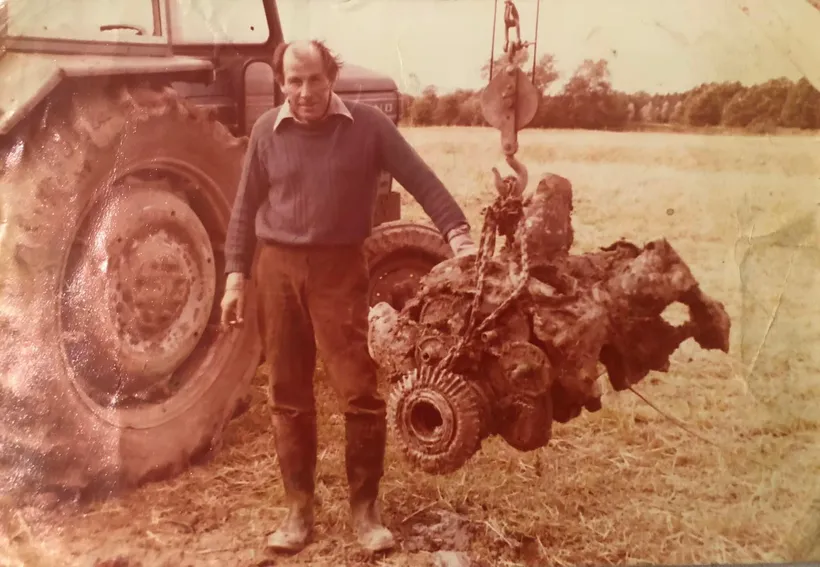
The farm offered a digger to retrieve the engines that were buried in 14' of clay. The driver was 53 year old George Ruscoe, and he winched the two Bristol Hercules engines out of the ground. The accompanying photograph and newspaper article shows him with one of the engines.
The Wartime Aircraft Recovery Group Wem / Sleap took both engines away on a lorry and the field was filled in. One engine was donated to the Bomber Command Museum of Canada, Nanton, Alberta. The other went to RAF Cosford, (now RAF Museum Midlands, Cosford, Shropshire) It was on display previously but not on display currently — likely in storage.
The forgoing narrative was compiled by Ian Ruscoe son of George Ruscoe (1925-2004), Rose Cottage, Rednal, recognizing his father's role as both witness to the crash and subsequent involvement with the recovery.