Ventral Turrets
{{storedairimage,ventralturret.jpeg,float:right;width:400px;margin-left:10px;,Orginal Ventral Turret. Discontinued
early.}}
As originally designed the Lancaster was provided with ventral defence in the form of a Nash and Thompson
FN64 turret, which was fitted to some early production aircraft. However, in common with all other periscope sighted
ventral turrets, the narrow viewing angle made it almost impossible for gunners to acquire and track targets,
and the few turrets which were installed were soon removed from service.
{{clearfloat}}
{{storedairimage,2_DS707_7-6-44.jpg,width:400px;,Note: 50 cal gun pointing at 45°}}
{{storedairorigimage,Mod_925ventral50calMG-1.jpg,width:400px;,Original Drawings. Right click for larger view.}}
{{storedairimage,3 _W4766.jpg,width:400px;,W4766 from 61 Squadron}}
The ventral .50 inch (50 calib) was approved as Lanc Mod.925 during February 1944, and was one of a number of
unsuccessful
measures taken to counter night fighter attacks from below.
The growth of the Luftwaffe night fighter force was followed by an increase in the in the number of attacks from
below, exacerbated from August 1943 onward by the introduction of aircraft equipped with Schrage Musik upward firing
20mm cannon. A number of responses were considered by Bomber Command including a free mounted ventral .50 calibre
Browning machine gun, which was approved on the Lancaster as Modification 925 during February 1944.
The modification was very basic, consisting of little more than an enlarged bicycle seat for the gunner and a simple
free mounted gun with open sights which fired through the ventral turret/H2S aperture. On aircraft with bulged bomb
doors the mounting (often unpainted) was incorporated into the fairing at the rear of the doors.
Non-H2S fitted aircraft were sporadically equipped with the gun from February 1944 onward, although a clear plan for
installation appears to have been lacking.
The quantity of aircraft which actually had the gun installed is unknown and photos of the mounting with a Browning
actually installed are very rare.
Serious problems quickly became apparent, as noted in the following V Group monthly newsletter for
April 1944:- "With the gunner strapped in his seat it is difficult to follow the gun round on the beam;
it is difficult for the gunner to get his head down behind the sight as it tends to push the oxygen mask upwards on
the gunners face; and also considerable vibration is experienced on the sight when the gun is fired."
These problems, plus the gradually more widespread introduction of H2S saw the gun fall out of use quite quickly,
although it does appear to have been retained on some aircraft until war's end (most notably in 3 Group).
The quantity of aircraft which actually had the gun installed is unknown and photos of the mounting with a Browning
actually installed are very rare.
{{clearfloat}}
{{storedairorigimage,75SqnORBextractMarch1945.jpg,float:right;width:400px;margin-left:10px;,75 Squadron ORB March 1945}}
Notice on these aircraft the extra position in the eight person crew of Mid-Under-Gunner.
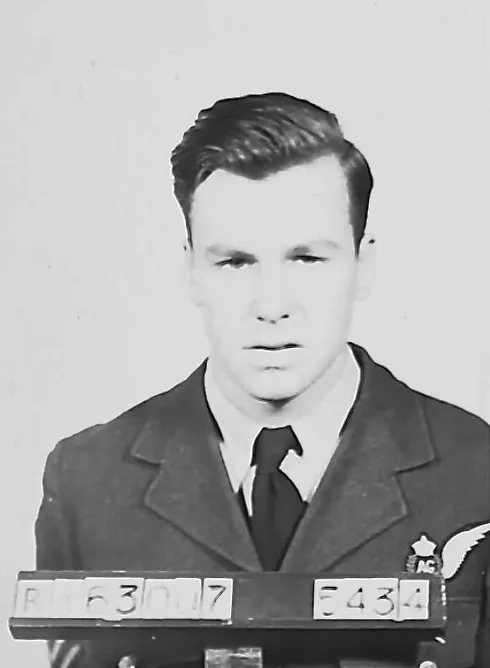

 Toronto, Ontario
 Canadian Virtual War Memorial
 Commonwealth War Graves Commission
 Finadagrave.com
 Library and Archives Canada Service Files (may not exist)


 Daily Operations 6bombergroup.ca
 Lancaster Bomber
 Wikipedia