Dalman, Albert Bruce (Flying Officer)
Killed in Flying Accident 1950-October-24


Birth Date: 1924-February-05
Born: Winnipeg, Manitoba
Parents: Son of Stephen and Elin (nee Gislasom) Dalman of Winnipeg, Manitoba.
Spouse:
Home: Winnipeg, Manitoba
Enlistment: Winnipeg, Manitoba
Enlistment Date: 1943-June-24
Service
RCAF
Unit
WEE- Winter Experimental Establishment
Base
Rank
Flying Officer
Position
Pilot
Service Numbers
30174
 Winnipeg, Manitoba
 Canadian Virtual War Memorial
 Finadagrave.com
Crew or Other Personnel
Harvard AJ977

Harvard serial: AJ977
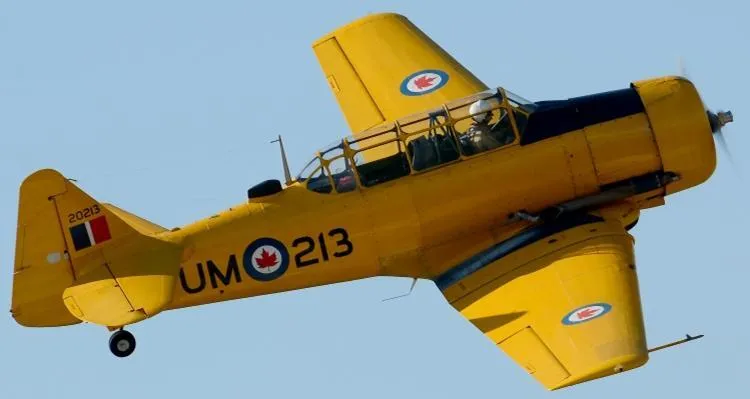
North American Harvard Mk. IV
Canadian Warplane Heritage Museum
Canadian Warplane Heritage Museum
The North American Harvard appeared in 1937, in response to a US Air Corps proposal for an advanced trainer. The first of 50 Harvard Mk. Is ordered by the Canadian Government were delivered to RCAF Sea Island, BC in July 1939. By early 1940, the Mk. II was being assembled in California with an all metal fuselage replacing the original tube and fabric structure. 1200 Mk. IIs were supplied from US sources, until Canadian built Harvards started being produced in 1941.
In August 1938, Noorduyn Aviation of Montreal farsightedly signed an agreement with North American, to build the Harvard under licence. When the British Commonwealth Air Training Plan (BCATP) came into being in December 1939, Noorduyn received its first orders and went on to produce 2,800, comprised of 1,500 AT-16 (paid for by the US), 1,200 Harvard IIB and 100 Harvard TT, (paid for by Canada) January 1941 to October 1945., Harvard Mk. IIBs were used as advanced trainers with the BCATP at fifteen Service Flying Training Schools across the nation. They helped pilots make to the transition from low powered primary trainers, like Fleet Finch or the de Havilland Tiger Moth, to high performance front line fighters such as the Spitfire.
At the end of WW II, although the RCAF retained the Harvard as a trainer, a large number of them were sold off to civilian operators. The RCAF soon regretted this, for by 1949 the Cold War with the Soviet Union was in full swing and the RCAF urgently needed trainers again. 100 T-6J Texans were leased temporarily from the USAAF and a further 270 Harvards, the Mk. IV version, were ordered from Canadian Car & Foundry, Thunder Bay. Post war, Canadian Car and Foundry produce 285 aircraft for the USAAF. The RCAF used the Harvard Mk. IV for a further fifteen years, before finally retiring it in 1966.
A total of 20,110 Harvards were built between 1938 and 1954, 3,355 of them in Canada. Countless numbers of privately owned Harvards are still flying today.
Canadian Warplane Heritage Museum's Harvard Mk. IV was built by Canadian Car & Foundry, Thunder Bay, Ontario in late 1951. The aircraft saw service at four RCAF flying schools across the nation until it was sold to a civilian owner in 1965. It was the third aircraft to join the Museum after Dennis Bradley, Alan Ness and John Weir donated it in 1973. Canadian Warplane Heritage Museum
 Harvard Advanced Trainer
 Wikipedia Harvard Advanced Trainer
 Harold A Skaarup Web Page
Harvard Mk. II / IIR AJ977
Delivered to stored reserve. Assigned to No. 39 Service Flying Training School at Swift Current, Saskatchewan on 22 January 1942. To Aircraft Repair in Edmonton for overhaul, 2 June to 22 August 1944. To storage with No. 4 Training Command when completed. To No. 2 Air command on 1 December 1944, still in storage. Noted as frozen series on 7 July 1945. To workshop reserve at No. 10 Repair Depot on 9 October 1945, for installation of radio. To storage at No. 10 Repair Depot on 3 February 1946. To Western Air command on 13 January 1947, for use by Winter Experimental Establishment Flight at Edmonton. Noted on 1 September 1947 with 2919:55 total time, 99:35 since overhaul, fitment standard. Noted on 1 December 1947 with 2957:30 total time, 137:10 since overhaul, condition good, fitment standard. Noted on 1 March 1948 with 2973:05 total time, 152:45 since overhaul, condition good, fitment standard. Noted on 1 April 1949 with 3115:20 total time, 295:00 since overhaul. To No. 10 Repair Depot for painting, 16 February to 27 March 1950. To North West Air Command and the WEE at Edmonton when completed. Back to No. 10 Repair Depot on 3 November 1950 for scrapping1942-01-17 Taken on Strength No. 4 Training Command 2019-08-20
1942-September-26 Accident: 37 Service Flying Training School Loc: Aerodrome Names: Frith
1943-April-29 Accident: 37 Service Flying Training School Loc: Aerodrome Names: Hay | Mcreavy
1943-June-29 Accident: 37 Service Flying Training School Loc: R1 Airdrie Names: Cross | Gilham
1950-11-03 Struck off Strength 2022-02-07
1950-11-03 Scrapped Assigned for scrapping 2019-08-20
 History WEE Archive Association Of Ontario