Blood, Kenneth Edwin ()
Rescued 1942-November-15

Birth Date: unkown date
Born:
Parents:
Spouse:
Home:
Enlistment:
Enlistment Date: unkown date
Service
RAAF
Unit
32 (OT) OTU- Operational Training Unit (RAF)
Base
RCAF Station Patricia Bay
Rank
Position
Wireless Operator/Air Gunner
Service Numbers
412370
Crew or Other Personnel
Hampden P5436


Accident Card - Handley Page Hampden Mk. I serial:P5436
This accident involved 1 aircraft on 1942-November-15. Hampden s/n P5436.
This accident involved 4 people. Blood K, Fink J, Robinson LH, Smith D
Mission
Hampden Mk. I P5436
Operational 1942-November-15 to 1942-November-15
32 (OT) OTU (RCAF) RCAF Station Patricia Bay
32 Operational Training Unit (OTU) RCAF Station Patricia Bay, British Columbia. Handley-Page Hampden P 5436 H-LB developed a "stabilized yaw" while turning at low speed and altitude during a torpedo-dropping exercise. The Hampden crashed into Saanich Inlet, British Columbia, but the 4-man crew escaped the aircraft before it sank in 600 feet of water. They were all later rescued by 3 Operational Training Unit (OTU) Supermarine Stranraer 947 flying boat piloted by Squadron Leader E W Cowan (RCAF) also flying out of Patricia Bay
The accident investigation found pilot error with possible high wind as a factor in the loss of the aircraft
Pilot Leonard Harry Robinson (RAFVR), Navigator Derek Walter Smith (RAC), Wireless Operator/Air Gunner Kenneth Edwin Blood (RAAF) and Wireless Operator/Air Gunner John Ovila Fink (RCAF) all survived this flying training accident
In 1985-6 Hampden P 5436 was salvaged from Saanich Inlet and restored for static display at the Canadian Museum of Flight in Langley, British Columbia and is the only complete Hampden airframe to survive
 0664_001.pdf
(1) Recovering Hampden P5436: 10 Tons Couldn't Move the WWII Bomb...
Hampden serial: P5436

(RCAF Photo via Chris Charland)(Source Harold A Skaarup Web Page)
Handley Page Hampden (Serial No. P5428), of No. 32 Operational Training Unit at RCAF Patricia Bay, British Columbia, in the torpedo-bomber training role between May 1942 and February 1944.
Handley Page Hampden (Serial No. P5428), of No. 32 Operational Training Unit at RCAF Patricia Bay, British Columbia, in the torpedo-bomber training role between May 1942 and February 1944.
Handley Page developed a modern stressed-skin mid-wing monoplane, powered by Bristol Pegasus radial air cooled engines, with its first flight in 1936. It had the most advanced wings available at the time, giving it a remarkably low landing speed of 73 mph for an aircraft of its size, with a top speed of 265 mph. The Hampden had a short, narrow but tall main fuselage with a very slender tail unit. This configuration led to the nicknames "Flying Panhandle" and "Flying Suitcase". At the end of the war, no complete or partial Hampden aircraft were retained for museum display.
The Hampden served in the early stages of the war, bearing the brunt of the early bombing war over Europe, taking part in the first night raid on Berlin and in the first 1000-bomber raid on Cologne. In Canada, Hampdens were built by six companies that formed Associated Aircraft. There were three in Ontario and three in Quebec, hence they were identified as the Ontario Group and Quebec Group. They supplied all the the components to the two assembly plants. The Ontario Group's assembly plant was at the Malton Airport, while the Quebec group's assembly plant was at the St. Hubert Airport. Canadian Museum of Flight and Harold A Skaarup web page
 Handley Page Hampden in Flight
 Wikipedia Hampden Bomber
 Hampden - Kestrel Publications
Aircraft Images
Hampden P5436
Hampden Mk. I P5436
Manufactured in 1942. Serving with No. 32 OTU, RCAF Station Patricia Bay, BC, when it crashed into water on practice torpedo mission on 15 November 1942, after entering "stabilized yaw" while turning at low speed and altitude. 4 crew rescued by Stranraer. Wreckage recovered from 600 feet of water in 1985 and 1986, restored using pieces from wrecks of AN136 and AN132 , plus parts purchased in UK. Now on display at Canadian Museum of Flight, Langley, BC. Marked "H*LB" by 2005. Still there in April 2009.1942-01-06 Taken on Strength 2019-08-20
1942-November-15 Accident: 32 Operational Training Unit Loc: Saanich Inlet Names: Blood | Fink | Robinson | Smith
1942-12-01 Struck off Strength 2019-08-20
Unit Desciption
32 (OT) OTU (32 Operational Training Unit)
The Operational Training Unit (OTU) was the last stop for aircrew trainees. They spent 8 to 14 weeks learning to fly operational aircraft (Hawker Hurricane or Fairey Swordfish, e.g.). The instructors had experience in actual operations, and often were posted to OTUs after their operational tour.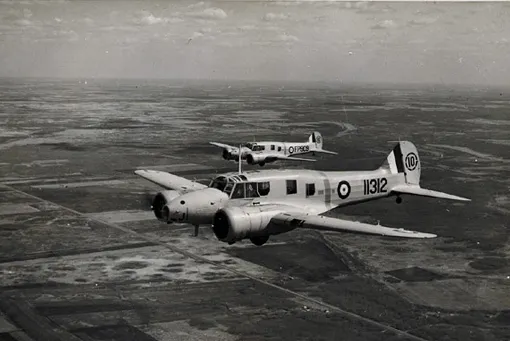
Avro Anson
More information on the RCAF Station at Patricia Bay, British Columbia can be found at:
 RCAF.info - Patricia Bay, British Columbia
 BC Aviation Museum Video On History Of Pat Bay
Hampden P5436 Mk. I - Operational - 1942-11-15 to 1942-11-15
Squadron: 32 (OT) OTU (RCAF)
Start Date: 1942-11-15
Completion Date: 1942-11-15
Mission: Operational
Operation: unspecified
Target City:
Target Specific:
Base: RCAF Station Patricia Bay
Take Off Time:
Squadron Code: H-LB
Radio Code:
Return Base:
Return Time:
Crash City: Canada
Crash Specifics:
Crash Latitude: 0.00000000
Crash Longitude: 0.00000000
Crash Reason: piloterror
Flak Battery:
Enemy Claim:
War Diary Unavailable
6 Group Unavailable
32 Operational Training Unit (OTU) RCAF Station Patricia Bay, British Columbia. Handley-Page Hampden P 5436 H-LB developed a "stabilized yaw" while turning at low speed and altitude during a torpedo-dropping exercise. The Hampden crashed into Saanich Inlet, British Columbia, but the 4-man crew escaped the aircraft before it sank in 600 feet of water. They were all later rescued by 3 Operational Training Unit (OTU) Supermarine Stranraer 947 flying boat piloted by Squadron Leader E W Cowan (RCAF) also flying out of Patricia Bay
The accident investigation found pilot error with possible high wind as a factor in the loss of the aircraft
Pilot Leonard Harry Robinson (RAFVR), Navigator Derek Walter Smith (RAC), Wireless Operator/Air Gunner Kenneth Edwin Blood (RAAF) and Wireless Operator/Air Gunner John Ovila Fink (RCAF) all survived this flying training accident
In 1985-6 Hampden P 5436 was salvaged from Saanich Inlet and restored for static display at the Canadian Museum of Flight in Langley, British Columbia and is the only complete Hampden airframe to survive
(1) Recovering Hampden P5436: 10 Tons Couldn't Move the WWII Bomb...
