Giblin, John Alec Emanuel (Sergeant)
Prisoner of War 1943-September-01


Birth Date: unkown date
Born:
Parents:
Spouse:
Home:
Enlistment:
Enlistment Date: unkown date
Service
RAF
Unit
214 (B) Sqn- Squadron (RAF)
Ultor In Umbris Avenging in the shadows
Base
RAF Chedburgh
Rank
Sergeant
Position
Flt Engineer
Service Numbers
1801548
PoW: 222698
Target
 Berlin Germany
Crew or Other Personnel
Stirling EE970


Mission
Stirling EE970
Bombing Berlin Germany 1943-August-31 to 1943-September-01
214 (B) Sqn (RAF) RAF Chedburgh
6t2 aircraft- 331 Lancasters, 176 Halifaxes, 106 Stirlings, 9 Mosquitoes. 47 aircraft- 2 Halifaxes, 17 Stirlings, IO Lancasters - lost, 7·6 per cent of the force. The Stirling casualties were 16·0 per cent! Approximately two thirds of the bombers lost were shot down by German fighters operating over or near Berlin. The use of 'fighter flares', dropped by German aircraft to 'mark' the bomber routes into and away from the target, was noted for the first time in Bomber Command records.
This raid was not successful. There was some cloud in the target area; this, together with difficulties with H2S equipment and probably the ferocity of the German defences, all combined to cause the Pathfinder markers to be dropped well south of the centre of the target area and the Main Force bombing to be even further away. The main bombing area eventually extended 30 miles back along the bombers' approach route. 85 dwelling-houses were destroyed in Berlin but the only industrial buildings hit were classed as damaged, 4 severely and 3 lightly. The only important public buildings hit were the headquarters of the Berlin inland canal and harbour system, the state police hospital and some market halls. 66 civilians and 2 soldiers were killed, 109 people were injured and 2,784 bombed out.
After this raid, Gauleiter Goebbels ordered the evacuation from Berlin of all children and all adults not engaged in war work to country areas or to towns in Eastern Germany where air raids were not expected.source: The Bomber Command War Diaries, Martin Middlebrook and Chris Everitt
Stirling EE970 took off from Chedburgh at 20:42 in Stirling Mark III (Sqn code: BU-B Bomber Command) on an operation to Berlin Germany.
The aircraft was hit by flak, caught fire, and while going down in flames the pilot ordered the crew to bail outThe aircraft was hit by flak, caught fire, and while going down in flames the pilot ordered the crew to bail out. Crashed at Charlottenfelde Germany
Killed: Flight Sergeant Douglas Conway Houghton RAF KIA Berlin 1939-1945 War Cemetery grave 6. D. 4. Pilot Officer Kenneth John Simpson RAAF KIA Runnymede Memorial Panel 191.
POWs includes Case: Sergeant John Evan Chisholm RAF POW Stalag 4B Muhlberg (Elbe). Sergeant George Daulby RAF POW Stalag 4B Muhlberg (Elbe). Sergeant Harold Melvyn Diebel RCAF R/161427 POW Stalag 4B Muhlberg (Elbe). Sergeant John Alec Emanuel Giblin RAF POW Stalag 4B Muhlberg (Elbe).
Stirling serial: EE970
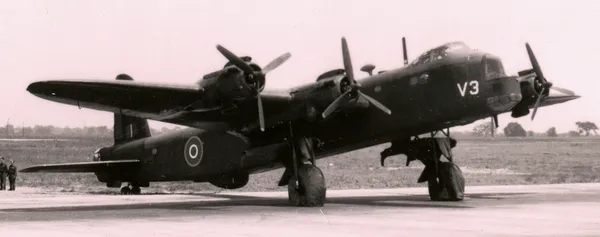
Source: Harold A Skaarup Web Page (L. Faux Photos)
In June 1944, this Short S.29 Stirling B Mk. IV (Serial No. LK589), coded V3, RAF, was flown across the Atlantic as part of a navigation training exercise and did a tour of bases in Eastern Canada. It is shown here at Malton, Ontario. It was flown back to the UK after a two-week visit.
In June 1944, this Short S.29 Stirling B Mk. IV (Serial No. LK589), coded V3, RAF, was flown across the Atlantic as part of a navigation training exercise and did a tour of bases in Eastern Canada. It is shown here at Malton, Ontario. It was flown back to the UK after a two-week visit.
The Short Stirling was a British four-engined heavy bomber of the Second World War. It has the distinction of being the first four-engined bomber to be introduced into service with the Royal Air Force (RAF).
The Stirling was designed during the late 1930s by Short Brothers to conform with the requirements laid out in Air Ministry Specification B.12/36. Prior to this, the RAF had been primarily interested in developing increasingly capable twin-engined bombers but had been persuaded to investigate a prospective four-engined bomber as a result of promising foreign developments in the field. Out of the submissions made to the specification Supermarine proposed the Type 317, which was viewed as the favourite, whereas Short's submission, named the S.29, was selected as an alternative. When the preferred Type 317 had to be abandoned, the S.29, which later received the name Stirling, proceeded to production. In early 1941 the Stirling entered squadron service. During its use as a bomber pilots praised the type for its ability to out-turn enemy night fighters and its favourable handling characteristics whereas the altitude ceiling was often a subject of criticism. The Stirling had a relatively brief operational career as a bomber before being relegated to second line duties from late 1943. This was due to the increasing availability of the more capable Handley Page Halifax and Avro Lancaster, which took over the strategic bombing of Germany. Decisions by the Air Ministry on certain performance requirements (most significantly to restrict the wingspan of the aircraft to 100 feet) had played a role in limiting the Stirling's performance; the 100ft limit also affected earlier models of the Halifax (MkI & MkII) though the Lancaster never adhered to it.
During its later service, the Stirling was used for mining German ports; new and converted aircraft also flew as glider tugs and supply aircraft during the Allied invasion of Europe during 1944"“1945. In the aftermath of the Second World War, the type was rapidly withdrawn from RAF service, having been replaced in the transport role by the Avro York, a derivative of the Lancaster that had previously displaced it from the bomber role. A handful of ex-military Stirlings were rebuilt for the civil market. Wikipedia
 Wikipedia Short Stirling
 Harold A Skaarup Web Page
Stirling EE970 - Bombing Berlin Germany - 1943-08-31 to 1943-09-01
Squadron: 214 (B) Sqn (RAF)
Start Date: 1943-08-31
Completion Date: 1943-09-01
Mission: Bombing
Operation: unspecified
Target City: Berlin Germany
Target Specific:
Base: RAF Chedburgh
Take Off Time: 20:42
Squadron Code: BU-B
Radio Code:
Return Base:
Return Time:
Crash City: 5km north east of Neukloster.
Crash Specifics:
Crash Latitude: 0.00000000
Crash Longitude: 0.00000000
Crash Reason: flak
Flak Battery:
Enemy Claim:
War Diary Unavailable
6 Bomber Group August31/September 1, 1943
48 Halifaxes from 419, 427,428 and 434 Squadrons were joined by 11 Lancasters from 426 Squadron on an attack at Berlin. The crews were over the target at between 17,000 and 23,000 feet, releasing 88,000 lbs of high explosives and 115,000 lbs of incendiaries. According to reports, the target was cloud covered and bombing was scattered. There was many night fighters operating, most of the crews falling to their guns. Richard Koval (6bombergroup.ca)
6t2 aircraft- 331 Lancasters, 176 Halifaxes, 106 Stirlings, 9 Mosquitoes. 47 aircraft- 2 Halifaxes, 17 Stirlings, IO Lancasters - lost, 7·6 per cent of the force. The Stirling casualties were 16·0 per cent! Approximately two thirds of the bombers lost were shot down by German fighters operating over or near Berlin. The use of 'fighter flares', dropped by German aircraft to 'mark' the bomber routes into and away from the target, was noted for the first time in Bomber Command records.
This raid was not successful. There was some cloud in the target area; this, together with difficulties with H2S equipment and probably the ferocity of the German defences, all combined to cause the Pathfinder markers to be dropped well south of the centre of the target area and the Main Force bombing to be even further away. The main bombing area eventually extended 30 miles back along the bombers' approach route. 85 dwelling-houses were destroyed in Berlin but the only industrial buildings hit were classed as damaged, 4 severely and 3 lightly. The only important public buildings hit were the headquarters of the Berlin inland canal and harbour system, the state police hospital and some market halls. 66 civilians and 2 soldiers were killed, 109 people were injured and 2,784 bombed out.
After this raid, Gauleiter Goebbels ordered the evacuation from Berlin of all children and all adults not engaged in war work to country areas or to towns in Eastern Germany where air raids were not expected.source: The Bomber Command War Diaries, Martin Middlebrook and Chris Everitt
Stirling EE970 took off from Chedburgh at 20:42 in Stirling Mark III (Sqn code: BU-B Bomber Command) on an operation to Berlin Germany.
The aircraft was hit by flak, caught fire, and while going down in flames the pilot ordered the crew to bail outThe aircraft was hit by flak, caught fire, and while going down in flames the pilot ordered the crew to bail out. Crashed at Charlottenfelde Germany
Killed: Flight Sergeant Douglas Conway Houghton RAF KIA Berlin 1939-1945 War Cemetery grave 6. D. 4. Pilot Officer Kenneth John Simpson RAAF KIA Runnymede Memorial Panel 191.
POWs includes Case: Sergeant John Evan Chisholm RAF POW Stalag 4B Muhlberg (Elbe). Sergeant George Daulby RAF POW Stalag 4B Muhlberg (Elbe). Sergeant Harold Melvyn Diebel RCAF R/161427 POW Stalag 4B Muhlberg (Elbe). Sergeant John Alec Emanuel Giblin RAF POW Stalag 4B Muhlberg (Elbe).
