 Chelsea, London, England
Beevor, the pilot of the Bristol Aircraft was killed in a flying accident on 1914-11-05 when his aircraft, in which he was on a flight to join the War in France, was lost to the sea somewhere between England and Dunkerque, on the coast of Belgium, where he was bound. Beevor and his passenger in all likelihood drowned, but in any event, their bodies were not recovered. He is remembered on the Chathan Naval Memorial at Chatham Dockyard in Kent, England.
Beevor, Charles Francis (Flight Lieutenant)
Killed in Flying Accident 1914-November-05


Birth Date: 1893-July-23
Born: Chelsea, London, England
Parents: Walter Beevor & E. B. Beevor
Spouse: unmarried
Home: Chelsea, London, England
Enlistment: 18th Hussars Regiment; 1914-07-01 RNAS
Enlistment Date: 1911-April-02
Service
RFC
Unit
2 Sqn- Squadron (RFC)
Base
Rank
Flight Lieutenant
Position
pilot
Service Numbers
Crew or Other Personnel
T.B.8 1220
T.B.8 serial: 1220
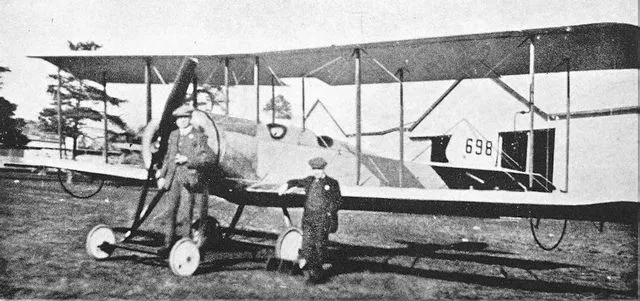
Bristol T.B,8
Source Wikipedia
The Bristol T.B.8, or Bristol-Coanda T.B.8 was an early (1913–14) British biplane built by the Bristol Aeroplane Company, which was produced in significant numbers (54 were built) for the time. While mainly used as a trainer, T.B.8s were briefly used as bombers at the start of the First World War by the Royal Naval Air Service (RNAS).
Henri Coandă, chief designer of the Bristol Aeroplane Company, developed the T.B.8 as a biplane development of his earlier Bristol-Coanda Monoplane to meet an order from the British Admiralty, the first aircraft, a conversion of a Bristol-Coanda monoplane, flying on 12 August 1913.This aircraft was tested with both wheeled undercarriage and floats.
The T.B.8 was a single engined, two seat biplane, with two bay wings and a slender fuselage. While early T.B.8s used wing warping, later production aircraft were fitted with ailerons. They were normally fitted with a distinctive four wheel undercarriage. T.B.8s were powered by a variety of rotary engines, including Gnome and Le Rhône engines with power ranging from 50 hp Gnomes to 100 hp Gnome Monosoupape engines. T.B.8s were produced both by conversion of Coanda Monoplanes, and by new production.
One T.B.8 was fitted with a prismatic Bombsight in the front cockpit and a cylindrical bomb carrier in the lower forward fuselage capable of carrying twelve 10 lb (4.5 kg) bombs, which could be dropped singly or as a salvo as required. This aircraft was displayed at the Paris Salon de l'Aéronautique and evaluated by the French military before being purchased by the RNAS.
The Bristol T.B.8 was considered too slow for frontline operations, and was relegated to training operations, serving until 1916. Wikipedia
 Bristol T.B.8