45 Delivery Group, RAF Transport Command, Liberator B.VI KL386 crashed and burned in shallow water taking off from Kindley Field, Bermuda
1st Officer Pilot EC Talbot (Canadian civilian) was killed


Birth Date: 1921
Born:
Parents: Son of William James Edgar and Harriet Emma Talbot, of Toronto, Ontario, Canada
Spouse:
Home: Toronto, Ontario
Enlistment:
Enlistment Date: unkown date
Service
RAF
Unit
45 Group (RAF)
Base
Dorval, Quebec
Rank
Civilian
Position
2nd Pilot
Service Numbers
 Toronto, Ontario
45 Delivery Group, RAF Transport Command, Liberator B.VI KL386 crashed and burned in shallow water taking off from Kindley Field, Bermuda
1st Officer Pilot EC Talbot (Canadian civilian) was killed
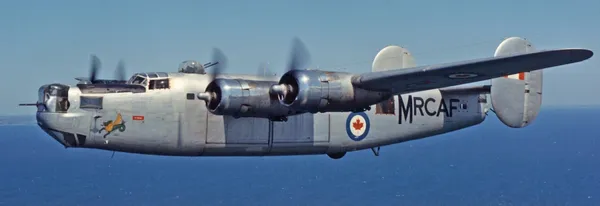
The Consolidated B-24 Liberator was an American heavy bomber flown by the RCAF during the Second Word War. It was designed with a shoulder-mounted, high aspect ratio Davis wing which gave the Liberator a high cruise speed, long range and the ability to carry a heavy bomb load. Early RAF Liberators were the first aircraft to cross the Atlantic Ocean as a matter of routine. In comparison with its contemporaries the B-24 was relatively difficult to fly and had poor low speed performance; it also had a lower ceiling compared with the Boeing B-17 Flying Fortress. Of the roughly 18,500 B-24s built in the USA during the war, 148 were flown by the RCAF on long range anti-submarine patrols, with the B-24 serving an instrumental role in closing the Mid-Atlantic gap in the Battle of the Atlantic. The RCAF also flew a few B-24s post war as transports.
Roughly half of all (RAF) Liberator crews in the China-Burma-India (CBI) Theatre were Canadian by the end of the war. John Muir of Vancouver flew the longest mission of the war: 24hrs, 10mins from Ceylon to Burma and back. (Kyle Hood) Harold Skaarup web page
 Commonwealth War Graves Commission
 Finadagrave.com


 Liberator bomber
 Wikipedia Liberator bomber
 Harold A Skaarup Web Page