 Victoria, British Columbia
Flight Lieutenant Symons had flown Hurricane aircraft with 3 Squadron in the Battle of Britain and was killed flight testing a Mosquito aircraft.
Symons, Charles Michael Brooke (Flight Lieutenant)
Killed in Flying Accident 1942-October-15


Birth Date: 1917
Born:
Parents: Son of Kyle Charles and Edith A. Symons, of Victoria, British Columbia.
Spouse: Husband of Margaret Jane Symons, of Victoria, British Columbia.
Home: Victoria, British Columbia
Enlistment:
Enlistment Date: unkown date
Service
RAF
Unit
3 Sqn- Squadron (RAF)
Tertius Primus Erit The third shall be first
Base
Rank
Flight Lieutenant
Position
Pilot
Service Numbers
41628
 Canadian Virtual War Memorial
Mosquito serial: DD784
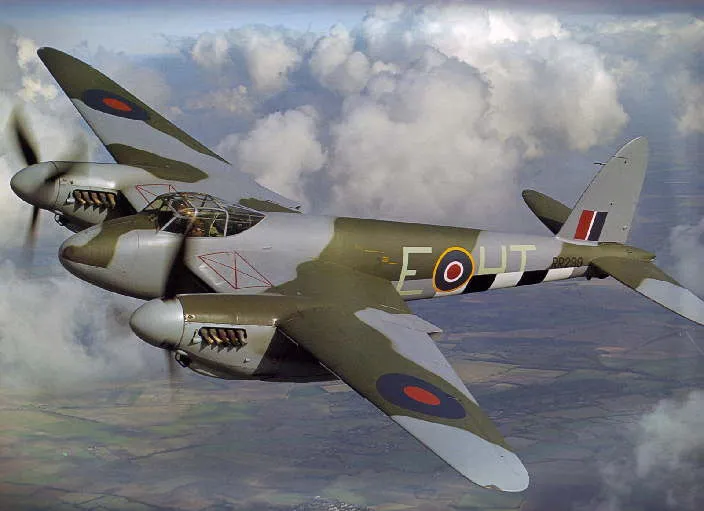
(British Aerospace photo) (Source Bomber Command Museum of Canada)
The de Havilland DH.98 Mosquito was a British twin-engine shoulder-winged multi-role combat aircraft, introduced during the Second World War. It was one of few operational front-line aircraft of the era whose frame was constructed almost entirely of wood. Nicknamed The Wooden Wonder, it was affectionately as the "Mossie" to its crews. The total number of DH98 Mosquito aircraft built was 7,781, the type serving with the main Allied air forces, including both the United States and Russia.
When Mosquito production began in 1941 it was the fastest propeller driven operational aircraft in the world. The first variant was an unarmed, high-speed, high-altitude photo-reconnaissance aircraft. Originally conceived as an unarmed fast bomber, the Mosquito's use evolved during the war into many roles including low to medium-altitude daytime tactical bomber, high-altitude night bomber, pathfinder, day or night fighter, fighter-bomber, intruder, and maritime strike aircraft. It was also used by the British Overseas Airways Corporation (BOAC) as a fast transport to carry small high-value cargoes to, and from, neutral countries, through enemy-controlled airspace. The crew of two, pilot and navigator, sat side by side, but a single passenger could ride in the aircraft's bomb bay when necessary.
The Mosquito FB Mk. VI was often flown in special raids, such as Operation Jericho, an attack on Amiens Prison in early 1944, and precision attacks against military intelligence, security and police facilities (such as Gestapo headquarters). On the 10th anniversary of the Nazi' seizure of power in 1943, a morning Mosquito attack knocked out the main Berlin broadcasting station while Hermann Goering was speaking, putting his speech off the air. Goering later said: "It makes me furious when I see the Mosquito. I turn green and yellow with envy. There is nothing the British do not have. They have the geniuses and we have the nincompoops."
The Mosquito flew with the RCAF and other air forces in the European, Mediterranean and Italian theatres. After the end of the Second World War Spartan Air Services flew 10 ex-RAF Mosquitoes, mostly B.35's plus one of only six PR.35's built, for high-altitude photographic survey work in Canada. There are approximately 30 non-flying Mosquitos around the world with five airworthy examples, four in the United States, and one in Canada. Harold Skaarup web page and Wikipedia
 Mosquito
 BAE Systems (formerly De Havilland)
 Wikipedia Mosquito
 Harold A Skaarup Web Page
 USAAF F-8 Mosquito Serial Numbers
 Mosquitos shipped to Taiwanese Airforce
 Mosquito B35 Maintenance Manual
Unit Desciption
3 Sqn Tertius Primus Erit (x)
History of the Squadron during World War II (Aircraft: Hurricane I, IIb, IIc, Typhoon Ib, Tempest V)
No. 3 Squadron is the oldest squadron in the RAF, Having been formed on 13th May 1912. It served through out World War I. It served in fighter and ground attack roles. Between the wars, it was disbanded and reformed a number of times, flying a number of different types of aircraft. Before the start of the Second World War No 3 Squadron was posted as part of Fighter Command to RAF Station Biggin Hill and equipped with the Hawker Hurricane Mk I. On the outbreak of war, it moved to Croydon, then to Hawkinge and Kenley. It was not in action until May, 1940, when it was briefly deployed to Merville, France as part of 63 Wing in support of the British Expeditionary Force following the German attack on the West. It was forced to withdraw after 10 days, having claimed 60 German aircraft for the loss of 21 of its own. Once back up to strength, No. 3 Squadron was used from May 1940 to April 1941 as air defence for the Royal Naval base at Scapa Flow and convoy protection, operating from Wick, Castletown and Skeabrae, remaining in Scotland until April 1941, when it moved south to RAF Martlesham Heath.
The squadron was involved in night-fighting, where it co-operated with "Turbinlite" searchlight equipped Douglas Havocs (the searchlight in the Havoc was intended to illuminate enemy aircraft so that the Hurricanes could attack them), but with no success. The Hurricane was not well equipped for night fighting. In June 1941 it moved to RAF Stapleford Tawney operating four-cannon Hurricane IIs in 'Rhubarb' attacks on defended ground targets and shipping in northern France and Belgium, flying from Stapleford Tawney and Hunsdon. It participated in the Dieppe raid, among other activities. In February 1943 it re-equipped with the Hawker Typhoon Ib for fighter-bomber and anti-shipping strikes, flying from a number of bases in SE England. It re-equipped in March 1944 with the new Hawker Tempest fighter, operating over the Normandy beach-head and against German V1 flying bombs, claiming 288 V-1s shot down.
It then deployed across the Channel, flying as part of the 2 TAF fighting through the low countries and into Germany. Amongst its pilots was F/L Pierre Clostermann, who flew with 3 Squadron from March 1945 until the end of the war in Europe
Maps for Movements of No. 3 Squadron RAF 1940-45
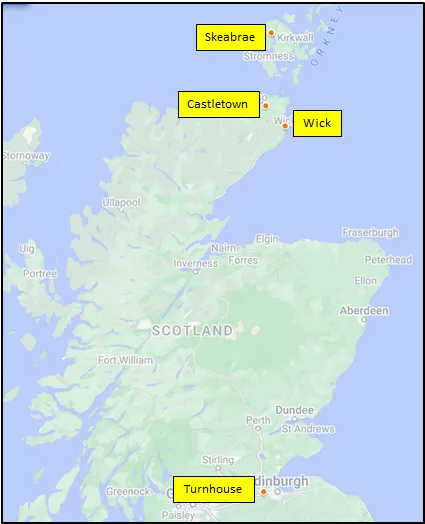
MAP 1: No 3 Squadron bases, Scotland May 1940-April 1941 (right-click on image to display enlarged view in new tab)
|

MAP 2: No. 3 Squadron bases, SE England April 1941-September 1944
|
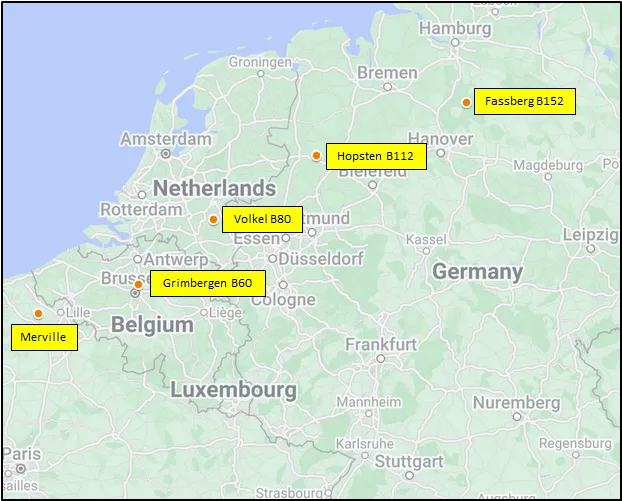
MAP 3: No. 3 Squadron bases in Europe September 1944-May 1945
|