 Red Deer Cemetery
Oxford aircraft - X6734 went missing when a heavy smoke from nearby forest fires blew in over the aerodrome at Penhold. The aircraft was not found until 1944-05-10 and was finally located in some bush 2 miles south of the camp. Flying Officer D. Merry and Leading Aircraftman G.D. Conway were found in the burned out aircraft deceased due to injuries received in the crash. The aircraft was completely burned out.
Merry, David (Flying Officer)
Killed in Flying Accident 1944-May-05


Birth Date: 1923
Born:
Parents:
Spouse:
Home:
Enlistment:
Enlistment Date: unkown date
Service
RAFVR
Unit
36 (OT) SFTS- Service Flying Training School (RAF)
Base
Penhold, Alberta, Canada
Rank
Flying Officer
Position
Pilot
Service Numbers
135135
 Commonwealth War Graves Commission
 Finadagrave.com
Crew or Other Personnel
Oxford X6734


Oxford serial: X6734
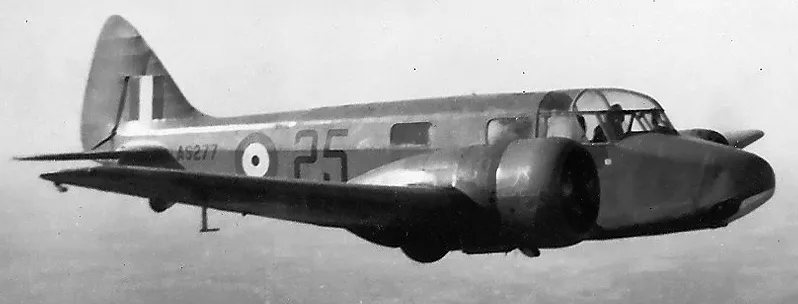
(Bob Brown Photo)(Source Harold A Skaarup Web Page)
Airspeed A.S. 10 Oxford Mk. II, RCAF (Serial No. AS277), 25, in flight over Saskatchewan, 1942.
Airspeed A.S. 10 Oxford Mk. II, RCAF (Serial No. AS277), 25, in flight over Saskatchewan, 1942.
The Airspeed AS.10 Oxford was a twin-engine monoplane aircraft developed and manufactured by Airspeed. It saw widespread use for training British Commonwealth aircrews in navigation, radio-operating, bombing and gunnery roles throughout the Second World War.
The Oxford was developed by Airspeed during the 1930s in response to a requirement for a capable trainer aircraft that conformed with Specification T.23/36, which had been issued by the British Air Ministry. Its basic design is derived from the company's earlier AS.6 Envoy, a commercial passenger aircraft. Performing its maiden flight on 19 June 1937, it was quickly put into production as part of a rapid expansion of the Royal Air Force (RAF) in anticipation of a large-scale conflict.
As a consequence of the outbreak of war, many thousands of Oxfords were ordered by Britain and its allies, including Australia, Canada, France, New Zealand, Poland, and the United States. Following the end of the conflict, the Oxford continued to achieve export sales for some time, equipping the newly formed air forces of Egypt, India, Israel, and Yugoslavia. It was considered to be a capable trainer aircraft throughout the conflict, as well as being used a general-purpose type. A large number of Oxfords have been preserved on static display. Wikipedia
 Oxford Trainer
 Wikipedia Oxford Trainer
Oxford Mk. I X6734
Taken on strength by No. 1 Port Detachment at Halifax, NS. To No. 3 Training Command on 23 July 1942, for use by the Composite Training Squadron. To No. 1 Training Command on 11 February 1943, for use by No. 1 Flying Instructors School at Trenton. To workshop reserve at No. 6 Repair Depot at Trenton on 15 May 1943. To No. 4 Training Command on 4 October 1943.
Category A crash on 4 May 1944, while with No. 36 Service Flying Training School at Penhold, Alberta.
Alberta, smoke from forest fires burning north of Edmonton suddenly descended in central Alberta, blotting out visibility and forcing aircraft engaged in night flying to divert to other landing fields as far south as Calgary. One aircraft was missing, Oxford I X6734. Despite the poor visibility in smoke searches were carried out by aircraft from 36 SFTS, 2 AOS (Edmonton) and 3 SFTS (Calgary), 13 SFTS (North Battleford, Saskatchewan) and 34 SFTS (Medicine Hat). The missing aircraft was located after 6 days, crashed in woods less than 2 miles from the airfield, Flying Officer D. Merry RAF (Trinidad) and Leading Aircraftman G.D. Conway RNZAF killed www.penholdbase.ca, Penhold Log Vol. 5, Number 5, via Paul Squires
. {{link,general, https://thelogbookproject.com/crash-of-oxford-x6734/,The Logbook Project}}1942-03-24 Taken on Strength 2019-08-20
1943-January-13 Accident: Conversion Training Squadron Loc: Rockliffe Ontario Names: Merrifield
1944-May-04 Accident: 36 Service Flying Training School Loc: Aerodrome Names: Conway | Merry
1944-06-12 Struck off Strength Struck off, reduced to spares and produce 2019-08-20
Unit Desciption
36 (OT) SFTS (36 Service Flying Training School)
Graduates of the EFTS "learn-to-fly" program went on a Service Flying Training School (SFTS) for 16 weeks. For the first 8 weeks the trainee was part of an intermediate training squadron; for the next 6 weeks an advanced training squadron and for the final 2 weeks training was conducted at a Bombing & Gunnery School. The Service schools were military establishments run by the RCAF or the RAF.
There were two different types of Service Flying Training Schools. Trainees in the fighter pilot stream went to an SFTS like No. 14 Aylmer, where they trained in the North American Harvard or North American Yale. Trainees in the bomber, coastal or transport pilot stream went to an SFTS like No. 5 Brantford where they learned multi-engine technique in an Airspeed Oxford, Avro Anson or Cessna Crane.

Airspeed Oxford Crash SFTS36
For Information on RCAF Station Penhold see here
 RCAF.Info - RCAF Station Penhold AB
RCAF.Info - Relief Landing Field Innisfail AB
RCAF.Info - Relief Landing Field Blackfalds AB
 Harvard Historical Aviation Society
Midland Aircraft Recovery Group - Men Of 36 SFTS
 Bomber Command Museum Of Canada - 36 SFTS