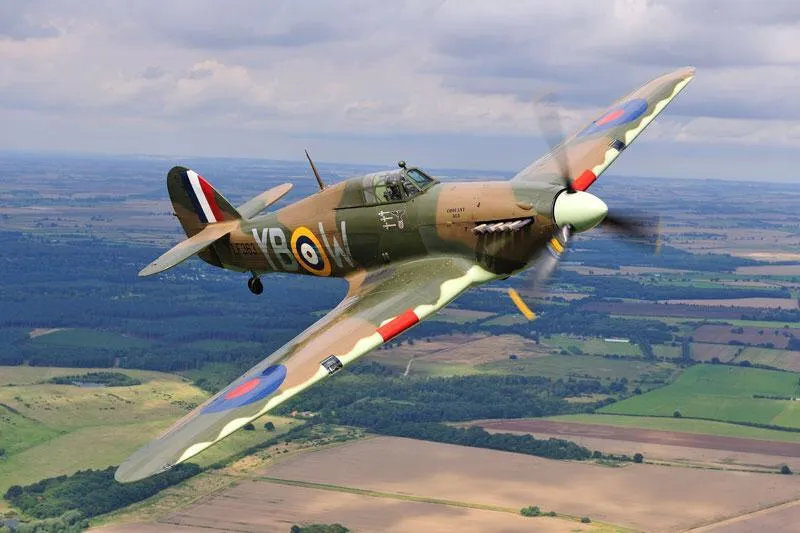
Hawker Hurricane Mk IIc.
Source BBMF
The Hawker Hurricane is a single-seat fighter aircraft of the 1930s"“1940s that was designed and predominantly built by Hawker Aircraft Ltd. for service with the Royal Air Force (RAF). The Hurricane developed through several versions, as bomber-interceptors, fighter-bombers, and ground support aircraft in addition to fighters. Versions designed for the Navy were popularly known as the Sea Hurricane, with modifications enabling their operation from ships. Some were converted to be used as catapult-launched convoy escorts. By the end of production in July 1944, 14,487 Hurricanes had been completed in Britain and Canada.
A major manufacturer of the Hurricane was Canadian Car and Foundry at their factory in Fort William (now Thunder Bay), Ontario. The facility's chief engineer, Elsie MacGill, became known as the "Queen of the Hurricanes". The initiative was commercially led rather than governmentally, but was endorsed by the British government; Hawker, having recognized that a major conflict was all but inevitable after the Munich Crisis of 1938, drew up preliminary plans to expand Hurricane production via a new factory in Canada. Under this plan, samples, pattern aircraft, and a complete set of design documents stored on microfilm, were shipped to Canada; the RCAF ordered 20 Hurricanes to equip one fighter squadron and two more were supplied to Canadian Car and Foundry as pattern aircraft but one probably did not arrive. The first Hurricane built at Canadian Car and Foundry was officially produced in February 1940. As a result, Canadian-built Hurricanes were shipped to Britain to participate in events such as the Battle of Britain. Canadian Car and Foundry (CCF) was responsible for the production of 1,451 Hurricanes.
Sea Hurricane
While the Sea Hurricane never served in the Royal Canadian Navy, it was, ironically, operated by the Royal Canadian Air Force. In late 1941, the RCAF found itself without any frontline fighters, having sent its earlier Hawker Hurricanes off to the UK along with 1 (Fighter) Squadron, RCAF, and was having a hard time procuring additional fighters to meet its needs.
For reasons that are still slightly unclear, the RCAF received 50 Sea Hurricanes in 1942. It is assumed that these aircraft, built in Thunder Bay, Ontario by Canadian Car and Foundry, were to be used as part of the Fleet Air Arm (FAA) Merchant Ship Fighting Unit (MSFU) based in Canada, but were diverted to the RCAF. These Sea Hurricanes were basically a Hurricane Mk. I with a tail-hook, catapult spools, a short blunt de Havilland spinner, and an eight gun wing.
Wikipedia and Harold A Skaarup Web Page
Folding Wings
The idea of adding folding wings to the Sea Hurricane was examined in 1940 but ultimately abandoned due to concerns about the aircraft's ability to accommodate the extra weight and the urgent need for next-generation aircraft. The Sea Hurricane was primarily designed as a stopgap measure for naval operations, which limited the resources available for such modifications.
Examination of the Concept
- Weight Concerns: There were significant worries about the Sea Hurricane's ability to handle the additional weight that folding wings would introduce.
- Resource Limitations: The Sea Hurricane was intended as a stopgap solution for naval operations, which meant that resources for further modifications were limited.
The Sea Hurricane was adapted from the original Hurricane design to meet the needs of naval aviation. Key modifications included:
- Strengthened Airframe: To withstand the rigors of carrier operations.
- Arrestor Hook: Essential for landing on aircraft carriers.
- Naval Equipment: Ensured functionality in maritime conditions.
While the folding wing concept was explored, the pressing demands of the war and the need for more advanced aircraft led to its dismissal. The Sea Hurricane continued to serve effectively in its modified form without the folding wings.
 Hurricane
 Wikipedia Hurricane
 Harold A Skaarup Web Page
 Hurricane - Kestrel Publications
Hurricane IID KW749
KW749 was part of the 8th batch of Hurricanes produced by Hawker's, Kingston-on-Thames and Langley. It served with #20 Squadron (Facta Non Verba), at Kalyan airfield, near Bombay (now Mumbai) India {{linkgooglemap,19.216,73.131,}}. It struck a hillside in bad weather on its way to Poona (now Pune), India {{linkgooglemap,18.492,73.848,}}
The Hurricane llD was armed with two 40 mm (1.57 in) anti-tank autocannon in a gondola-style pod, one under each wing and a single Browning machine gun in each wing loaded with tracers for aiming purposes. The first aircraft flew on 18 September 1941 and deliveries started in 1942. Had additional armour for the pilot, radiator and engine, and were armed with a Rolls-Royce gun with 12 rounds, later changed to the 40 mm (1.57 in) Vickers S gun with 15 rounds. The outer wing attachments were strengthened so that 4G could be pulled at a weight of 8,540 lb (3,870 kg).[162] The weight of guns and armour protection marginally impaired the aircraft's performance. These Hurricanes were nicknamed "Flying Can Openers", perhaps a play on the logo of No. 6 Squadron, which flew the Hurricane starting in 1942. A total of 296 built by Hawker from January 1942 to February 1943. Wikipedia


 . He lost his life when Hurricane aircraft KW 749 struck a hillside in bad weather near Khandala, India, en route to Poona (now Pune). The crash appears to have been near Khandala
 Canadian Virtual War Memorial
 Commonwealth War Graves Commission
 Finadagrave.com
 Library and Archives Canada Service Files (may not exist)