Lines, Walter John Edward (Flight Sergeant)
Killed in Action 1942-April-21


Birth Date: 1918-January-08
Born: Walkerton, Ontario, Canada
Parents: Son of Elmer Lines and Arnetta (nee Reis) Lines
Spouse: Husband of Dorothy Mae (nee Black) Lines
Home: Walkerville, Ontario
Enlistment:
Enlistment Date: 1940-January
Service
RCAF
Unit
138 (SD) Sqn- Squadron (RAF)
For Freedom
Base
RAF Tempsford
Rank
Flight Sergeant
Position
Observer
Service Numbers
R/72363
 Walkerville, Ontario
 Canadian Virtual War Memorial
 Commonwealth War Graves Commission
 Finadagrave.com
 Library and Archives Canada Service Files (may not exist)
Crew or Other Personnel
Whitley Z9158



Mission
Whitley Mk. V Z9158
SOE 1942-April-21 to 1942-April-21
138 (SD) Sqn (RAF) RAF Tempsford
138 (Special Duties) Squadron (For Freedom) RAF Tempsford. Whitley Mk V aircraft Z 9158, on returning from a successful SOE Operation to drop leaflets over Saint Etienne, France, encountered weather with poor visibility and was diverted to different landing sites twice, only to fly into the ground at the Porton Down bombing range, Wiltshire, England. Only one crew member survived the crash
Pilot Officer Ian Anderson Miller (RCAF), Flight Sergeant Walter John Edward Lines (RCAF), Sergeant Sydney William Frances Leigh (RAFVR), and Sergeant Raymond Fred Shaddick (RAFVR) were all killed in action
The sole survivor from this crew was Rear Air Gunner Sergeant Kenneth Hubbard (RAFVR), who was unharmed but sadly, would himself be killed in action 1943-05-14 on another 138 Squadron SOE Operation over France
 Royal Air Force Serial and Image Database
Whitley serial: Z9158
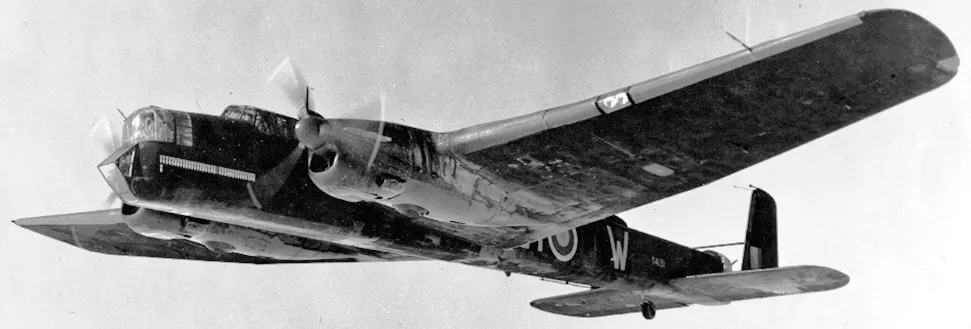
The Armstrong Whitworth AW 38 Whitley was one of three British twin-engined, front line bomber types that were in service with the Royal Air Force (RAF) at the outbreak of the Second World War. Alongside the Vickers Wellington and the Handley Page Hampden, the Whitley was developed during the mid-1930s according to Air Ministry Specification B.3/34, which it was subsequently selected to meet. In 1937, the Whitley formally entered into RAF squadron service; it was the first of the three medium bombers to be introduced. Following the outbreak of war in September 1939, the Whitley participated in the first RAF bombing raid upon German territory and remained an integral part of the early British bomber offensive. In 1942 it was superseded as a bomber by the larger four-engined "heavies" such as the Avro Lancaster. Its front line service included maritime reconnaissance with Coastal Command and the second line roles of glider-tug, trainer and transport aircraft. The type was also procured by British Overseas Airways Corporation as a civilian freighter aircraft. The aircraft was named after Whitley, a suburb of Coventry, home of one of Armstrong Whitworth's plants.
John Lloyd, the Chief Designer of Armstrong Whitworth Aircraft, selected the Armstrong Siddeley Tiger IX radial engine to power the Whitley, which was capable of generating 795 hp (593 kW). One of the more innovative features of the Whitley's design was the adoption of a three-bladed two-position variable-pitch propeller built by de Havilland; the Whitley was the first aircraft to fly with such an arrangement. Lloyd was unfamiliar with the use of flaps on a large heavy monoplane, they were initially omitted from the design. To compensate, the mid-set wings were set at a high angle of incidence (8.5°) to confer good take-off and landing performance. Although flaps were included late in the design stage, the wing remained unaltered; as a result, the Whitley flew with a pronounced nose-down attitude when at cruising speed, resulting in considerable drag. The Whitley holds the distinction of having been the first RAF aircraft with a semi-monocoque fuselage, which was built using a slab-sided structure to ease production. This replaced the tubular construction method traditionally employed by Armstrong Whitworth, who instead constructed the airframe from light-alloy rolled sections, pressings and corrugated sheets.
The Whitley had a crew of five: a pilot, co-pilot/navigator, a bomb aimer, a wireless operator and a rear gunner. The pilot and second pilot/navigator sat side by side in the cockpit, with the wireless operator further back. The navigator, his seat mounted on rails and able to pivot, slid backwards and rotated to the left to use the chart table behind him after takeoff. The bomb aimer position was in the nose with a gun turret located directly above. The fuselage aft of the wireless operator was divided horizontally by the bomb bay; behind the bomb bay was the main entrance and aft of that the rear turret. The offensive armaments were stowed in two bomb bays housed within the fuselage, along with a further 14 smaller cells in the wing. Other sources state there were 16 "cells" total: two groups of 2 in the fuselage, and four groups of 3 in the wings, plus two smaller cells for parachute flares in the rear fuselage. Bomb racks capable of holding larger bombs were installed on the Whitley Mk III variant. Wikipedia
 Wikipedia Armstrong Whitworth Whitley
 YouTube Armstrong Whitworth Whitley
Whitley Mk. V Z9158
Unit Desciption
138 (SD) Sqn For Freedom ()
Whitley Z9158 Mk. V - SOE - 1942-04-21 to 1942-04-21
War Diary Unavailable
6 Group Unavailable
138 (Special Duties) Squadron (For Freedom) RAF Tempsford. Whitley Mk V aircraft Z 9158, on returning from a successful SOE Operation to drop leaflets over Saint Etienne, France, encountered weather with poor visibility and was diverted to different landing sites twice, only to fly into the ground at the Porton Down bombing range, Wiltshire, England. Only one crew member survived the crash
Pilot Officer Ian Anderson Miller (RCAF), Flight Sergeant Walter John Edward Lines (RCAF), Sergeant Sydney William Frances Leigh (RAFVR), and Sergeant Raymond Fred Shaddick (RAFVR) were all killed in action
The sole survivor from this crew was Rear Air Gunner Sergeant Kenneth Hubbard (RAFVR), who was unharmed but sadly, would himself be killed in action 1943-05-14 on another 138 Squadron SOE Operation over France
Royal Air Force Serial and Image Database
