443 Hornet Squadron (Our Sting Is Death). Flying Officer Horrell took off from Antwerp with another pilot, Flying Officer L.P. Piche, in Auster aircraft NJ 669. They were enroute to airfield B70 to pick up a Spitfire aircraft. After checking in at B70 they were never heard from again. A German was captured later and was wearing one of the missing pilot's identification.
Horrell, Arthur James Herbert (Flying Officer)
Killed in Action 1944-October-11


Birth Date: 1920-April-04
Born:
Parents: Herbert John & Anna Horrel
Spouse: Shirley Edith Horrell, of Windsor, Ontario.
Home: Windsor, Ontario (parents)
Enlistment:
Enlistment Date: unkown date
Service
RCAF
Unit
443 Sqn- Squadron
Our Sting is Death
Base
Rank
Flying Officer
Position
Pilot
Service Numbers
J/21413
 Canadian Virtual War Memorial
 Library and Archives Canada Service Files (may not exist)


Auster serial: NJ669
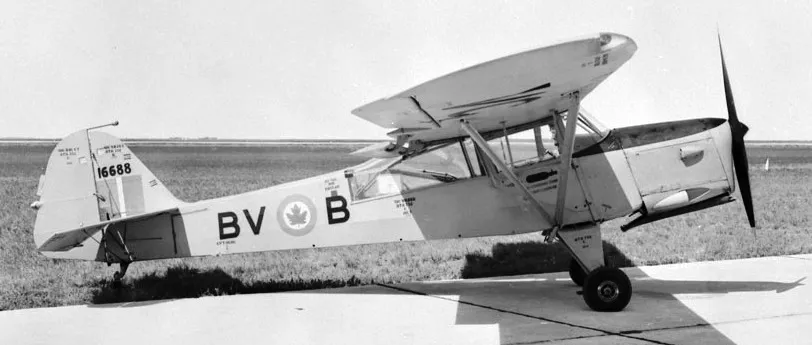
(Library and Archives Canada Photo, MIKAN No. 3617348)
Auster T7, RCAF (Serial No. 16688), BV-B, No. 444 (Air Observation Post) Squadron, 5 Aug 1952. On 1 Oct 1947, No. 444 (Air Observation Post) Squadron was formed at the Canadian Joint Air Training Centre (CJATC) at Rivers, Manitoba, flying de Havilland Chipmunk and Auster AOP Mk. VI aircraft. These aircraft were used to train army pilots in ranging and directing artillery fire. The squadron was disbanded on 1 Apr 1949.
Auster T7, RCAF (Serial No. 16688), BV-B, No. 444 (Air Observation Post) Squadron, 5 Aug 1952. On 1 Oct 1947, No. 444 (Air Observation Post) Squadron was formed at the Canadian Joint Air Training Centre (CJATC) at Rivers, Manitoba, flying de Havilland Chipmunk and Auster AOP Mk. VI aircraft. These aircraft were used to train army pilots in ranging and directing artillery fire. The squadron was disbanded on 1 Apr 1949.
Taylorcraft Aeroplanes (England) Limited began in 1938 at the Britannia Works, Thurmaston near Leicester, England making light observation aircraft (designed by the Taylorcraft Aircraft Corporation of America). 1,604 high-wing Taylorcraft Auster monoplanes were built during World War II for the armed forces of the UK and Canada, primarily for the role of Air Observation Post (AOP).
During the war the head office and drawing office were at a big old house on the outskirts of Thurmaston called "The Woodlands". The fuselages and wings were manufactured at Syston under the works manager by the name of Sharp. Sheet metalwork was done at the old 'en tout cas' works at Thurmaston. Final assembly, fitting out and testing took place at Rearsby aerodrome. The name changed to Auster (after the Roman name for the south wind) on 7 March 1946, when production shifted to Rearsby aerodrome, all in Leicestershire. All designs were evolved from the early Taylorcraft with a sprung skid or tailwheel beneath the fin (except for a low-wing aircraft called the "Agricola" designed for aerial farming work; only nine of these were completed). When the company was merged into Beagle Aircraft in June, 1961, the high-wing design was developed still further as the Terrier and, with a nosewheel, the Airedale.
The various Auster models were extensively used in the UK and British colonies after World War II for a variety of activities such as AOP, mail delivery, VIP transport, private owner flights and joy rides at seaside airports and town carnivals.
The Auster name was dropped in 1962 after Beagle Aircraft was created. https://en.wikipedia.org/wiki/Auster
 Harold A Skaarup Web Pages
Unit Desciption
443 Sqn Our Sting is Death ("Hornet")
History of the Squadron before and during World War II (Aircraft: Spitfires IXB, XIV, XIVE.)

No 443 (F) Squadron was formed in Dartmouth, Nova Scotia  as No. 127 (F) Squadron RCAF on January 2, 1942. It was the sixth of six home squadrons transferred overseas without its aircraft, and was re-designated No. 443 (F) Squadron RCAF at Digby, Lincolnshire, UK on February 8 1944. It flew Spitfire aircraft in offensive and defensive operations in the preparation for D-Day, and 443 Squadron, along with its sister squadrons 441 and 442, commenced flying operations with 144 (F) Wing RCAF, W/C Johnnie Johnson commanding, of the 2nd Tactical Air Force just prior to the Normandy Invasion. 144 (F) Wing RCAF was the first Allied air wing to operate from French soil. These operations continued until August 1944. The Squadron then hop-scotched across France, Belgium, and Holland with 126 and 127 (F) Wings RCAF until "VE" Day. They continued to serve with the British Occupation Forces on the cessation of hostilities in Europe, the squadron being assigned to the British Air Forces of Occupation (Germany). The squadron was disbanded at Utersen, Germany on March 21, 1946.
In the course of operations, the squadron flew 5850 sorties for the loss of 20 pilots, of whom 1 was killed, 8 presumed dead and 6 POWs. They accounted for 42 enemy aircraft confirmed destroyed, 2 probables and 29 damaged. In ground attacks they were credited with 1077 motor vehicles, 25 locomotives among other vehicles. The squadron had 1 ace: Squadron Leader H.W. McLeod, DSO, DFC and Bar. The squadron amassed 1 DSO, 6 DFCs. Battle Honours were: Fortress Europe 1944, France and Germany 1944-45, Normandy 1944, Arnhem, Rhine. Wikipedia, Kostenuk and Griffin
Maps for Movements of 443 Squadron 1944-46

MAP 1: 443 Squadron Movements 1944-46 (right-click on image to display enlarged in new tab)
|

MAP 2: 443 Squadron Movements in Europe 1944-46
|
443 Squadron History Summary 1944-46

443 Squadron History Summary 1944-46 Page 2

History of the Squadron Post-WWII (Aircraft: Mustang IV, Sabre 5, Expeditor, Otter, Sea King)
On 1 September 1951, the squadron was re-formed at Sea Island, Vancouver, as a Day Fighter Squadron in the RCAF Auxiliary, first flying P-51 Mustangs and eventually F-86 Sabres. In 1958, with the RCAF Auxiliary assuming the roles of Civil Defence, Search and Rescue and Light Transport, 443 (Aux) Squadron was re-equipped with the C-45 Expeditor and later the DHC-3 Otter and performed these roles until its second disbandment in March of 1964.
A decade later, in Shearwater, Nova Scotia , the Royal Canadian Navy’s only ship-borne helicopter squadron HS 50 (HS is the NATO designation for a Helicopter Anti-Submarine Squadron) was successfully meeting the needs of the Navy. However, to better administer HS 50 Squadron, it was split into HS 423 and HS 443 in September of 1974. Each squadron was tasked with continuing to provide the Commander of Maritime Command with operational Sea King Helicopter Detachments.
In response to the ever-growing need for ship-borne helicopter assets in the Pacific, HS 443 Squadron was transferred to Victoria International Airport at Pat Bay, British Columbia , in July of 1989 where it now provides the Commander of Maritime Forces Pacific with Helicopter Air Detachments. Early in 1995, HS 443 was re-designated as 443 Maritime Helicopter (MH) Squadron to better fit the ever-changing geopolitical situations and the increasingly diverse roles of maritime helicopters and the ships they support. The squadron now flies CH-145 Cyclone helicopters.