Source: Harold A Skaarup Web Page
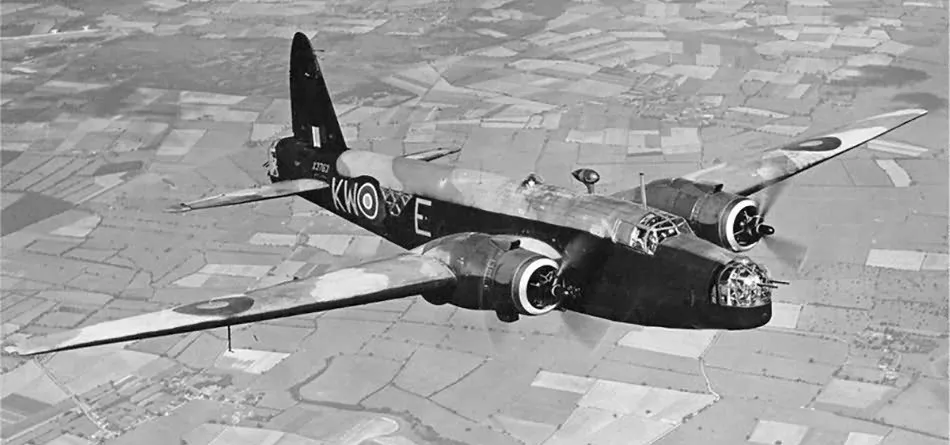
Vickers Wellington B. Mk. III (Serial No. X3763), coded KW-E, No. 425 'Alouette' (B) Squadron, RCAF, late summer of 1942
The Vickers Wellington was a British twin-engined, long-range medium bomber. It was designed during the mid-1930s at Brooklands in Weybridge, Surrey. Led by Vickers-Armstrongs' chief designer Rex Pierson, a key feature of the aircraft is its geodetic airframe fuselage structure, which was principally designed by Barnes Wallis. Development had been started in response to Air Ministry Specification B.9/32, issued in the middle of 1932, for a bomber for the Royal Air Force. This specification called for a twin-engined day bomber capable of delivering higher performance than any previous design.
The Wellington was used as a night bomber in the early years of the Second World War, performing as one of the principal bombers used by Bomber Command. During 1943, it started to be superseded as a bomber by the larger four-engined "heavies" such as the Avro Lancaster. The Wellington continued to serve throughout the war in other duties, particularly as an anti-submarine aircraft.
It holds the distinction of having been the only British bomber that was produced for the duration of the war, and of having been produced in a greater quantity than any other British-built bomber. The Wellington remained as first-line equipment when the war ended, although it had been increasingly relegated to secondary roles. The Wellington was one of two bombers named after Arthur Wellesley, 1st Duke of Wellington, the other being the Vickers Wellesley.
In August 1936, an initial order for 180 Wellington Mk I aircraft, powered by a pair of 1,050 hp (780 kW) Bristol Pegasus radial engines, was received by Vickers; it had been placed so rapidly that the order occurred prior to the first meeting intended to decide the details of the production aircraft. In October 1937, another order for a further 100 Wellington Mk Is, produced by the Gloster Aircraft Company, was issued; it was followed by an order for 100 Wellington Mk II aircraft with Rolls-Royce Merlin X V12 engines. Yet another order was placed for 64 Wellingtons produced by Armstrong Whitworth Aircraft. With this flurry of order and production having been assured by the end of 1937, Vickers set about simplifying the manufacturing process of the aircraft and announced a target of building one Wellington per day.
A total of 180 Wellington Mk I aircraft were built; 150 for the RAF and 30 for the Royal New Zealand Air Force (RNZAF) (which were transferred to the RAF on the outbreak of war and used by 75 Squadron). In October 1938, the Mk I entered service with 9 Squadron. The Wellington was initially outnumbered by the Handley Page Hampden (also ordered by the Ministry to B.9/32) and the Armstrong Whitworth Whitley (to B.34/3 for a 'night' bomber) but outlasted both rival aircraft in service. The Wellington went on to be built in 16 separate variants, in addition to two training conversions after the war. The number of Wellingtons built totalled 11,462 of all versions, a greater quantity produced than any other British bomber. On 13 October 1945, the last Wellington to be produced rolled out.
Wikipedia
 Wikipedia Vickers Wellington
 RCAF - Vickers Wellington
 YouTube Vickers Wellington documentary
Harold A Skaarup Web Page
101 (B) Sqn Mens Agitat Molem ()
No. 101 Squadron RAF was originally formed within the RFC as a bomber unit in July 1917. It was disbanded in December 1919, then re-formed at Bircham Newton, Norfolk, in 1928, being the only operational squadron to fly the Boulton Paul Sidestrand and Overstrand aircraft. These were the first RAF bombers to have enclosed and power-operated turrets. When WWII broke out, the squadron was based at West Raynham, Norfolk, having now equipped with Bristol Blenheim aircraft. It was a reserve squadron until its first operation against Germany in July, 1940, and it later spent the greater part of its attacks on the barges in the channel and North Sea ports, which had been gathered for operation SEALION, the projected German invasion of Britain. In April 1941, a flight of the squadron's Blenheims was detached to Manston in Fighter Command's No. 11 Group, and from there it attacked enemy shipping during daylight, in an operation known as Channel Stop. In June, 1940 the squadron moved to Oakington, Cambridgeshire, where it remained until February 1942, when it moved to Bourne, Cambridgeshire.
During May and June 1941, the squadron converted to Vickers Wellingtons and flew with Bomber Command. It participated in all three 1000-bomber raids to Cologne, Essen and Bremen in 1942. In August 1942 the squadron moved to Stradishall, Suffolk, and in September to Holme-on-Spalding Moor, Yorkshire. Later in the year the squadron converted to Avro Lancaster aircraft, and continued the Bomber Command assault on Germany and Italy. In June 1943 the squadron moved again, to Ludford Magna, Lincolnshire. It participated in the raid on the rocket development centre at Peenemunde, and was fortunate enough to evade the enemy night fighters on that occasion.
In late 1943 the squadron was given a new function within Bomber Command, that of Radio Counter Measures, to attempt to cut the radio communications between the German night fighter controllers and the fighter pilots. Each aircraft was equipped with the radio device known as A.B.C. or Airborne Cigar. A special German-speaking radio operator in the aircraft used the ABC equipment to scan the appropriate frequencies, and when the German signals were detected, jamming was started by transmitting a warbling note. The Lancaster aircraft carrying ABC were easily distinguished because they carried three large aerials, two dorsally and one under the nose. In addition to the ABC equipment, the Lancasters carried a full bomb load. Unfortunately, because they transmitted strong signals, it was possible for night fighters to seek them out, and squadron losses were relatively high as a consequence; only three other Lancaster squadrons had higher losses. On the night of 5/6 June 1944, the squadron put up 21 ABC Lancasters to jam enemy wireless communications to prevent night fighters from being directed to the airborne invasion forces.
After its last operational mission, to Berchtesgaden in late April 1945, the squadron participated in operation MANNA, dropping food to help the staving populace of the Netherlands. It also was part of operation DODGE, bringing back British troops from Italy. The squadron moved to Binbrook, Lincolnshire in October 1945. It was successively equipped with Avro Lincoln, English Electric Canberra and Avro Vulcan aircraft.
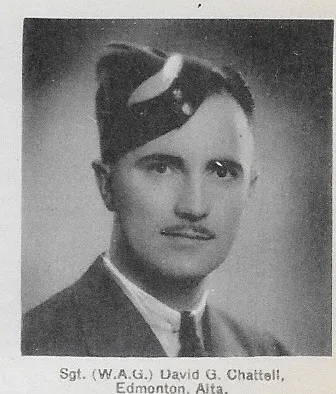

 Edmonton, Alberta (parents)
 Canadian Virtual War Memorial
 Library and Archives Canada Service Files (may not exist)