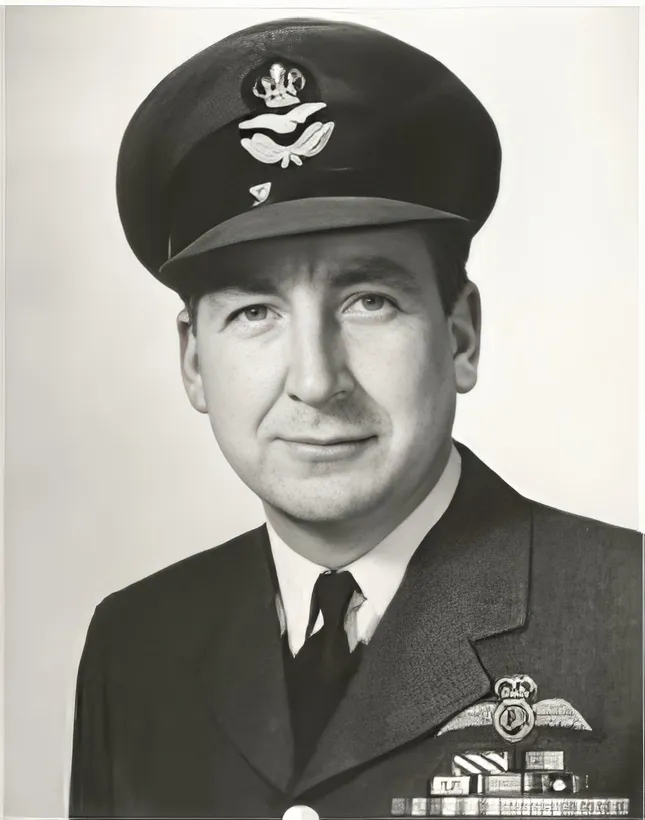
MacKenzie, Andrew Robert (Squadron Leader)
PoW China 1952-December-05

Birth Date: 1920-August-10
Born: Montreal, Montreal Region, Quebec, Canada
Parents: Son of Robert Burns MacKenzie and Ida Estell Ranson
Spouse: Husband of Joyce (nee Skene) MacKenzie
Home:
Enlistment: Montreal, Quebec
Enlistment Date: 1940-April-03
Service
RCAF
Unit
139 Sqn/51 Wing (F) Sqn- Squadron (USAF)
Base
Suwon, South Korea
Rank
Squadron Leader
Position
Pilot
Service Numbers
J/10976
 Beechwood Cemetery
 Finadagrave.com
Mission
Sabre 512906
Combat 1952-December-05 to 1952-December-05
139 Sqn/51 Wing (F) Sqn (USAF) Suwon, South Korea
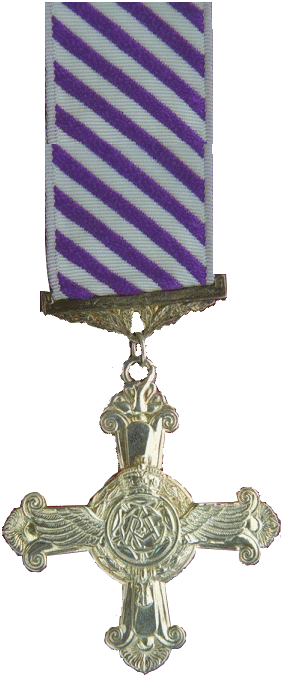
Squadron Leader Andrew Robert MacKenzie DFC (RCAF) joined the RCAF in 1940 and went on to serve with #421 and #403 Squadrons in Europe. He was an ace pilot with eight confirmed enemy aircraft shot down. He was the victim of a "friendly fire" incident 1944-06-28 when he was struck by allied flak but he and his wingman managed to return to base safely
MacKenzie left the service after World War 2 but re-enlisted in 1946 and was Commanding Officer of 441 Squadron (RCAF) when he was sent to fly North American F-86 Sabre jets with a USAF Squadron during the Korean War. Here, he was again the victim of "friendly fire" when he was shot down near the Yalu River and captured by Chinese troops. He was the only RCAF officer to become a Prisoner of War in Korea and was held, largely in solitary confinement, until released 1954-12-05, two years to the day from when he was captured and long after hostilities had ceased 1953-07-27. MacKenzie returned home, stayed in the RCAF and retired in 1967
Aces High, A Tribute to the Most Notable Fighter Pilots of the British and Commonwealth Forces in WWII by Christopher Shores and Clive Williams, page 415
Combat Over Korea by Philip Chinnery, pages 178,188
Fighter Squadron 441 Squadron from Hurricanes to Hornets by Larry Milberry, pages 72-76,79-82,84,87,91-93,117,127,135,227,269,295 Aviation Safety Network
Sabre serial: 512906
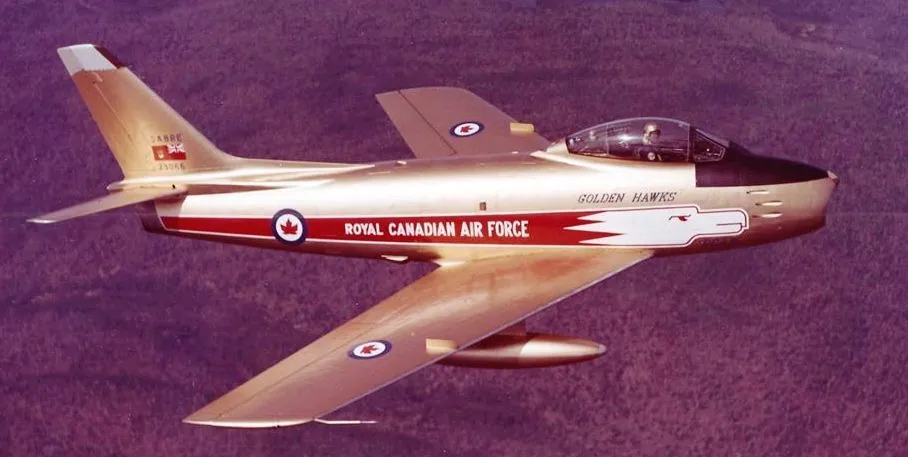
Canadair CL-13 Sabre Mk. 5 (Serial No. 23066), Golden Hawks
The North American F-86 Sabre, sometimes called the Sabrejet, is a transonic jet fighter aircraft. Produced by North American Aviation, the Sabre is best known as the United States' first swept-wing fighter that could counter the swept-wing Soviet MiG-15 in high-speed dogfights in the skies of the Korean War (1950"“1953), fighting some of the earliest jet-to-jet battles in history. Considered one of the best and most important fighter aircraft in that war, the F-86 is also rated highly in comparison with fighters of other eras. Although it was developed in the late 1940s and was outdated by the end of the 1950s, the Sabre proved versatile and adaptable and continued as a front-line fighter in numerous air forces.
Its success led to an extended production run of more than 7,800 aircraft between 1949 and 1956, in the United States, Japan, and Italy. In addition, 738 carrier-modified versions were purchased by the US Navy as FJ-2s and -3s. Variants were built in Canada and Australia. The Canadair Sabre added another 1,815 aircraft and the significantly redesigned CAC Sabre (sometimes known as the Avon Sabre or CAC CA-27), had a production run of 112. The Sabre is by far the most-produced Western jet fighter, with a total production of all variants at 9,860 units.
The fighter-bomber version (F-86H) could carry up to 2,000 lb (907 kg) of bombs, including an external fuel-type tank that could carry napalm. Unguided 2.75-inch (70-millimeter) rockets were used on some fighters on training missions, but 5-inch (127 mm) rockets were later carried on combat operations. The F-86 could also be fitted with a pair of external jettisonable jet fuel tanks (four on the F-86F beginning in 1953) that extended the range of the aircraft. Both the interceptor and fighter-bomber versions carried six 0.50 in (12.7 mm) M3 Browning machine guns with electrically-boosted feed in the nose (later versions of the F-86H carried four 20 mm (0.79 in) cannon instead of machine guns). Firing at a rate of 1,200 rounds per minute, the 0.50-inch guns were harmonized to converge at 1,000 ft (300 m) in front of the aircraft, using armor-piercing (AP) and armor-piercing incendiary (API) rounds, with one armor-piercing incendiary tracer (APIT) for every five AP or API rounds. The API rounds used during the Korean War contained magnesium, which were designed to ignite upon impact, but burned poorly above 35,000 ft (11,000 m) as oxygen levels were insufficient to sustain combustion at that height. Initial planes were fitted with the Mark 18 manual-ranging computing gun sight. The last 24 F-86A-5-Nas and F-86Es were equipped with the A-1CM gunsight-AN/APG-30 radar, which used radar to automatically compute a target's range, which later proved to be advantageous against MiG opponents over Korea. Wikipedia
 Wikipedia North American F-86 Sabre
 YouTube F-86 Sabre Aerobatics - No Music! - Airshow London 2018
 F-86 (Canadair Sabre) Part Manual Volume I
F-86 (Canadair Sabre) Part Manual Volume II
F-86 (Canadair Sabre) Maintenance and Diagrams (Partial Document)
Previous Events
1944-June-28 Flight Lieutenant Survived
Spitfire LF Mk IX |
403 F Sqn RCAF |
403 Squadron (Stalk and Strike), B2 Bazenville, France. Flight Lieutenant Andrew Robert MacKenzie, (RCAF) flying Spitfire IX MK693 and his wingman returned to base early after Mackenzie's aircraft was struck by friendly flak. Both airmen were safe
MacKenzie was an ace pilot in World War 2 with eight confirmed enemy aircraft shot down. He would later go on the fly with a USAF squadron in Korea where he would again be shot down by friendly fire and became the only RCAF officer to be a POW of China in the Korean War Aces High, A Tribute to the Most Notable Fighter Pilots of the British and Commonwealth Forces in WWII by Christopher Shores and Clive Williams, page 415 |
|
 403 Squadron Operations Record Book excerpt
Spitfire LF Mk IX MK693
Sweep 1944-June-28 to 1944-June-28
403 (F) Sqn (RCAF) B2, Bazenville, France
#403 Squadron RCAF (Stalk and Strike), B2, Bazenville, France. Then Flight Lieutenant MacKenzie, was on a fighter sweep flying Spitfire IX aircraft MK 693, 1944-06-28, when he was the victim of a "friendly fire" incident, struck by allied flak. Despite the damage to his Spitfire, both MacKenzie and his wingman managed to return to base safely
Squadron Leader Andrew Robert MacKenzie DFC (RCAF) joined the RCAF in 1940 and went on to serve with #421 and #403 Squadrons in Europe. He was an ace pilot with eight confirmed enemy aircraft shot down
Aces High, A Tribute to the Most Notable Fighter Pilots of the British and Commonwealth Forces in WWII by Christopher Shores and Clive Williams, page 415
Sabre 512906 - Combat - 1952-12-05 to 1952-12-05
War Diary Unavailable
6 Group Unavailable
Squadron Leader Andrew Robert MacKenzie DFC (RCAF) joined the RCAF in 1940 and went on to serve with #421 and #403 Squadrons in Europe. He was an ace pilot with eight confirmed enemy aircraft shot down. He was the victim of a "friendly fire" incident 1944-06-28 when he was struck by allied flak but he and his wingman managed to return to base safely
MacKenzie left the service after World War 2 but re-enlisted in 1946 and was Commanding Officer of 441 Squadron (RCAF) when he was sent to fly North American F-86 Sabre jets with a USAF Squadron during the Korean War. Here, he was again the victim of "friendly fire" when he was shot down near the Yalu River and captured by Chinese troops. He was the only RCAF officer to become a Prisoner of War in Korea and was held, largely in solitary confinement, until released 1954-12-05, two years to the day from when he was captured and long after hostilities had ceased 1953-07-27. MacKenzie returned home, stayed in the RCAF and retired in 1967
Aces High, A Tribute to the Most Notable Fighter Pilots of the British and Commonwealth Forces in WWII by Christopher Shores and Clive Williams, page 415
Combat Over Korea by Philip Chinnery, pages 178,188
Fighter Squadron 441 Squadron from Hurricanes to Hornets by Larry Milberry, pages 72-76,79-82,84,87,91-93,117,127,135,227,269,295