 Blackthorn, Oxford, England
1917-01-01: to be 2nd-Lieutenant seconded to the RFC.
1917-01-31: posted to 27Sqn, France.
1917-04-06: Kirby was OK in Martinsyde 'Elephant', A-3994; after a forced Landing at Hirsin on return from a bombing raid.
1919-02-03: Aeroplane Officer
Kirby, Eric William (Lieutenant)
Survived 1917-April-06


Birth Date: 1890-December-27
Born: Blackthorn, Oxford, England
Parents: William Croxton Kirby & Eleanor Rogers
Spouse: unmarried
Home: Blackthorn, Oxford, England
Enlistment:
Enlistment Date: unkown date
Service
RAF
Unit
27 (FB) Sqn- Squadron (RFC)
Base
France
Rank
Lieutenant
Position
pilot
Service Numbers
Elephant serial: A3994
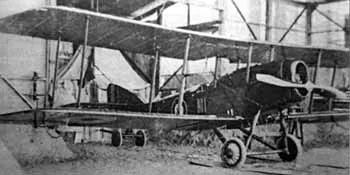
Martinsyde Elephant between 1916 and 1917
Wikipedia Aerodrome.com
The Martinsyde G.100 "Elephant" and the G.102 were British fighter bomber aircraft of the First World War built by Martinsyde. The type gained the name "Elephant" from its relatively large size and lack of manoeuvrability. The G.102 differed from the G.100 only in having a more powerful engine.
An unusually large aircraft by contemporary standards for a single-seater, the Elephant two-bay equal span staggered biplane was designed by A A Fletcher of the Martinsyde Company, a prototype powered by a 120 hp Austro-Daimler engine entering test in the autumn of 1915.
The initial production version, the G.100, was powered by a 120h p six-cylinder Beardmore engine and was armed with a single 0.303 in drum-fed Lewis Gun mounted above the centre section. This was later augmented by a similar weapon bracket-mounted to the port fuselage side behind the cockpit.
The G.100 was gradually succeeded by the G.102 with a 160 hp Beardmore engine. Maximum speed of the 160 hp aircraft was 108 mph (174 km/h) at sea level, falling to 100 mph (160 km/h) at 10,000 ft; it had a maximum ceiling of 14,000 ft (4,300 m).
The G.100 was built originally as a long-range, single-seat fighter and escort machine but on the basis of its size and weight was reclassified as a day bomber.
Deliveries to the RFC commenced in mid-1916, a total of 270 being manufactured. The G.100 and G.102 Elephants were used in France and the Middle East, although only No. 27 Squadron, RFC was completely equipped with this type.
While not particularly successful as a fighter owing to its poor agility by comparison to other fighters of the times, the Elephant performed a useful service in long-range bombing, carrying up to a 260 lb (120 kg) bomb load. It successfully performed this role from the summer of 1916 through to late 1917. It was also used for long-range photo reconnaissance, where stability and endurance were required (the type was capable of a five-and-a-half-hour flight). Wikipedia
 Martynside Elephant
Elephant G.102 A3994
airhistory.org.uk/rfc
Type: Martinsyde G.102 Elephant Built by: Martinsyde /Brooklands Contract: 87/A/487 (dated 11-09-1916) Taken on charge: 03-1917 Struck off charge: 14-05-1917 History: At Brooklands allot EF 16.03.17