- Navigator, 419 (Moose) Sqn
- returning from raid on Essen, night of 1942-06-16/17; starboard engine failed (icing) near Limburg, Belgium; hit by flak over Antwerp
- crew bailed out; 19-yr-old pilot F/S Charles "Emile" LeBlanc crash-landed the aircraft
Watson, John H ()
Evader 1942-June-17

Birth Date: unkown date
Born:
Parents:
Spouse:
Home:
Enlistment:
Enlistment Date: unkown date
Service
RCAF
Unit
Base
Rank
Position
Service Numbers
R/116701
Crew or Other Personnel
Wellington X3359


Mission
Wellington Mk. III X3359
Bombing Essen Germany 1942-June-16 to 1942-June-17
419 (B) Sqn (RCAF) RAF Mildenhall
106 aircraft - 40 Wellingtons, 39 Halifaxes, 15 Lancasters, 12 Stirlings. 8 aircraft 4 Hallifaxes, 3 Wellingtons, 1 Stirling - lost
.Only 16 crews reported that they had identified Essen; 56 bombed alternative targets, 45 of them attacking Bonn. Essen reports only 3 high-explosive and 400 incendiary bombs in the city with one person being wounded
.This raid concluded the present series of 5 raids on Essen in 16 nights. 1607 sorties had been dispatched and 84 aircraft (5.2 per cent) lost. No industrial damage was caused in Essen on any of these raids; a few houses were destroyed and 38 civilians were killed. Bomber Command now temporarily abandoned its campaign against Essen which would not be visited in strength for 3 months. /p>
source: The Bomber Command War Diaries, Martin Middlebrook and Chris Everitt
419 Moose Squadron (Moosa Aswayita) RAF Mildenhall. Wellington III aircraft X 3359 VR-N had the starboard engine fail and the pilot was forced to jettison the bomb load in an attempt to maintain altitude and return to base during an operation to Essen, Germany. The aircraft could not get above 3,000 feet and fell victim to the heavily defended city of Antwerp, Belgium. The pilot, FS CE LeBlanc (RCAF), maintained control of the aircraft long enough for his crew to bail out, he waited too long and went down with the aircraft, killed in action
Two of the crew, Sergeant EA Winkler (RCAF) and Sergeant NW Bradley (RCAF), survived and were taken as Prisoners Of War
The other two crew members Pilot Officer JH Watson (RCAF) and Sergeant Angers MiD (RCAF) survived, evaded capture and were returned safely to England
Wellington serial: X3359
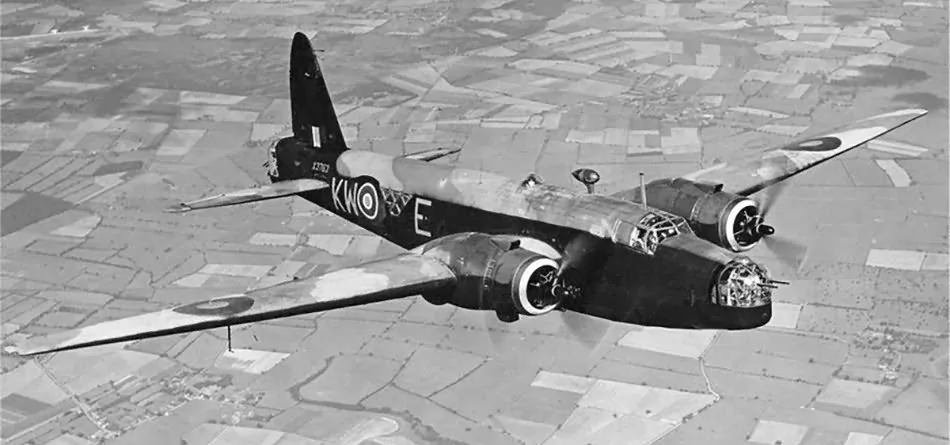
Source: Harold A Skaarup Web Page
Vickers Wellington B. Mk. III (Serial No. X3763), coded KW-E, No. 425 'Alouette' (B) Squadron, RCAF, late summer of 1942
Vickers Wellington B. Mk. III (Serial No. X3763), coded KW-E, No. 425 'Alouette' (B) Squadron, RCAF, late summer of 1942
The Vickers Wellington was a British twin-engined, long-range medium bomber. It was designed during the mid-1930s at Brooklands in Weybridge, Surrey. Led by Vickers-Armstrongs' chief designer Rex Pierson, a key feature of the aircraft is its geodetic airframe fuselage structure, which was principally designed by Barnes Wallis. Development had been started in response to Air Ministry Specification B.9/32, issued in the middle of 1932, for a bomber for the Royal Air Force. This specification called for a twin-engined day bomber capable of delivering higher performance than any previous design.
The Wellington was used as a night bomber in the early years of the Second World War, performing as one of the principal bombers used by Bomber Command. During 1943, it started to be superseded as a bomber by the larger four-engined "heavies" such as the Avro Lancaster. The Wellington continued to serve throughout the war in other duties, particularly as an anti-submarine aircraft.
It holds the distinction of having been the only British bomber that was produced for the duration of the war, and of having been produced in a greater quantity than any other British-built bomber. The Wellington remained as first-line equipment when the war ended, although it had been increasingly relegated to secondary roles. The Wellington was one of two bombers named after Arthur Wellesley, 1st Duke of Wellington, the other being the Vickers Wellesley.
In August 1936, an initial order for 180 Wellington Mk I aircraft, powered by a pair of 1,050 hp (780 kW) Bristol Pegasus radial engines, was received by Vickers; it had been placed so rapidly that the order occurred prior to the first meeting intended to decide the details of the production aircraft. In October 1937, another order for a further 100 Wellington Mk Is, produced by the Gloster Aircraft Company, was issued; it was followed by an order for 100 Wellington Mk II aircraft with Rolls-Royce Merlin X V12 engines. Yet another order was placed for 64 Wellingtons produced by Armstrong Whitworth Aircraft. With this flurry of order and production having been assured by the end of 1937, Vickers set about simplifying the manufacturing process of the aircraft and announced a target of building one Wellington per day.
A total of 180 Wellington Mk I aircraft were built; 150 for the RAF and 30 for the Royal New Zealand Air Force (RNZAF) (which were transferred to the RAF on the outbreak of war and used by 75 Squadron). In October 1938, the Mk I entered service with 9 Squadron. The Wellington was initially outnumbered by the Handley Page Hampden (also ordered by the Ministry to B.9/32) and the Armstrong Whitworth Whitley (to B.34/3 for a 'night' bomber) but outlasted both rival aircraft in service. The Wellington went on to be built in 16 separate variants, in addition to two training conversions after the war. The number of Wellingtons built totalled 11,462 of all versions, a greater quantity produced than any other British bomber. On 13 October 1945, the last Wellington to be produced rolled out. Wikipedia
 Wikipedia Vickers Wellington
 YouTube Vickers Wellington documentary
Wellington Mk. III X3359
VR N
Served with No. 419 (B) Squadron, RCAF from 13 May 1942, coded "VR*N", named "N for Nails". Failed to return from raid on Essen on 16 / 17 June 1942. Airborne at 23:55 on 16 June 1942 from Mildenhall. Experienced engine over heating problems, possibly due to plug fouling, jettisoned bombs and fuel after one engine shut down. Crossed Antwerp at 4,000 feet en route back to UK, coned by searchlights and hit by flak. Crashed near Wuustwezel (Antwerp), 16 km NNE of Antwerp. Pilot Sgt. C.E. LeBlanc killed, 2 evaded, 2 POW.
N
Wellington X3359 Mk. III - Bombing Essen Germany - 1942-06-16 to 1942-06-17
Squadron: 419 (B) Sqn (RCAF)
Start Date: 1942-06-16
Completion Date: 1942-06-17
Mission: Bombing
Operation: unspecified
Target City: Essen Germany
Target Specific:
Base: RAF Mildenhall
Take Off Time: 23:55
Squadron Code: VR-N
Radio Code:
Return Base:
Return Time:
Crash City: Belgium
Crash Specifics: along the Bredabaan, Gooreind, Wuustwezel, Antwerp
Crash Latitude: 0.00000000
Crash Longitude: 0.00000000
Crash Reason: engine
Flak Battery:
Enemy Claim:
Essen
{{webimage,wardiaries.jpg,float:right;width:150px;,Book no longer in print}}106 aircraft- 40 Wellingtons, 39 Halifaxes, 15 Lancasters, 12 Stirlings. 8 aircraft - 4 Halifaxes, 3 Wellingtons, I Stirling - lost. Only 16 crews reported that they had identified Essen; 56 bombed alternative targets, 45 of them attacking Bonn. Essen reports only 3 high-explosive and 400 incendiary bombs in the city with one person being wounded.
This raid concluded the present series of 5 raids on Essen in 16 high nights. 1,607 sorties had been dispatched and 84 aircraft (5'2 per cent) lost. No industrial damage was caused in Essen on any of these raids; a few houses were destroyed and 38 civilians were killed. Bomber Command now temporarily abandoned its campaign against Essen which would not be visited in strength for 3 months.
6 Group Unavailable
106 aircraft - 40 Wellingtons, 39 Halifaxes, 15 Lancasters, 12 Stirlings. 8 aircraft 4 Hallifaxes, 3 Wellingtons, 1 Stirling - lost
.Only 16 crews reported that they had identified Essen; 56 bombed alternative targets, 45 of them attacking Bonn. Essen reports only 3 high-explosive and 400 incendiary bombs in the city with one person being wounded
.This raid concluded the present series of 5 raids on Essen in 16 nights. 1607 sorties had been dispatched and 84 aircraft (5.2 per cent) lost. No industrial damage was caused in Essen on any of these raids; a few houses were destroyed and 38 civilians were killed. Bomber Command now temporarily abandoned its campaign against Essen which would not be visited in strength for 3 months. /p>
source: The Bomber Command War Diaries, Martin Middlebrook and Chris Everitt
419 Moose Squadron (Moosa Aswayita) RAF Mildenhall. Wellington III aircraft X 3359 VR-N had the starboard engine fail and the pilot was forced to jettison the bomb load in an attempt to maintain altitude and return to base during an operation to Essen, Germany. The aircraft could not get above 3,000 feet and fell victim to the heavily defended city of Antwerp, Belgium. The pilot, FS CE LeBlanc (RCAF), maintained control of the aircraft long enough for his crew to bail out, he waited too long and went down with the aircraft, killed in action
Two of the crew, Sergeant EA Winkler (RCAF) and Sergeant NW Bradley (RCAF), survived and were taken as Prisoners Of War
The other two crew members Pilot Officer JH Watson (RCAF) and Sergeant Angers MiD (RCAF) survived, evaded capture and were returned safely to England
 419 Squadron RCAF 1941 to 1945 Crew of Wellington X3359
