1917-07-28: Barnes was seriously injured in JN4, B-1926; when the fin and rudder collapsed in a turn and the aircraft nose-dived to the ground during a trial flight at Warton near Oxford. The person taking the trial flight to see if he liked flying was Lt Ian Cooke, a Canadian, who was killed in the crash.
Barnes, Robert Fulton ()
Survived 1917-July-28


Birth Date: 1891-April-08
Born: Fort Macleod, Willow Creek, Alberta
Parents: Rennie Burford Barnes & Sarah Isabella Martin
Spouse: Sarah Isabella Martin
Home: Victoria, B.C.
Enlistment:
Enlistment Date: unkown date
Service
RFC
Unit
17 (OT) TS- Training Squadron (RFC)
Base
Oxford England
Rank
Position
pilot-instructor
Service Numbers
Home
 Victoria, B.C.
JN serial: B1926
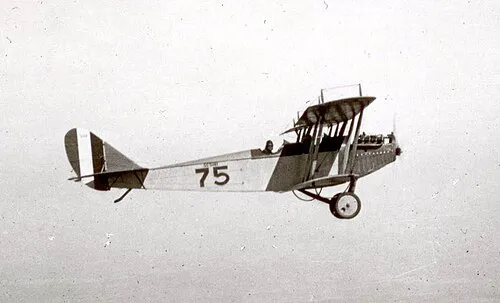
A Curtiss JN-4 (Jenny) on a training flight during World War I
Source George Johnson, Aviation Section, US Army Signal Corps
The Curtiss JN "Jenny" is a series of biplanes built by the Glenn Curtiss Aeroplane Company of Hammondsport, New York, later the Curtiss Aeroplane and Motor Company. Although the Curtiss JN series was originally produced as a training aircraft for the US Army, the "Jenny" (the common nickname derived from "JN") continued after World War I as a civilian aircraft, becoming the "backbone of American postwar [civil] aviation". A version of the plane manufactured in Canada was known as the Curtiss Canuck.
The Curtiss JN-4 is possibly North America's most famous World War I aircraft. It was widely used during World War I to train beginning pilots, with an estimated 95% of all trainees having flown a JN-4. The US version was called "Jenny", a derivation from its official designation. It was a twin-seat (student in front of instructor), dual-control biplane. Its tractor propeller and maneuverability made it ideal for initial pilot training with a 90 hp (67 kW) Curtiss OX-5 V8 engine giving a top speed of 75 mph (121 km/h) and a service ceiling of 6,500 ft (2,000 m). The British used the JN-4 (Canadian), along with the Avro 504, for their primary World War I trainer using the Canadian Aeroplanes Ltd. indigenous variant.[13] Many Royal Flying Corps pilots earned their wings on the JN-4, both in Ontario and later in winter facilities at Camp Taliaferro, Texas.
Although ostensibly a training aircraft, the Jenny was extensively modified while in service to undertake additional roles. Due to its robust but easily adapted structure able to be modified with ski undercarriage, the Canadian Jenny was flown year-round, even in inclement weather. The removable turtle deck behind the cockpits allowed for conversion to stretcher or additional supplies and equipment storage, with the modified JN-4s becoming the first aerial ambulances, carrying out this role both during wartime and in later years. Most of the 6,813 Jennys built were unarmed, although some had machine guns and bomb racks for advanced training. With deployment limited to North American bases, none saw combat service in World War I.
After World War I, thousands were sold on the civilian market, including one to Charles Lindbergh in May 1923, in which he then soloed. Surplus US Army aircraft were sold (some still in their unopened packing crates) for as little as $50, flooding the market. With private and commercial flying in North America unhampered by regulations concerning their use, pilots found the Jenny's stability and slow speed made it ideal for stunt flying and aerobatic displays in the barnstorming era between the world wars, with the nearly identical Standard J-1 aircraft often used alongside it. Some were still flying into the 1930s. Wikipedia
 Curtiss JN
JN JN-4/4A B1926
airhistory.org.uk/rfc
Type: Curtiss JN-4/4a Constructor's number: 29 History: 17RS Croydon; 16TS Beaulieu by 06.17; 50TS Narborough; crashed 28.07.17 (Lt I Cooke)