 Westboro,Ontario
1917-05-09: Anderson was OK in Spad scout B-1526, when he ran into a Nissan hut on landing from an offensive patrol.
He retired from the RCAF with the end of WWII
Anderson, Norman Russell (OC EAC, RCAF)
Survived 1917-May-09


Birth Date: 1893-April-29
Born: Walkerton, Ontario
Parents: Alexander Anderson & Ellen Nellie Russell
Spouse: Mary Letitia Dorothea Grasett
Home: Westboro,Ontario
Enlistment: Ingersoll, Ontario, 168th Oxford County Btn., CEF
Enlistment Date: 1916
Service
RAF
Unit
19 (F) Sqn- Squadron (RFC)
Base
France
Rank
OC EAC, RCAF
Position
pilot
Service Numbers
 Finadagrave.com
S.VII serial: B1526
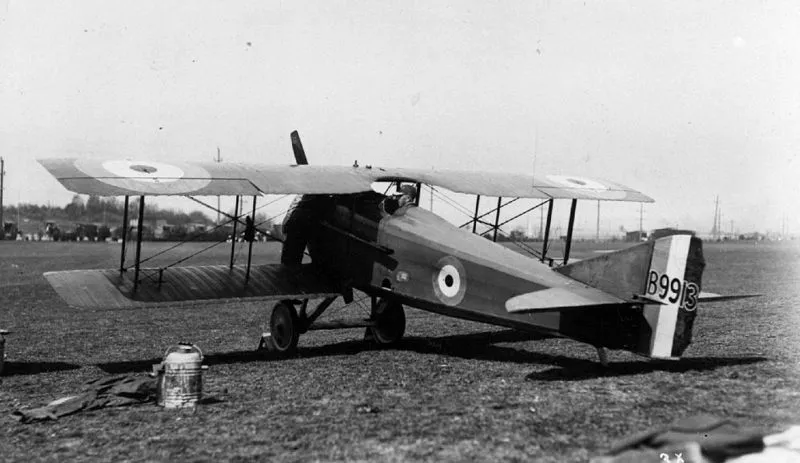
British-built SPAD S.VII of the RFC 30 July 2012
The SPAD S.VII C.1 was the first in a series of single-seat biplane fighter aircraft produced by Société Pour L'Aviation et ses Dérivés (SPAD) during the First World War. Like its successors, the S.VII was renowned as a sturdy and rugged aircraft with good diving characteristics. It was also a stable gun platform, although pilots used to the more maneuverable Nieuport fighters found it heavy on the controls.
Construction was of a single-bay biplane wing with additional struts mounted mid-bay at the point of junction of the flying and landing wires. This design simplified rigging and reduced drag. The fuselage was of the standard construction for the time, consisting of a wooden frame covered with fabric, while the forward part was covered with metal sheeting. A .303 (7.7mm) Vickers machine gun was installed above the engine, synchronized to fire through the propeller arc. The prototype was also fitted with a large spinner, to be abandoned later.
Early production aircraft suffered from numerous defects which took time to resolve and limited deliveries. While a few SPADs arrived at frontline units as early as August 1916, large numbers only began to appear in the first months of 1917.
With early problems solved and production shared between several manufacturers, the SPAD VII was finally available in large numbers at the front in early 1917. By mid-1917, some 500 were in front-line service, having largely replaced the Nieuport. It gained a reputation for being stronger than its predecessors. Its principal shortcoming was its one machine gun armament at a time when the opposing Albatros D.III fighters were equipped with two. The SPAD VII was gradually replaced by the improved SPAD XIII in frontline units, but remained in use as a trainer aircraft with Aviation Militaire throughout the war, and it remained as the standard pilot certification test aircraft until 1928. Wikipedia
 SPAD S.Vll
S.VII VII B1526
airhistory.org.uk/rfc
Type: SPAD VII Constructor's number: S1128 Engine: 140HS Taken on charge: 03-04-1917 Struck off charge: 10-05-1917