 Mount Union Penna, USA
Agnew went missing in C-2691, RE-8; Missing on Counter Attack patrol. Lt Agnew POW/2Lt Stephen Coates (British) POW. Both were repatriated 1918-11-23.
Agnew, Albert Byington (Lieutenant)
Prisoner of War 1918-November-10


Birth Date: 1892-July-11
Born: Mount Union Penna, USA
Parents: Mr. & Mrs. J. B. Agnew
Spouse: Claudia Esther Snyder
Home: Mount Union Penna, USA
Enlistment:
Enlistment Date: 1917
Service
RAF
Unit
12 (BR) Sqn- Squadron (RAF)
Leads the Field
Base
France
Rank
Lieutenant
Position
pilot
Service Numbers
152133
R.E.8 serial: C2691
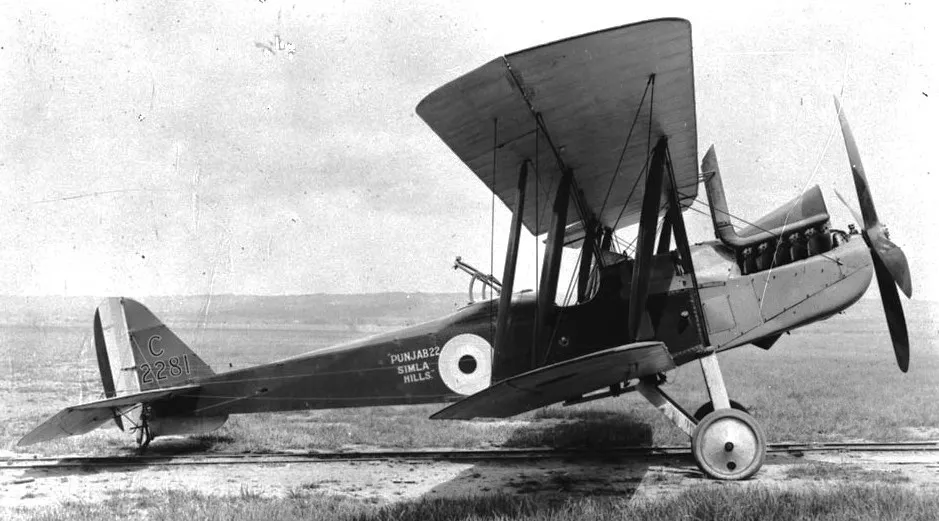
Source: Harold A Skaarup Web Page (Library and Archives Canada Photo, MIKAN No. 3390896)
Royal Aircraft Factory (Reconnaissance Experimental) R.E.8 (Serial No. C2281), "Punjab 22 Simla Hills", built by Daimler Company Ltd. Coventry, ca 1918
Royal Aircraft Factory (Reconnaissance Experimental) R.E.8 (Serial No. C2281), "Punjab 22 Simla Hills", built by Daimler Company Ltd. Coventry, ca 1918
The Royal Aircraft Factory R.E.8 was a British two-seat biplane reconnaissance and bomber aircraft of the First World War designed and produced at the Royal Aircraft Factory. It was also built under contract by Austin Motors, Daimler, Standard Motors, Siddeley-Deasy and the Coventry Ordnance Works.
Intended as a replacement for the vulnerable B.E.2, the R.E.8 was widely regarded as more difficult to fly and gained a reputation in the Royal Flying Corps for being "unsafe" that was never entirely dispelled. Although eventually it gave reasonably satisfactory service, it was never an outstanding combat aircraft. Nonetheless, it remained the standard British reconnaissance and artillery observation aircraft from mid-1917 to the end of the war, serving alongside the rather more popular Armstrong Whitworth F.K.8.
More than 4,000 R.E.8s were eventually produced; these aircraft saw service in a range of different theatres, including Italy, Russia, Palestine and Mesopotamia, as well as the Western Front. The R.E.8 was rapidly withdrawn from service after the end of the conflict, by which time it was regarded as totally obsolete. Wikipedia
 Wikipedia Royal Aircraft Factory R.E.8
 Harold A Skaarup Web Page
R.E.8 R.E.8 C2691
airhistory.org.uk/rfc
Type: RE8 Built by: Daimler Contract: 87/A/7399 (dated 21-08-1917) Taken on charge: 07-1918
Unit Desciption
12 (BR) Sqn Leads the Field ()
No 12 Squadron RFC was formed at Netheravon on 4th February 1915. From 1916 to 1918 it was employed in a ground support role. It was part of the Army of Occupation at the end of WWI and was then disbanded at Bickendorf, Germany in July 1922. It was re-formed at Northolt, Middlesex in April 1923 as a bomber squadron flying DH 9A's. In 1924 it received Fairey Fawn aircraft, and later these were replaced with Fairey Foxes. From October 1935 until August 1936 it was based at Aden to reinforce RAF Middle East Command. On returning to England it re-equipped with Hawker Hinds and was based at Andover, Hampshire, until May 1939, by which time it was equipped with Fairey Battles.
From May 1939 until the outbreak of WWII the squadron was based at Bicester, Oxfordshire, the moved to France in September of 1939. It was based at a number of airfields in France, successively Berry-au-Bac, Amifontaine, Echemines and Souge. It returned to England in July 1940. During its stay in France, the squadron formed part of the Advanced Air Striking Force. During the German invasion of Belgium and France in May 1940, the squadron attacked the German invading forces, principally by trying to destroy bridges which could be used by the invading forces. On one such attack, F/O D.E. Garland (pilot) and Sgt T. Gray (observer) attacked a bridge over the Albert Canal. They were shot down and perished, but their attack appeared to have been successful and they were both awarded posthumous Victoria Crosses, the first VCs awarded to the RAF in WWII. It was clear from the heavy losses of the Fairey Battle squadrons that the aircraft was hopelessly outclassed as an effective weapon of war.
After withdrawing from France, the squadron spent a month at Finningley, Yorkshire, before moving to Binbrook, Lincolnshire in early July 1940. It was used to attack shipping in the German-held Channel ports, where shipping was being collected for the invasion of Britain, operation SEALION. During the period August-September 1940 it operated from Thorney Island, Hampshire and Eastchurch, Kent: it returned to Binbrook in September 1940. In November, the squadron began to re-equip with Vickers Wellingtons. It now flew as part of No. 1 Group of Bomber Command in its strategic bombing of Germany. It remained at Binbrook from September 1940 to September 1942, with a short diversion to Thruxton in June-July 1942. In September 1942 the squadron settled into its final home of WWI, Wickenby in Lincolnshire, where it remained until September 1945, when it returned to Binbrook.
The squadron later continued to fly bomber aircraft, namely Avro Lincoln and English Electric Canberra before being disbanded in July 1961. It was later reinstated as part of the V-bomber force, flying Avro Vulcans.