 Toronto, Ontario
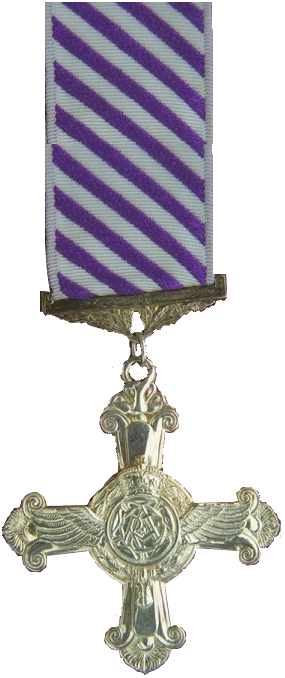
Serving with the 75th Battalion of the CEF, Harold Molyneux received a head wound in the Battle of Vimy Ridge on 1917-04-09. When he recovered, he transferred to the Royal Flying Corps and received his pilot's certificate in October 1917. He was posted to 56 Sqn on 1918-04-04. In the seven months before the end of the war he accounted for five enemy aircraft and was awarded the DFC. He was posted to Home Establishment on November 8 and the war ended three days later. During World War II, Molyneux served with the Royal Canadian Air Force.
Molyneaux, Harold Arthur Sydney (Lieutenant)
Survived 1918-April-04


Birth Date: 1896-March-14
Born: Toronto, Ontario
Parents: Frederick C. M. Molyneux & Nora Evelyn Langtry
Spouse: Louise Logan Van Nostrand
Home: Toronto, Ontario
Enlistment: Toronto, Ontario
Enlistment Date: 1917-April-09
Service
RAF
Unit
60 (F) Sqn- Squadron (RAF)
Per Ardua Ad Aethera Tendo I strive through difficulties to the sky
Base
Rank
Lieutenant
Position
pilot
Service Numbers
35816
S.E.5 serial: F5504

Royal Aircraft Factory S.E.5a, No. 1 Fighting Squadron, Canadian Air Force, Upper Hayford, UK, 1919, flown by Capt Albert Debrisay Carter, DSO & Bar, Belgian Croix de Guerre, from Moncton, New Brunswick
Source: Harold A Skaarup Web Page (Library and Archives Canada Photo, MIKAN No. 3523023)
Source: Harold A Skaarup Web Page (Library and Archives Canada Photo, MIKAN No. 3523023)
The Royal Aircraft Factory S.E.5 was a British biplane fighter aircraft of the First World War. It was developed at the Royal Aircraft Factory by a team consisting of Henry Folland, John Kenworthy and Major Frank Goodden. It was one of the fastest aircraft of the war, while being both stable and relatively manoeuvrable.
In most respects the S.E.5 had superior performance to the rival Sopwith Camel, although it was less immediately responsive to the controls. Problems with its Hispano-Suiza engine, particularly the geared-output H-S 8B-powered early versions, meant that there was a chronic shortage of the type until well into 1918. Thus, while the first examples had reached the Western Front before the Camel, there were fewer squadrons equipped with the S.E.5 than with the Sopwith fighter.
Together with the Camel, the S.E.5 was instrumental in regaining allied air superiority in mid-1917 and maintaining it for the rest of the war, ensuring there was no repetition of "Bloody April" 1917 when losses in the Royal Flying Corps were much heavier than in the Luftstreitkräfte. The S.E.5s remained in RAF service for some time following the Armistice that ended the conflict; some were transferred to various overseas military operators, while a number were also adopted by civilian operators.
The S.E.5 was powered by various engines, initially adopting a Hispano-Suiza 8 V8 engine. The Hispano-Suiza engine was advanced for the era, incorporating such features as an aluminium cylinder block with steel liners, dual ignition and forced lubrication that aided cooling; especially compared with contemporary rotary engines, it had the advantage of being easy to operate by most pilots. An expansion tank for the cooling system was integrated into the leading edge of the upper wing's centre section. One of its greatest advantages over the Sopwith Camel was its superior performance at altitude, making it a much better match for the Fokker D.VII when that fighter arrived at the front.
The S.E.5 was armed with a single synchronised .303-inch Vickers machine gun in contrast to the Camel's two, but it also had a wing-mounted Lewis gun fitted on a Foster mounting, which enabled the pilot to fire at an enemy aircraft from below. This armament configuration was much appreciated by the pilots of the first S.E.5 squadrons as the new hydraulic-link "C.C." synchronising gear for the Vickers machine gun was unreliable at first. The Vickers gun was mounted on the forward left dorsal surface of the fuselage with the breech inside the cockpit, at a slight upwards angle. Typically, spare magazines for the Lewis gun would have been placed within most of the free space in the cockpit including the forward areas, such as the instrumentation panel. Wikipedia
 Wikipedia Royal Aircraft Factory S.E.5
 Harold A Skaarup Web Page
 SE.5 - Kestrel Publications
S.E.5 S.E.5a F5504
airhistory.org.uk/rfc
Type: SE5a Built by: Vickers /Weybridge Contract: 35A/1177/C1071 (dated 05-06-1918) Taken on charge: 09-1918 Comments: del to 10AAP Brooklands