 Toronto, Ontario
90 Squadron (Celer). Fortress aircraft was undergoing altitude tests when it broke up in the air at 30,000 feet over Catterick Bridge, Yorkshire.
Wills, Thomas James (Sergeant)
Killed in Action 1941-June-22


Birth Date: 1921
Born:
Parents: Son of Thomas James Wills and Rella Wills; husband of Mary Isobel Wills, of Toronto, Ontario, Canada. Scholar of Yale University.
Spouse: Husband of Mary Isobel Wills, of Toronto, Ontario, Canada. Scholar of Yale University.
Home: Toronto, Ontario
Enlistment:
Enlistment Date: unkown date
Service
RCAF
Unit
90 Sqn- Squadron (RAF)
Celer Swift
Base
Rank
Sergeant
Position
Pilot
Service Numbers
R/53359
 Canadian Virtual War Memorial
 Library and Archives Canada Service Files (may not exist)
Flying Fortress serial: AN522
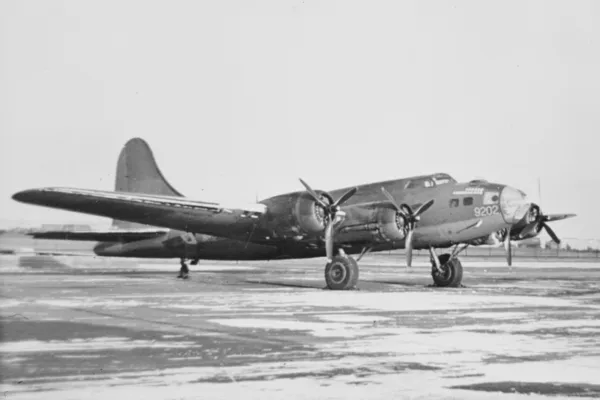
The Boeing Flying Fortress B-17
The Boeing B-17 Flying Fortress is a four-engined heavy bomber developed in the 1930s for the United States Army Air Corps (USAAC). Competing against Douglas and Martin for a contract to build 200 bombers, the Boeing entry (prototype Model 299/XB-17) outperformed both competitors and exceeded the Air Corps' performance specifications. Although Boeing lost the contract (to the Douglas B-18 Bolo) because the prototype crashed, the Air Corps ordered 13 more B-17s for further evaluation. From its introduction in 1938, the B-17 Flying Fortress evolved through numerous design advances, becoming the third-most produced bomber of all time, behind the four-engined Consolidated B-24 Liberator and the multirole, twin-engined Junkers Ju 88.
The B-17 was primarily employed by the USAAF in the daylight strategic bombing campaign of World War II against German industrial, military and civilian targets. The United States Eighth Air Force, based at many airfields in central, eastern and southern England, and the Fifteenth Air Force, based in Italy, complemented the RAF Bomber Command's night-time area bombing in the Combined Bomber Offensive to help secure air superiority over the cities, factories and battlefields of Western Europe in preparation for the invasion of France in 1944. The B-17 also participated to a lesser extent in the Pacific War, early in World War II, where it conducted raids against Japanese shipping and airfields.
From its prewar inception, the USAAC (by June 1941, the USAAF) promoted the aircraft as a strategic weapon; it was a relatively fast, high-flying, long-range bomber with heavy defensive armament at the expense of bombload. It developed a reputation for toughness based upon stories and photos of badly damaged B-17s safely returning to base. The B-17 dropped more bombs than any other U.S. aircraft in World War II. Of approximately 1.5 million tons of bombs dropped on Nazi Germany and its occupied territories by U.S. aircraft, over 640,000 tons were dropped from B-17s. In addition to its role as a bomber, the B-17 was also employed as a transport, antisubmarine aircraft, drone controller, and search-and-rescue aircraft.
The RCAF acquired six used B-17E and F aircraft from the United States in 1943. Stripped of all armament and armour, the aircraft were employed by the RCAF's No. 168 Squadron on a trans-Atlantic mail service vital to the morale of overseas forces. The aircraft were progressively modified and improved for service in this transport role, and some aircraft were subsequently stripped of paint and appeared in a polished, bare metal finish. No. 168 Squadron delivered more than two million pounds of mail between December 1943 and March 1946.
As of October 2019, nine aircraft remain airworthy, though none of them were ever flown in combat. Dozens more are in storage or on static display. The oldest of these is a D-series flown in combat in the Pacific on the first day of World War II. Wikipedia and RCAF
 B.17 Flying Fortress
 Wikipedia B 17 Bomber
 Harold A Skaarup Web Page
Flying Fortress AN522
WP J
Was USAAF B-17C s/n 40-2053. Returned to Boeing for resale to UK; contract signed Jan41. Norden bombsight removed and Sperry auto-pilot installed. Atlantic Ferry Organization (ATFERO), Dorval, Montreal, Canada. Used by ATFERO for training at McChord Field, Tacoma, WA. Delivered to Royal Air Force Apr41 as Fortress Mark I, serial AN522 [initially marked incorrectly as AM522] at Portland, OR [to avoid higher WA Sales Tax]. Ferried to Boise, ID Apr41, to Cheyenne, WY Apr 1941 and to Patterson Field, Dayton, OH Apr41. Ferried to Wright Field, OH 5 May 1941 for painting and installation of self-sealing fuel tanks. Ferried to Floyd Bennett Field, Long Island, NY May 1941 for preparation for delivery flight to England. Ferried to RCAF Gander, Newfoundland. Ferried RCAF Gander, Newfoundland to Heathfield, Ayr, Scotland 14/15 May 1941. No.90 Squadron [WP-J], RAF Watton, Norfolk 3 May 1941. RAF West Raynham, Norfolk 15May41. On 22nd June 1941 the aircraft departed from RAF Great Massingham flying the short distance to West Raynham to pick up passengers and crew for the test flight. Then took off from West Raynham, the purpose of the flight was to allow physiological research and tests to be done at high altitude. On board alongside the crew of five airmen were two senior medical officers in the rear of the aircraft and a further qualified pilot who was to take temperature readings in the cockpit cabin. The aircraft was to fly at an altitude of 30,000ft so that a problem resulting in oxygen masks freezing was to be investigated and an assessment of the energy used by air gunners while in combat was also to be monitored. An hour after taking off and while flying between 30,000 and 31,000ft the aircraft entered a large cumulonimbus cloud. The temperature in the aircraft was estimated to have dropped by some 20 degrees and pieces of ice began to enter through the open rear gun ports. After around a minute of flying in these conditions the aircraft entered a steep and high-speed dive after control was lost while flying in this very turbulent weather. The pilot was able to regain some control briefly and was able to begin to pull out of the dive but before the aircraft fully pulled out of the dive the forces on the airframe were too great and the port wing spar failed at around 25,000ft. The port wing broke off at around the port outer engine nacelle and this was followed by the disintegration of the aircraft in the air. None of the six crew in the front of the aircraft stood any chance with none able to attempt to abandon the aircraft because of the forces involved and they went down with the aircraft. The two medical officers in the rear of the aircraft had both been able to reach their parachutes and clip them onto their harnesses, one of these officers became wedged by the port guns and although the other man was able to free him he then abandoned the aircraft through the starboard gun port and landed safely. The other medical officer remained unable to get himself clear of the aircraft and he also went down with the aircraft. Because of the height this aircraft broke up and the wreckage was spread over a wide area from the region of Catterick racecourse in the south-west and extended to some six miles north-east of Catterick Bridge. The port wing section was found towards the north-east end of the trail while much of the cockpit section, the engines and most of the fuselage were found nearer the south-west end. Part of a wing section was found resting against the rear of the Farmers Arms pub at Catterick Bridge and further fragments of the aircraft were in the fields beyond this pub. It is likely that a restricted oxygen supply caused by freezing at altitude caused the pilot to lose control (7KIA:1RTD). Salvaged 9 Jul 1941. At the time of the accident it had flown a total of 66 hours. First B-17 lost in WWII. The second pilot was 1st Lt Follett Bradley Jnr, USAAC who became the first American casualty of WWII. https://www.joebaugher.com/usaf_serials/usafserials.html
J