 De Winton, Alberta
Multiple fatalities associated with this accident. It appears that he was not at 2 Wireless School as originally listed. 2 Wireless School was disbanded at the end of the second world war. It appears he was working on resupply missions in the North West Territories during installation of LORAN Radar sites in the Canadian Artic. Crash landed at RCAF LORAN Detachment at Kittigazuit, N.W.T on 28 July 1948. Coded "CC*M" at time of crash. One fatality, Leading Aircraftman T. Warrack.
Warrack, Thomas (Leading Aircraftman)
unknown 1948-July-28


Birth Date: 1919-October-05
Born: De Winton, Alberta
Parents: Son of John and Georgina of Strathmore, Alberta.
Spouse: Husband of Nora (nee Scollen). Father of Sharon Warrack of Edmonton, Alberta.
Home: De Winton, Alberta
Enlistment: Calgary, Alberta
Enlistment Date: 1943-March-15
Service
RCAF
Unit
Base
Rank
Leading Aircraftman
Position
Service Numbers
24791
 Canadian Virtual War Memorial
 Finadagrave.com
Canso serial: 11081
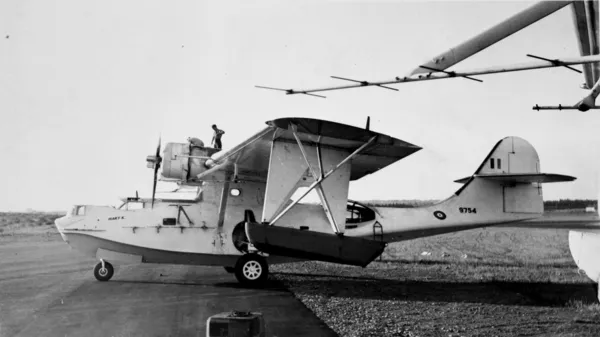
RCAF Canso A (Serial No. 9754), No. 162 Squadron, F/L David Ernest Hornell aircraft.
The Consolidated Catalina and Canso were close cousins. The Canso was the true amphibious version of the design and therefore included a conventional undercarriage to allow for either water or land use. The Canso provided more than two decades of valuable service to the RCAF. The Catalina variant came first and was produced beginning in 1935 for the United States Navy. The amphibious version, designated PBY-5A, came in service early in 1941 and the RCAF began using the aircraft on anti-submarine patrols that same year. After the Second World War, the RCAF used Cansos for search and rescue, Arctic survey missions and various transport operations. RCAF
 Canso PBY
 Wikipedia Canso PBY
 Harold A Skaarup Web Page
Canso A 11081
Delivered new to storage. To No. 162 (BR) Squadron on 29 September 1944. To No. 4 Repair Depot at Scoudouc, NB 11 January to 11 May 1945 for repairs. With No. 162 (BR) Squadron in Iceland after VE day. Returned to Canada via UK and Azores in June 1945. To No. 10 RD in Calgary on 13 August 1945 for partial conversion to freighter. To No. 9 (T) Group 1 June 1946, used by No. 435 (T) Squadron, RCAF Station Edmonton, Alberta, from August 1946. Had conducted training flights from Winnipeg with No. 164 Squadron, as early as 20 June 1946. To Rockcliffe, 26 August 1946. With Winnipeg Detachment by September 1946. To Fairchild Aircraft in Longueuil, Quebec for further conversion work 7 February 1947. To North West Air Command on 8 August 1947, used by K Flight at RCAF Station Edmonton, Alberta. Sent to replace 11036 following its crash, and to complete this unit's commitment to Operation Beetle (installation of LORAN sites in Canadian Arctic). Under maintenance at No. 10 Repair Depot, Calgary, in November 1947. Reported on 1 December 1947 as "time since new 606:10, condition good, fitment freighter". Reported on 1 March 1948 as "time since new 689:00, condition good, fitment freighter, attached to Nelson". Crash landed at RCAF LORAN Detachment at Kittigazuit, N.W.T on 28 July 1948. Coded "CC*M" at time of crash. One fatality, Leading Aircraftman T. Warrack. Crew member Leading Aircraftman (later Corporal) R.W.S. Trent assisted in aircraft evacuation, would later receive US Soldier's Medal for actions saving US personnel while with No. 103 Search and Rescue Unit in Newfoundland in 1953. Scrapped on site, salvageable material sent to No. 10 RD.1944-05-22 Taken on Strength Eastern Air Command 2019-08-20
1948-08-30 Struck off Strength Struck off after crash, see comments 2019-08-20