He was appointed as a Probationary Sub-Lieutenant (Temp.) RCNVR (With seniority dated 01/01/1943). He served in HMCS Kings (Officer Training establishment) 1943. He was appointed as a Sub-Lieutenant (Temp.) RCNVR (With seniority dated 15/02/1943). He served in RCAF Goderich for 12 Elementary Flying Training School 1943. He served in RCAF Aylmer ON for 14 Service Flying Training School 1944. He was appointed as an A/Lieutenant (Temp.) RCNVR 1944. He served in H.M.S. Speaker for 1840 Squadron 1944. He served in H.M.S. Indomitable for 1839 RN Squadron 1945. (He was killed in action during Operation Iceberg, accidentally shot down by "friendly fire" on 13/04/1945 when his plane was shot down by gunfire from Fleet chasing Japanese aircraft during pre-dawn attack.)
From Joe Baugher Database: 70480 (JW862) shot down by own fleet's flak while returning to HMS Indomitable after combat Apr 12, 1945. Pilot killed.Thurston, Charles Rae (Lieutenant)
Killed in Action 1945-April-13


Birth Date: 1923-October-22
Born:
Parents: Son of Jason Everard Thurston and Ida Maude Thurston, of Toronto, Ontario.
Spouse:
Home: Toronto, Ontario
Enlistment:
Enlistment Date: unkown date
Service
RN FAA
Unit
1845 Sqn- Squadron (RN FAA)
Base
HMS Indomitable
Rank
Lieutenant
Position
Pilot
Service Numbers
073280
Home
 Toronto, Ontario
 Nauticcpedia
 Canadian Virtual War Memorial
 Commonwealth War Graves Commission
 Finadagrave.com
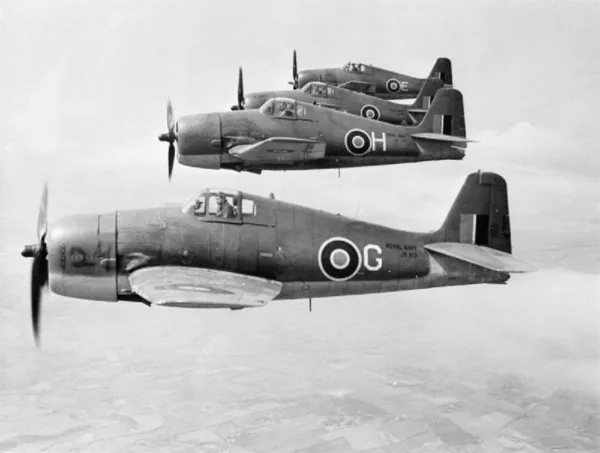
Hellcat serial: JW862
Source Wikimedia
The Grumman F6F Hellcat is an American carrier-based fighter aircraft of World War II. Designed to replace the earlier F4F Wildcat and to counter the Japanese Mitsubishi A6M Zero, it was the United States Navy's dominant fighter in the second half of the Pacific War. In gaining that role, it prevailed over its faster competitor, the Vought F4U Corsair, which initially suffered from several carrier-operating issues, including poor forward visibility, landing bounce and stall characteristics.
Powered by a 2,000 hp (1,500 kW) Pratt & Whitney R-2800 Double Wasp, the same powerplant used for both the Corsair and the USAAF Republic P-47 Thunderbolt fighters, the F6F was an entirely new aircraft that retained only a general resemblance to the earlier Wildcat. Some military observers tagged the Hellcat as the "Wildcat's big brother".
The F6F made its combat debut on 31 August 1943 during raids on Marcus Island. It subsequently established itself as a rugged, well-designed carrier fighter, which was able to outperform the A6M Zero and played a major role in helping the U.S. gain air superiority in the Pacific. In total, 12,275 were built in just over two years.
The British Fleet Air Arm (FAA) received 1,263 F6Fs under the Lend-Lease Act; initially, it was known as the Grumman Gannet Mark I. The name Hellcat replaced it in early 1943 for the sake of simplicity, the Royal Navy at that time adopting the use of the existing American naval names for all the U.S.-made aircraft supplied to it, with the F6F-3 being designated Hellcat F Mk. I, the F6F-5, the Hellcat F Mk. II and the F6F-5N, the Hellcat NF Mk. II. They saw action off Norway, in the Mediterranean, and in the Far East. Several were fitted with photographic reconnaissance equipment similar to the F6F-5P, receiving the designation Hellcat FR Mk. II. In the European and Mediterranean theaters, these FAA Hellcats primarily faced land-based aircraft so experienced far fewer opportunities for air-to-air combat than their USN/Marines counterparts; nevertheless, they claimed a total of 52 enemy aircraft kills during 18 aerial combats from May 1944 to July 1945. 1844 Naval Air Squadron, on board HMS Indomitable of the British Pacific Fleet was the highest-scoring unit, with 32.5 kills.
FAA Hellcats, as with other Lend-Lease aircraft, were rapidly replaced by British aircraft after the end of the war, with only two of the 12 squadrons equipped with the Hellcat at VJ-Day still retaining Hellcats by the end of 1945. These two squadrons were disbanded in 1946. When the war ended, 889 Squadron FAA, equipped with 6 Hellcat Is and II (PR) photo-reconnaissance variants, was preparing to depart from Scotland for the Far East (the squadron had been based at RAF Woodvale since its re-formation after VE Day, and practising carrier operations on HMS Trouncer before moving to HMS Ravager), to replace 888 Squadron FAA, and intended to photograph Japanese beaches in anticipation of the planned invasion that was forestalled by the Atomic bombings of Hiroshima and Nagasaki. With the cessation of hostilities, the squadron (which included pilot William Stevenson) was disbanded and the Hellcats dumped off the Scottish coast. (That was the fate of much lend-lease equipment that survived the war, including aircraft; under the terms of lend-lease agreements, any aircraft that were not returned to the United States or paid for had to be destroyed.)
Hellcats were credited with destroying a total of 5,223 enemy aircraft while in service with the U.S. Navy, U.S. Marine Corps, and Royal Navy Fleet Air Arm (FAA).This was more than any other Allied naval aircraft. Wikipedia