 Sydney, Nova Scotia
3 Squadron (Tertius Primus Erit). Tempest aircraft missing. Flight Lieutenant Robertson had previously flown Hurricane aircraft with 245 Squadron.
Robertson, William Roy (Flight Lieutenant)
Killed in Action 1945-May-12


Birth Date: 1923
Born:
Parents:
Spouse:
Home: Sydney, Nova Scotia
Enlistment:
Enlistment Date: unkown date
Service
RAF
Unit
3 Sqn- Squadron (RAF)
Tertius Primus Erit The third shall be first
Base
Rank
Flight Lieutenant
Position
Pilot
Service Numbers
116147
 Canadian Virtual War Memorial
Tempest serial: EJ588
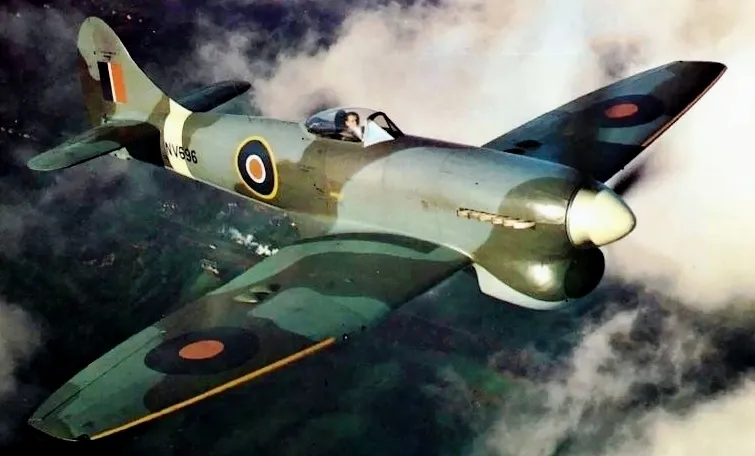
Source: Harold A Skaarup Web Page (RAF Photo)
Hawker Tempest Mk. V, RAF (Serial No. NV596)
Hawker Tempest Mk. V, RAF (Serial No. NV596)
The Hawker Tempest was a British fighter aircraft primarily used by the Royal Air Force (RAF) in the Second World War. The Tempest, originally known as the Typhoon II, was an improved derivative of the Hawker Typhoon, intended to address the Typhoon's unexpected deterioration in performance at high altitude by replacing its wing with a thinner laminar flow design. Since it had diverged considerably from the Typhoon, it was renamed Tempest. The Tempest emerged as one of the most powerful fighters of World War II and was the fastest single-engine propeller-driven aircraft of the war at low altitude.
Upon entering service in 1944, the Tempest was used as a low-level interceptor, particularly against the V-1 flying bomb threat, and as a ground attack platform, in which it supported major events such as Operation Market Garden. Later, it successfully targeted the rail infrastructure in Germany and Luftwaffe aircraft on the ground, as well as countering such attacks by German fighters. The Tempest was effective in the low-level interception role, including against newly developed jet-propelled aircraft such as the Messerschmitt Me 262.
The further-developed Tempest II did not enter service until after the end of hostilities. It had several improvements, including being tropicalised for combat against Japan in South-East Asia as part of the Commonwealth Tiger Force.
The Tempest was a single engine fighter aircraft that excelled at low-level flight. In service, its primary role soon developed into performing "armed reconnaissance" operations, often deep behind enemy lines. The Tempest was particularly well suited to the role because of its high speed at low to medium altitudes, its long range when equipped with two 45-gallon drop tanks, the good firepower of the four 20mm cannon and the good pilot visibility. The three-piece windscreen and side windows of the Tempest had directly benefited from examination of captured Focke-Wulf Fw 190s, improvements included the careful design and positioning of the frame structure, blind spots being reduced to an absolute minimum. It had a bullet-resistant centre panel made up of two layers, the outer 1.5 in (38 mm) thick and the inner 0.25 in (6.5 mm). Wikipedia
 Wikipedia Hawker Tempest
 Harold A Skaarup Web Page
Unit Desciption
3 Sqn Tertius Primus Erit (x)
History of the Squadron during World War II (Aircraft: Hurricane I, IIb, IIc, Typhoon Ib, Tempest V)
No. 3 Squadron is the oldest squadron in the RAF, Having been formed on 13th May 1912. It served through out World War I. It served in fighter and ground attack roles. Between the wars, it was disbanded and reformed a number of times, flying a number of different types of aircraft. Before the start of the Second World War No 3 Squadron was posted as part of Fighter Command to RAF Station Biggin Hill and equipped with the Hawker Hurricane Mk I. On the outbreak of war, it moved to Croydon, then to Hawkinge and Kenley. It was not in action until May, 1940, when it was briefly deployed to Merville, France as part of 63 Wing in support of the British Expeditionary Force following the German attack on the West. It was forced to withdraw after 10 days, having claimed 60 German aircraft for the loss of 21 of its own. Once back up to strength, No. 3 Squadron was used from May 1940 to April 1941 as air defence for the Royal Naval base at Scapa Flow and convoy protection, operating from Wick, Castletown and Skeabrae, remaining in Scotland until April 1941, when it moved south to RAF Martlesham Heath.
The squadron was involved in night-fighting, where it co-operated with "Turbinlite" searchlight equipped Douglas Havocs (the searchlight in the Havoc was intended to illuminate enemy aircraft so that the Hurricanes could attack them), but with no success. The Hurricane was not well equipped for night fighting. In June 1941 it moved to RAF Stapleford Tawney operating four-cannon Hurricane IIs in 'Rhubarb' attacks on defended ground targets and shipping in northern France and Belgium, flying from Stapleford Tawney and Hunsdon. It participated in the Dieppe raid, among other activities. In February 1943 it re-equipped with the Hawker Typhoon Ib for fighter-bomber and anti-shipping strikes, flying from a number of bases in SE England. It re-equipped in March 1944 with the new Hawker Tempest fighter, operating over the Normandy beach-head and against German V1 flying bombs, claiming 288 V-1s shot down.
It then deployed across the Channel, flying as part of the 2 TAF fighting through the low countries and into Germany. Amongst its pilots was F/L Pierre Clostermann, who flew with 3 Squadron from March 1945 until the end of the war in Europe
Maps for Movements of No. 3 Squadron RAF 1940-45
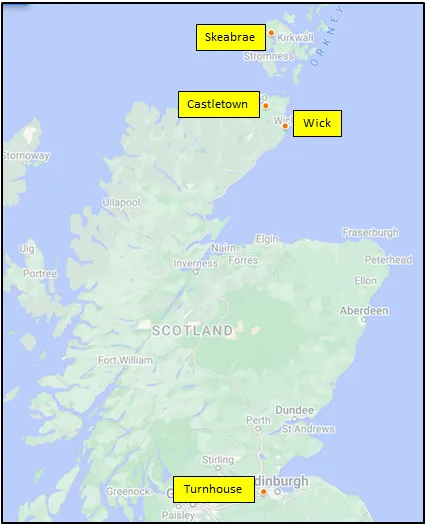
MAP 1: No 3 Squadron bases, Scotland May 1940-April 1941 (right-click on image to display enlarged view in new tab)
|

MAP 2: No. 3 Squadron bases, SE England April 1941-September 1944
|
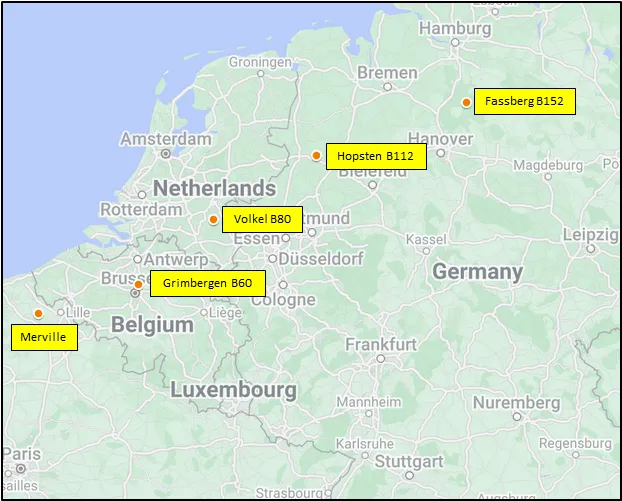
MAP 3: No. 3 Squadron bases in Europe September 1944-May 1945
|