 Dixon's Corners, Ontario
1918-02-18:McGinn died in Bristol Scout, B-716; when he failed to recover from a spin.
McGinn, Wilfred Joseph (Second-Lieutenant)
Killed in Flying Accident 1918-February-18


Birth Date: 1897-September-30
Born: Brinston, Ontario
Parents: James McGinn & Alice Gibbons
Spouse: unmarried
Home: Dixon's Corners, Ontario
Enlistment: Toronto, Ontario: RFC enlixstment
Enlistment Date: 1917-September-06
Service
RFC
Unit
34 (OT) TS- Training Squadron (RFC)
Base
Chattis Hill England
Rank
Second-Lieutenant
Position
Pilot
Service Numbers
 Canadian Virtual War Memorial
Scout (Bristol) serial: B716
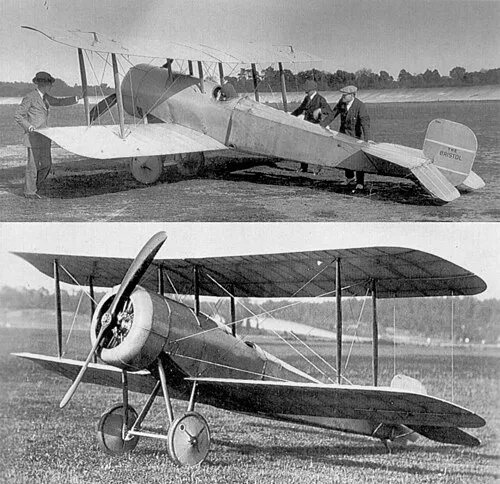
Bristol Scout
Source From Windsock Datafile No.44
The Bristol Scout was a single-seat rotary-engined biplane originally designed as a racing aircraft. Like similar fast, light aircraft of the period it was used by the RNAS and the RFC as a "scout", or fast reconnaissance type. It was one of the first single-seaters to be used as a fighter aircraft, although it was not possible to fit it with an effective forward-firing armament until the first British-designed gun synchronizers became available later in 1916, by which time the Scout was obsolescent. Single-seat fighters continued to be called "scouts" in British usage into the early 1920s.
The first flight was made at Larkhill on 23 February 1914 by Busteed and it was then exhibited at the March 1914 Aero Show at Olympia in London. After more flying at Larkhill the prototype, later referred to as the Scout A, was returned to the factory at Filton for modifications.
It was evaluated by the British military on 14 May 1914 at Farnborough, when, flown by Busteed, the aircraft achieved an airspeed of 97.5 mph (157 km/h), with a stalling speed of 40 mph (64 km/h).Impressed by the performance of the aircraft, the War Office ordered twelve examples on 5 November and the Admiralty ordered a further 24 on 7 November. The production aircraft, later called the Scout C, differed from their predecessors mainly in constructional detail, although the cowling was replaced by one with a small frontal opening and no stiffening ribs, the top decking in front of the cockpit had a deeper curve and the aluminium covering of the fuselage sides extended only as far as the forward centre-section struts, aft of which the decking was plywood. Wikipedia
 Bristol Scout
Scout (Bristol) Scout D B716
airhistory.org.uk/rfc
Type: Bristol Scout D Built by: 1SARD Comments: 1SARD Farn from salvage