 St. Eleanor's, Prince Edward Island.
1918-02-05: Ireland was killed, as was his pilot 2Lt. R.P. Pohlmann (British). The squadron was attacked by around 15 EAs, his aircraft went down in flames during the bombing of Deynze Railway Station.
Ireland, Roy (Air Mechanic Class II)
Killed in Action 1918-February-05
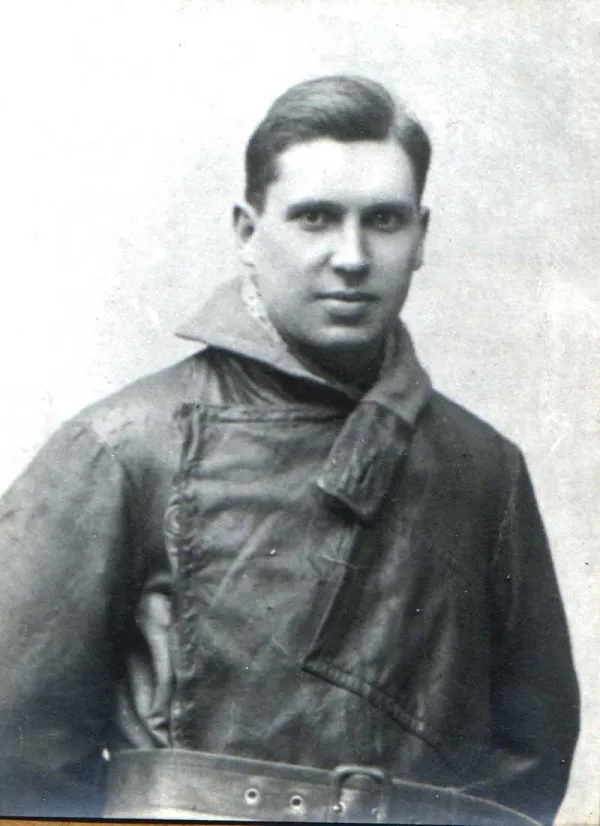

Birth Date: 1891
Born:
Parents: Edward J. Ireland & Carrie W. Ireland
Spouse:
Home: St. Eleanor's, Prince Edward Island.
Enlistment:
Enlistment Date: unkown date
Service
RFC
Unit
25 (B) Sqn- Squadron (RFC)
Base
France
Rank
Air Mechanic Class II
Position
Gunner/Observer
Service Numbers
114348
 Canadian Virtual War Memorial
 Finadagrave.com
DH. 4 serial: A7865

(Library and Archives Canada Photo, MIKAN No. 3390141)
(Source Harold A Skaarup web page) de Havilland DH.4, RAF, c1918.
(Source Harold A Skaarup web page) de Havilland DH.4, RAF, c1918.
The Airco DH.4 was a British two-seat biplane day bomber of the First World War. It was designed by Geoffrey de Havilland (hence "DH") for Airco, and was the first British two-seat light day-bomber capable of defending itself.
It was powered by a number of different engines in its early years, including the 375 hp (280 kW) Rolls-Royce Eagle engine. It was armed with one 0.303 in (7.7 mm) Vickers machine gun for the pilot and one 0.303 in (7.7 mm) Lewis gun mounted on a Scarff ring for the observer. The DH.4 could carry a pair of 230 lb (100 kg) bombs or four 112 lb (51 kg) bombs. It was first flown in August 1916 and less than a year later, it entered operational service in France with No. 55 Squadron, RFC, on 6 March 1917.
Despite its success, numbers in service with the RFC actually started to decline from spring 1918, mainly due to a shortage of engines, and production switched to the DH.9. Unfortunately, the DH.9 proved to be inferior to the DH.4 in most respects.
Following the Armistice of 11 November 1918, many DH.4s were sold to civil operators where it was found to be particularly useful as a mailplane. Early commercial passenger airplane service in Europe was initiated with modified variants of the DH-4. War-surplus DH-4s became key aircraft in newly emerging air forces throughout the world. The U.S. Army later had several companies re-manufacture its remaining DH.4s to DH.4B standard and they operated the type into the early 1930s. Harold Skaarup web page, Wikipedia
 DH-4
 Wikipedia DH-4
 Harold A Skaarup Web Page
DH. 4 A7865
airhistory.org.uk/rfc
Type: Airco D.H.4 Built by: Airco /Hendon Contract: 87/A/496 (dated 11-07-1916) Taken on charge: 12-1917 Struck off charge: 05-02-1918