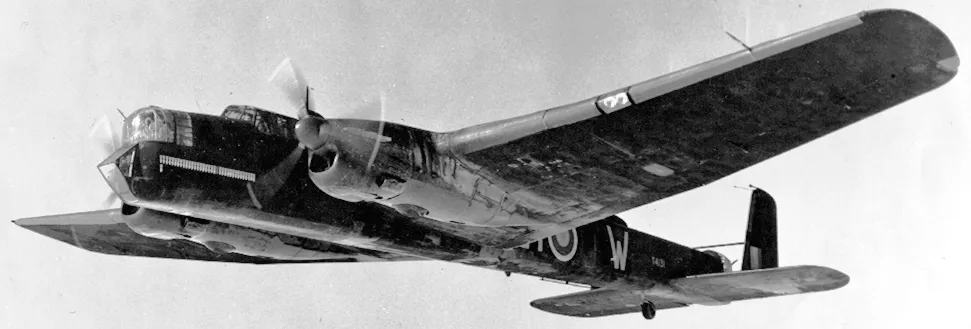
Source: Harold A Skaarup Web Page (RAF Photo)
The Armstrong Whitworth AW 38 Whitley was one of three British twin-engined, front line bomber types that were in service with the Royal Air Force (RAF) at the outbreak of the Second World War. Alongside the Vickers Wellington and the Handley Page Hampden, the Whitley was developed during the mid-1930s according to Air Ministry Specification B.3/34, which it was subsequently selected to meet. In 1937, the Whitley formally entered into RAF squadron service; it was the first of the three medium bombers to be introduced.
Following the outbreak of war in September 1939, the Whitley participated in the first RAF bombing raid upon German territory and remained an integral part of the early British bomber offensive. In 1942 it was superseded as a bomber by the larger four-engined "heavies" such as the Avro Lancaster. Its front line service included maritime reconnaissance with Coastal Command and the second line roles of glider-tug, trainer and transport aircraft. The type was also procured by British Overseas Airways Corporation as a civilian freighter aircraft. The aircraft was named after Whitley, a suburb of Coventry, home of one of Armstrong Whitworth's plants.
John Lloyd, the Chief Designer of Armstrong Whitworth Aircraft, selected the Armstrong Siddeley Tiger IX radial engine to power the Whitley, which was capable of generating 795 hp (593 kW). One of the more innovative features of the Whitley's design was the adoption of a three-bladed two-position variable-pitch propeller built by de Havilland; the Whitley was the first aircraft to fly with such an arrangement. Lloyd was unfamiliar with the use of flaps on a large heavy monoplane, they were initially omitted from the design. To compensate, the mid-set wings were set at a high angle of incidence (8.5°) to confer good take-off and landing performance. Although flaps were included late in the design stage, the wing remained unaltered; as a result, the Whitley flew with a pronounced nose-down attitude when at cruising speed, resulting in considerable drag. The Whitley holds the distinction of having been the first RAF aircraft with a semi-monocoque fuselage, which was built using a slab-sided structure to ease production. This replaced the tubular construction method traditionally employed by Armstrong Whitworth, who instead constructed the airframe from light-alloy rolled sections, pressings and corrugated sheets.
The Whitley had a crew of five: a pilot, co-pilot/navigator, a bomb aimer, a wireless operator and a rear gunner. The pilot and second pilot/navigator sat side by side in the cockpit, with the wireless operator further back. The navigator, his seat mounted on rails and able to pivot, slid backwards and rotated to the left to use the chart table behind him after takeoff. The bomb aimer position was in the nose with a gun turret located directly above. The fuselage aft of the wireless operator was divided horizontally by the bomb bay; behind the bomb bay was the main entrance and aft of that the rear turret. The offensive armaments were stowed in two bomb bays housed within the fuselage, along with a further 14 smaller cells in the wing. Other sources state there were 16 "cells" total: two groups of 2 in the fuselage, and four groups of 3 in the wings, plus two smaller cells for parachute flares in the rear fuselage. Bomb racks capable of holding larger bombs were installed on the Whitley Mk III variant.
Wikipedia
 Wikipedia Armstrong Whitworth Whitley
 YouTube Armstrong Whitworth Whitley
 Harold A Skaarup Web Page
102 (B) Sqn Tentate Et Perficite (Ceylon)
No. 102 Squadron RFC was formed in August 1917 and served on the Western Front in WWI as a night bomber unit equipped with FE2b aircraft. It continued in this night bomber role until the cessation of hostilities. The squadron was disbanded on July 3, 1919. It was re-formed on October 1, 1935 as a bomber unit, at Worthy Down, Hampshire, where it remained until it moved to Finningley, Yorkshire in September, 1936. Further moves were to Honington, Suffolk in July of 1937, and to Driffield, Yorkshire in July 1938. The squadron originally flew Handley Page Heyford aircrft, but re-equipped with Armstrong Whitworth Whitleys before the outbreak of WWII. While the squadron remained based at Driffield, detachments were sent to Villeneuve, France between October 1939 and February 1940. There were also detachments seconded to Coastal Command at Kinloss, Scotland in November and December 1939.
The squadron's first operation was on the second night of the war, when it dropped leaflets over the Ruhr in Germany. The first bombing attack was on the night of 12/13 December 1939, when a seaplane was attacked at its base at Sylt, Germany. When Italy entered the war on 10/11 June, 1940, the squadron flew from Jersey airport in the Channel Islands to attack Turin. Between August and September 1940 the squadron was based at Leeming, Yorkshire.
The squadron was seconded to Coastal Command from September to October 1940, flying from Prestwick, Scotland. It moved to Linton-on-Ouse, Yorkshire in October and November of 1940, and then to Dalton, Yorkshire in November 1941. In June of 1942 the squadron moved to Topcliffe, Yorkshire and in August moved to Pocklington, from which it flew until the end of hostilities, as a member of No. 4 Group of Bomber Command. From December 1941 until the end of the war, the squadron flew Handley Page Halifax aircraft. Although most of their missions were bombing sorties, the squadron also transported 134,280 gallons of petrol to Belgium to help fuel the Second Army in September/October 1944.
One of the remarkable airmen who flew with the squadron was P/O Leonard Cheshire, later G/C and VC holder. His aircraft P5005 N-Nuts was very badly holed on an attack to an oil refinery at Wesseling, Germany on the night of 12/13 November 1940. The aircraft suffered a huge hole on the port fuselage, but Cheshire was able to stabilize it and brought the aircraft home, to be awarded an immediate DSO. Overall in the course of the war, the squadron dropped 14,118 tons of bombs and laid 1865 mines. Among the awards gained by squadron personnel were 5 DSOs, 115 DFCs, 2 Bars to DFC and 34 DFMs.
The squadron was transferred to Transport Command on May 7, 1945 and was disbanded on February 28, 1946.
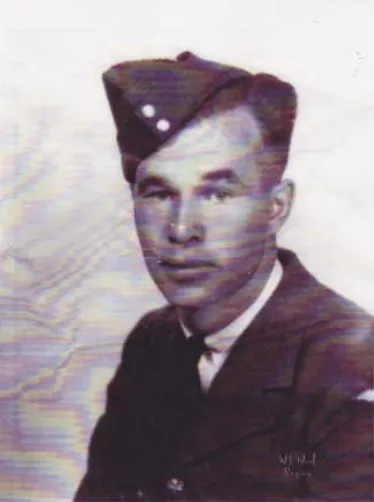

 Bralorne, British Columbia
 Canadian Virtual War Memorial
 Commonwealth War Graves Commission
 Finadagrave.com
 Saskatchewan Virtual War Memorial
 Library and Archives Canada Service Files (may not exist)