 Carbon, Alberta
1674 Heavy Conversion Unit. Liberator GR VI aircraft KG 896 hit a hill and crashed six miles west of Belfast at Tornagrough, Ireland during a night radar homing practice flight.
Flying Officer Appleyard (RCAF), F/O(s) WD Cheyne (RAF), WI Holmes (RNZAF), CAJ Honey (RAF), AJ Pryde (RAAF) and SFB Sargent (RAF), Sgt(s) O Aston (RAF), DA Bates (RAF), RJ Edge (RAF), RSP Hook (RAF) and P McNeilly (RAF) were killed.
Appleyard, Richard Henry (Flying Officer)
Killed in Flying Accident 1945-March-19


Birth Date: 1914-June-01
Born:
Parents:
Spouse:
Home: Carbon, Alberta
Enlistment:
Enlistment Date: unkown date
Service
RCAF
Unit
1674 HCU- Heavy Conversion Unit (RAF)
Base
RAF Aldergrove
Rank
Flying Officer
Position
Navigator
Service Numbers
J/42507
Prev: R/194576
 Canadian Virtual War Memorial
 Commonwealth War Graves Commission
 Finadagrave.com
 Library and Archives Canada Service Files (may not exist)
Liberator serial: KG896
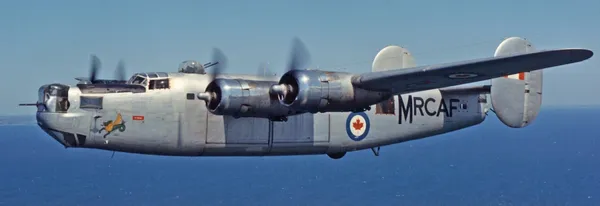
(DND Photos via James Craik) (Source Harold A Skaarup Web Page)
Consolidated Liberator G.R. Mk. VIII, RCAF (Serial No. 11130) ex-USAAF Consolidated (Vultee) B-24L Liberator USAAF (44-50154)
ex-RAF (Serial No. 5009), ex-Indian Air Force (Serial No. HE773).
Currently preserved in the Canada Aviation and Space Museum Ottawa Ontario.
The Consolidated B-24 Liberator was an American heavy bomber flown by the RCAF during the Second Word War. It was designed with a shoulder-mounted, high aspect ratio Davis wing which gave the Liberator a high cruise speed, long range and the ability to carry a heavy bomb load. Early RAF Liberators were the first aircraft to cross the Atlantic Ocean as a matter of routine. In comparison with its contemporaries the B-24 was relatively difficult to fly and had poor low speed performance; it also had a lower ceiling compared with the Boeing B-17 Flying Fortress. Of the roughly 18,500 B-24s built in the USA during the war, 148 were flown by the RCAF on long range anti-submarine patrols, with the B-24 serving an instrumental role in closing the Mid-Atlantic gap in the Battle of the Atlantic. The RCAF also flew a few B-24s post war as transports.
Roughly half of all (RAF) Liberator crews in the China-Burma-India (CBI) Theatre were Canadian by the end of the war. John Muir of Vancouver flew the longest mission of the war: 24hrs, 10mins from Ceylon to Burma and back. (Kyle Hood) Harold Skaarup web page
 Liberator bomber
 Wikipedia Liberator bomber
 Harold A Skaarup Web Page
Liberator B 24 KG896
The aircraft was carrying out a radar homing exercise with a launch on Lough Neagh when it flew in to rising ground at Tornaroy, Hannahstown, south east of Standing Stones Hill at 0220 hrs and burst into flames, killing all 11 on board, No further details
source: Malcolm Deeley, Ulster Aviation Society