G.4 (Total: 3, Canadian: 0, Group 0)
Caudron G.4
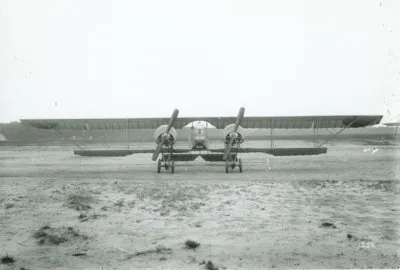
Source Nederlandse Modelbouw en Luchtvaartsite
The Caudron G.4 is a French biplane with twin engines, widely used during World War I as a reconnaissance bomber against the German Empire. Later, when Germany developed a fighter force, the aircraft was used for night bombing. It was designed by René and Gaston Caudron as an improvement over their single-engined Caudron G.3. While the Caudron G.3 was a reliable reconnaissance aircraft, it could not carry a useful bombload, and owing to its design, was difficult to fit with useful defensive armament. In order to solve these problems, the Caudron G.4 was designed as a twin-engined development of the G.3, first flying in March 1915.
While the G.4 had a similar pod and boom layout to the G.3, it had two Le Rhône rotary or Anzani 10 radial engines mounted on struts between the wings instead of a single similar engine at the front of the crew nacelle, while wingspan was increased and the tailplane had four rudders instead of two. This allowed an observer/gunner position to be fitted in the nose of the nacelle, while the additional power allowed it to carry a bombload of 100kg.
The G.4 was in use in Belgium, France, Finland, Italy, Portugal, the United Kingdom, and the United States.
The G.4 was one of the few twin-engine aircraft to be able to fly with one engine stopped.
A total of 1358 G.4s were produced in France, while a further 51 examples were produced by the A.E.R. company in Italy and 12 were built in Britain by the British Caudron company. wikipedia
 Caudron G.IV