O/100 (Total: 12, Canadian: 0, Group 0)
Handley Page O/100
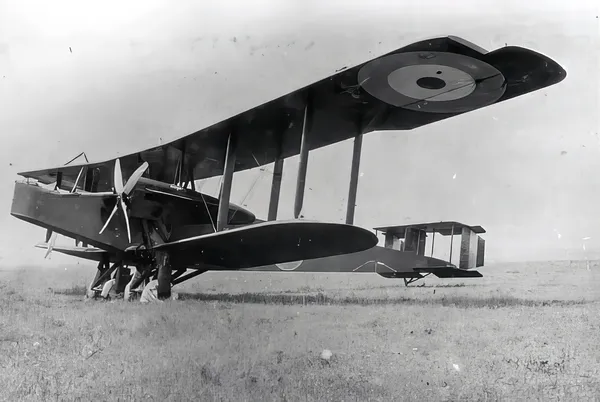
The Handley Page Type O was a biplane bomber used by Britain during the First World War. When built, the Type O was one of the largest aircraft in the world. There were two main variants, the Handley Page O/100 (H.P.11) and the Handley Page O/400 (H.P.12). The aircraft were used in France for tactical night attacks on targets in German-occupied France and Belgium and for strategic bombing of industrial and transport targets in the Rhineland. Some aircraft were temporarily diverted to anti-submarine reconnaissance and bombing in the Tees estuary in 1917 and two aircraft operated in the eastern Mediterranean.
The O/100 was an unequal-span three-bay biplane, with the overhanging part of the upper wing braced by kingposts, a rectangular section fuselage and a biplane tail with twin balanced rudders, between the horizontal surfaces. Balanced ailerons were fitted to the upper wing only and extended beyond the wing trailing edge and wing tips. The engines drove four-bladed propellers, rotating in opposite directions to cancel the torque, and were enclosed in armoured nacelles mounted between the wings on tubular steel struts. The nacelles had a long tapered fairing to reduce drag. To clear the wing rigging wires when the wings were folded, the rear portions of the fairings were hinged to fold inward. The structure of the fuselage and flying surfaces was primarily spruce, with the spars routed into I-beams to reduce weight. Wikipedia