H-12 (Total: 19, Canadian: 0, Group 0)
Curtiss H-12
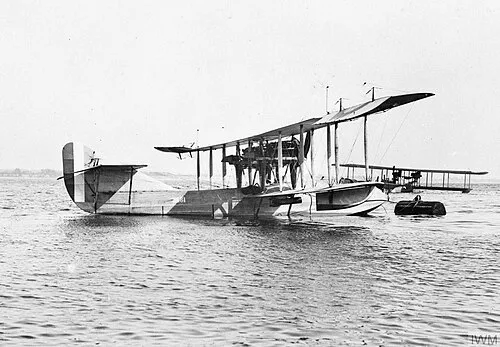
Source Imperial War Museums
The Curtiss Model H was a family of classes of early long-range flying boats, the first two of which were developed directly on commission in the United States in response to the £10,000 prize challenge issued in 1913 by the London newspaper, the Daily Mail, for the first non-stop aerial crossing of the Atlantic. As the first aircraft having transatlantic range and cargo-carrying capacity, it became the grandfather development leading to early international commercial air travel, and by extension, to the modern world of commercial aviation. The last widely produced class, the Model H-12, was retrospectively designated Model 6 by Curtiss' company in the 1930s, and various classes have variants with suffixed letters indicating differences.
Curtiss next developed an enlarged version of the same design, designated the Model H-8, with accommodation for four crew members. A prototype was constructed and offered to the United States Navy, but was ultimately also purchased by the British Admiralty. This aircraft would serve as the pattern for the Model H-12, used extensively by both the Royal Navy and the United States Navy. Upon their adoption into service by the RNAS, they became known as Large Americas, with the H-4s receiving the retronym Small America.
As built, the Model H-12s had 160 hp (118 kW) Curtiss V-X-X engines, but these engines were under powered and deemed unsatisfactory by the British so in Royal Naval Air Service (RNAS) service the H-12 was re-engined with the 275 hp (205 kW) Rolls-Royce Eagle and then the 375 hp (280 kW) Eagle VIII. Porte redesigned the H-12 with an improved hull; this design, the Felixstowe F.2, was produced and entered service. Some of the H-12s were later rebuilt with a hull similar to the F.2, these rebuilds being known as the Converted Large America. Later aircraft for the U.S. Navy received the Liberty engine (designated Curtiss H-12L).
With the RNAS, H-12s and H-16s operated from flying boat stations on the coast in long-range anti-submarine and anti-Zeppelin patrols over the North Sea. A total of 71 H-12s and 75 H-16s were received by the RNAS, commencing patrols in April 1917, with 18 H-12s and 30 H-16s remaining in service in October 1918. Wikipedia
 Curtis H-12
The Curtiss Model H was a family of classes of early long-range flying boats, the first two of which were developed directly on commission in the United States in response to the £10,000 prize challenge issued in 1913 by the London newspaper, the Daily Mail, for the first non-stop aerial crossing of the Atlantic. As the first aircraft having transatlantic range and cargo-carrying capacity, it became the grandfather development leading to early international commercial air travel, and by extension, to the modern world of commercial aviation. The last widely produced class, the Model H-12, was retrospectively designated Model 6 by Curtiss' company in the 1930s, and various classes have variants with suffixed letters indicating differences.
Curtiss next developed an enlarged version of the same design, designated the Model H-8, with accommodation for four crew members. A prototype was constructed and offered to the United States Navy, but was ultimately also purchased by the British Admiralty. This aircraft would serve as the pattern for the Model H-12, used extensively by both the Royal Navy and the United States Navy. Upon their adoption into service by the RNAS, they became known as Large Americas, with the H-4s receiving the retronym Small America.
As built, the Model H-12s had 160 hp (118 kW) Curtiss V-X-X engines, but these engines were under powered and deemed unsatisfactory by the British so in Royal Naval Air Service (RNAS) service the H-12 was re-engined with the 275 hp (205 kW) Rolls-Royce Eagle and then the 375 hp (280 kW) Eagle VIII. Porte redesigned the H-12 with an improved hull; this design, the Felixstowe F.2, was produced and entered service. Some of the H-12s were later rebuilt with a hull similar to the F.2, these rebuilds being known as the Converted Large America. Later aircraft for the U.S. Navy received the Liberty engine (designated Curtiss H-12L).
With the RNAS, H-12s and H-16s operated from flying boat stations on the coast in long-range anti-submarine and anti-Zeppelin patrols over the North Sea. A total of 71 H-12s and 75 H-16s were received by the RNAS, commencing patrols in April 1917, with 18 H-12s and 30 H-16s remaining in service in October 1918.
With the RNAS, H-12s and H-16s operated from flying boat stations on the coast in long-range anti-submarine and anti-Zeppelin patrols over the North Sea. A total of 71 H-12s and 75 H-16s were received by the RNAS, commencing patrols in April 1917, with 18 H-12s and 30 H-16s remaining in service in October 1918.
U.S. Navy H-12s were kept at home and did not see foreign service, but ran anti-submarine patrols from their own naval stations. Twenty aircraft were delivered to the U.S. Navy. Some of the H-16s, however, arrived at bases in the UK in time to see limited service just before the cessation of hostilities. Navy pilots disliked H-16 because, in the event of a crash landing, the large engines above and behind the cockpit were likely to break loose and continue forward striking the pilot.
Canada received two former Royal Air Force H-16 Large Americas as an Imperial Gift. Wikipedia