F.B.5 Gunbus (Total: 65, Canadian: 0, Group 0)
Vickers F.B.5 Gunbus
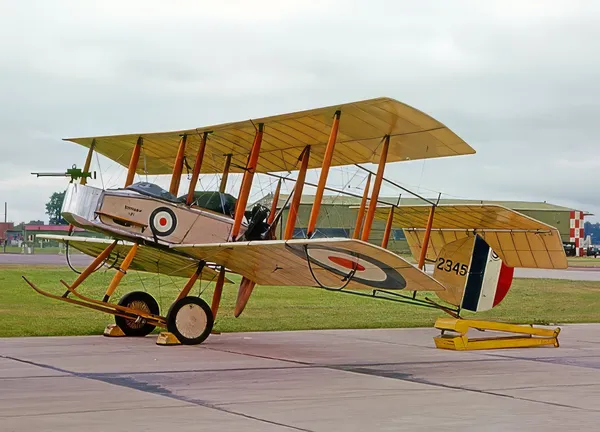
Vickers F.B.5 Gunbus flying replica G-ATVP, painted as 2345 of the Royal Flying Corps, at Yeovilton in 1966; By RuthAS - Own work
The Vickers F.B.5 (Fighting Biplane 5) (known as the "Gunbus") was a British two-seat pusher military biplane of the First World War. Armed with a single .303 in (7.7 mm) Lewis gun operated by the observer in the front of the nacelle, it was the first aircraft purpose-built for air-to-air combat to see service, making it the world's first operational fighter aircraft.
The first F.B.5 was delivered to No. 6 Squadron of the Royal Flying Corps (RFC) at Netheravon in November 1914. The F.B.5 began to be seen on the Western Front when the first reached No.2 Squadron RFC on 5 February 1915. The type served in ones and twos with several other units before No. 11 Squadron RFC became the world's first fighter squadron when, fully equipped with the F.B.5, it deployed to Villers-Bretonneux, France on 25 July 1915.
By the end of 1915, the aircraft was outclassed by the Fokker Eindecker. Examples of the improved Vickers F.B.9 were sent to France, pending sufficient supplies of the Royal Aircraft Factory F.E.2b however both the F.B.5 and F.B.9 were fully withdrawn from frontline service by July 1916. Remaining examples, in British service, were mostly used as trainers. Wikipedia