Anderson, Neil MacDonald (Lieutenant)
Killed in Flying Accident 1954-August-25


Birth Date: 1928-May-10
Born: Hamilton, Hamilton Municipality, Ontario, Canada
Parents: Son of Neil MacDonald Anderson and Anna (nee Furey) Anderson
Spouse: Husband of Deidre Mary (nee Chisholm) Anderson
Home:
Enlistment: Toronto, Ontario
Enlistment Date: 1951-June-12
Service
Army
Unit
6149 (AAC) Sqn- Squadron (USAF)
Base
Chuncheon, South Korea
Rank
Lieutenant
Position
Observer
Service Numbers
ZB10338
 United Nations Memorial Cemetery
 Canadian Virtual War Memorial
 Finadagrave.com
Mission
Texan T-6 LT-6G 493580
Operational 1954-August-25 to 1954-August-25
6149 (AAC) Sqn (USAF) Chuncheon, South Korea
Lieutenant Neil MacDonald Anderson of the Queen's Own Rifles of Canada was serving with his unit in Korea in 1954 when he was selected to fly as an Observer with the USAF 6149th Tactical Control Squadron, 6147 Tactical Control Group, Fifth Air Force, referred to as "The Mosquitos". While flying a training mission in T6 Texan aircraft 49-3580, both Lieutenant Anderson and his pilot, Lieutenant Frank Ernest Arnold Jr were killed when their aircraft stalled, spun into a hillside and exploded near Tanggok, South Korea
 Anderson Neil MacDonald I The Queen's Own Rifles of Canada...
Neil MacDonald Anderson I Veteran's Affairs Canada
Riflemen I The Queen's Own Rifles of Canada Regimental Museum and...
Mosquitos to Wolves. The Evolution of the Airborne Forward Air Controller
USAF Aircraft Accident Reports for 1954
Texan T-6 serial: 493580
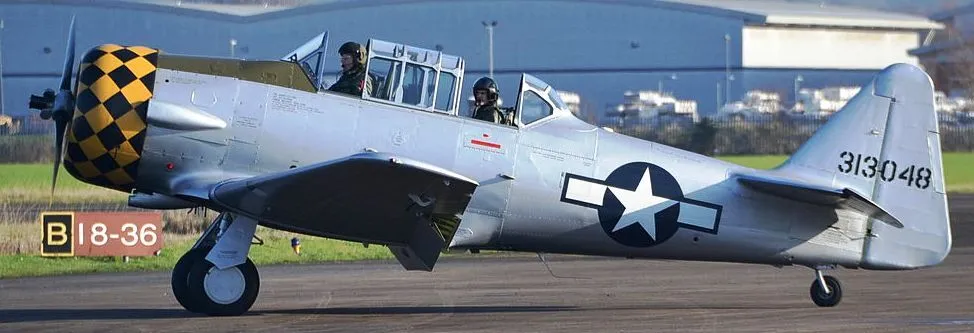
North American AT-6D Texan (Serial No. 313048), Reg. No. G-TDJN, David Nock
The North American Aviation T-6 Texan is an American single-engined advanced trainer aircraft used to train pilots of the United States Army Air Forces (USAAF), United States Navy, Royal Air Force, Royal Canadian Air Force and other air forces of the British Commonwealth during World War II and into the 1970s. Designed by North American Aviation, the T-6 is known by a variety of designations depending on the model and operating air force. The United States Army Air Corps (USAAC) and USAAF designated it as the AT-6, the United States Navy the SNJ, and British Commonwealth air forces the Harvard, the name by which it is best known outside the US. Starting in 1948, the new United States Air Force (USAF) designated it the T-6, with the USN following in 1962. It remains a popular warbird used for airshow demonstrations and static displays. It has also been used many times to simulate various historical aircraft, including the Japanese Mitsubishi A6M Zero. A total of 15,495 T-6s of all variants were built.
At the end of WW II, although the RCAF retained the Harvard as a trainer, a large number of them were sold off to civilian operators. The RCAF soon regretted this, for by 1949 the Cold War with the Soviet Union was in full swing and the RCAF urgently needed trainers again. 100 T-6J Texans were leased temporarily from the USAF and a further 270 Harvards, the Mk. IV version, were ordered from Canadian Car & Foundry, Thunder Bay.
The Texan's ancestry goes back to the North American NA-16 prototype which was first flown on April 1, 1935. In 1935, NAA submitted this design for the U.S. Army Air Corps Basic Trainer Competition. NAA also targeted the export market. Wikipedia (with revisions)
 Wikipedia North American T-6 Texan
 North American T-6 Texan
Texan T-6 493580 LT-6G - Operational - 1954-08-25 to 1954-08-25
6 Group Unavailable
Lieutenant Neil MacDonald Anderson of the Queen's Own Rifles of Canada was serving with his unit in Korea in 1954 when he was selected to fly as an Observer with the USAF 6149th Tactical Control Squadron, 6147 Tactical Control Group, Fifth Air Force, referred to as "The Mosquitos". While flying a training mission in T6 Texan aircraft 49-3580, both Lieutenant Anderson and his pilot, Lieutenant Frank Ernest Arnold Jr were killed when their aircraft stalled, spun into a hillside and exploded near Tanggok, South Korea
Anderson Neil MacDonald I The Queen's Own Rifles of Canada...
Neil MacDonald Anderson I Veteran's Affairs Canada
Riflemen I The Queen's Own Rifles of Canada Regimental Museum and...
Mosquitos to Wolves. The Evolution of the Airborne Forward Air Controller
USAF Aircraft Accident Reports for 1954