Footprints on the Sands of Time, RAF Bomber Command Prisoners of War in Germany 1939-45 by Oliver Clutton-Brock, page 259


Birth Date: unkown date
Born:
Parents:
Spouse:
Home:
Enlistment:
Enlistment Date: unkown date
Service
RAFVR
Unit
115 (B) Sqn- Squadron (RAF)
Despite The Elements
Base
RAF Little Snoring
Rank
Flying Officer
Position
Pilot
Service Numbers
117001
PoW: 3008
 Hanover Germany
Footprints on the Sands of Time, RAF Bomber Command Prisoners of War in Germany 1939-45 by Oliver Clutton-Brock, page 259
115 Squadron RAF (Despite the Elements) RAF Little Snoring. Lancaster II aircraft DS 691 KO-B was shot down from 20000 feet by a combination of flak and night fighter (probably Hauptman Hans-Wolfgang von Niebelschutz of Stab IV/NJG5) during an operation against targets in Hanover Germany. The Lancaster crashed at 01:32 3 km South of Fuhrberg, Germany 22 km NNE of Hanover
Flight Sergeant William Frederick Nethersole (RAAF) and Flight Sergeant Herbert John Willis DFM (RAFVR) were killed in action
Flight Lieutenant Wilfred Collins Blewett (RCAF), Flying Officer William Pryde (RCAF), Flying Officer Arthur Sidney Cade(RAFVR), Sergeant Daryl Eugene Davis (RAFVR) and Sergeant Walter Thomas Mitchell (RAFVR) all survived and were captured to become Prisoners of War.
This was the only aircraft lost by 428 Squadron RCAF lost on this operation
 115 Squadron
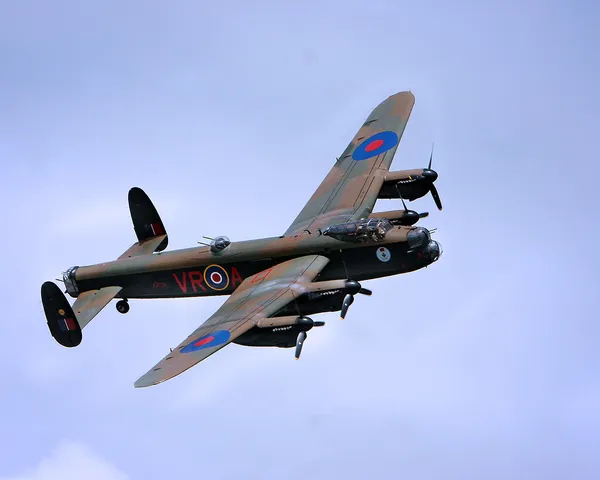
The Avro Lancaster is a British Second World War heavy bomber. It was designed and manufactured by Avro as a contemporary of the Handley Page Halifax, both bombers having been developed to the same specification, as well as the Short Stirling, all three aircraft being four-engined heavy bombers adopted by the Royal Air Force (RAF) during the same wartime era.
The Lancaster has its origins in the twin-engine Avro Manchester which had been developed during the late 1930s in response to the Air Ministry Specification P.13/36 for a capable medium bomber for "world-wide use". Originally developed as an evolution of the Manchester (which had proved troublesome in service and was retired in 1942), the Lancaster was designed by Roy Chadwick and powered by four Rolls-Royce Merlins and in one version, Bristol Hercules engines. It first saw service with RAF Bomber Command in 1942 and as the strategic bombing offensive over Europe gathered momentum, it was the main aircraft for the night-time bombing campaigns that followed. As increasing numbers of the type were produced, it became the principal heavy bomber used by the RAF, the Royal Canadian Air Force (RCAF) and squadrons from other Commonwealth and European countries serving within the RAF, overshadowing the Halifax and Stirling. Wikipedia
No. 115 Sqn was originally formed on Dec 1, 1917 as a heavy bomber squadron and joined the Independent Air Force of the RAF in August 1918. It was disbanded in 1919, then re-formed in June 1937. It formed part of RAF Bomber Command No. 3 Group in WWII. Starting with Handley Page Harrow aircraft, it transferred to Vickers Wellingtons in 1939, which it flew until March 1943, when it transferred to Avro Lancaster B. Mk. II and later B. Mks I and III. Between April 1940 and September 1942 the squadron was seconded to Coastal Command and based at Kinloss, Scotland. It rejoined Bomber Command and flew from Mildenhall, East Wretham and Little Snoring in 1942 and 1943 before settling at Witchford, Cambridgeshire from November 1943 until the end of hostilities.
In April 1940 the squadron made the RAF's first bombing attack on the mainland of Europe, at Stavanger in Norway. In August of 1941 it participated in the service trials of the new navigational aid, GEE, and as a result of its report the device was put into mass production. Overall, in WWII the squadron flew 5392 sorties and dropped about 23,000 tons of bombs. This was the second-highest tonnage of bombs in Bomber Command. The squadron was 3rd in the number of raids in the course of the war. Since it was active over the whole span of WWI, it lost the greatest number of aircraft of any squadron in Bomber Command: it was the only squadron to lose more than 200 aircraft.
War Diary Unavailable
16 Lancasters from 408 and 426 squadrons were joined by 70 Halifaxes from 419, 427, 428, 429, 431, and 434 squadrons and 14 Wellingtons from 432 squadron on an attack at Hannover. The crews were over the target at between 18,000 and 22,000 feet, releasing 272,000 lbs of high explosives and 294,000 lbs of incendiaries. According to reports, the sky was clear and an accurate attack was made with severe damage being caused. Richard Koval (6bombergroup.ca)
115 Squadron RAF (Despite the Elements) RAF Little Snoring. Lancaster II aircraft DS 691 KO-B was shot down from 20000 feet by a combination of flak and night fighter (probably Hauptman Hans-Wolfgang von Niebelschutz of Stab IV/NJG5) during an operation against targets in Hanover Germany. The Lancaster crashed at 01:32 3 km South of Fuhrberg, Germany 22 km NNE of Hanover
Flight Sergeant William Frederick Nethersole (RAAF) and Flight Sergeant Herbert John Willis DFM (RAFVR) were killed in action
Flight Lieutenant Wilfred Collins Blewett (RCAF), Flying Officer William Pryde (RCAF), Flying Officer Arthur Sidney Cade(RAFVR), Sergeant Daryl Eugene Davis (RAFVR) and Sergeant Walter Thomas Mitchell (RAFVR) all survived and were captured to become Prisoners of War.
This was the only aircraft lost by 428 Squadron RCAF lost on this operation
115 Squadron

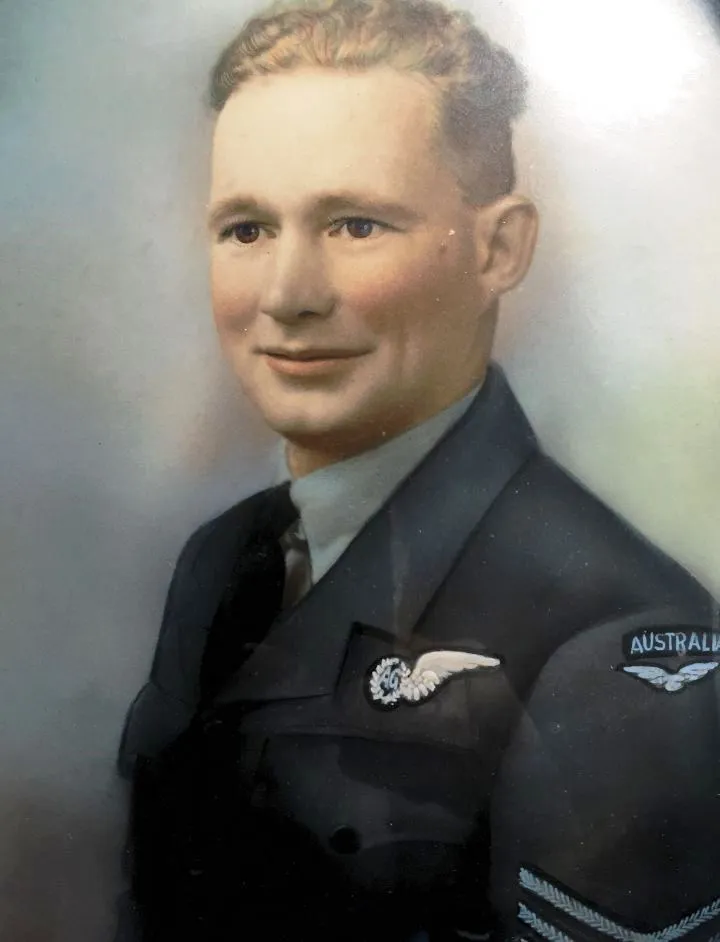

 Lancaster Bomber
 Wikipedia