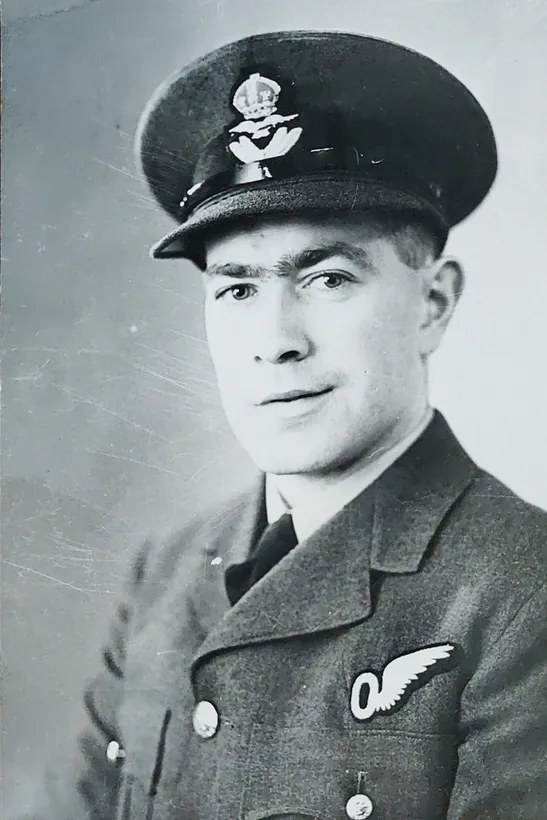
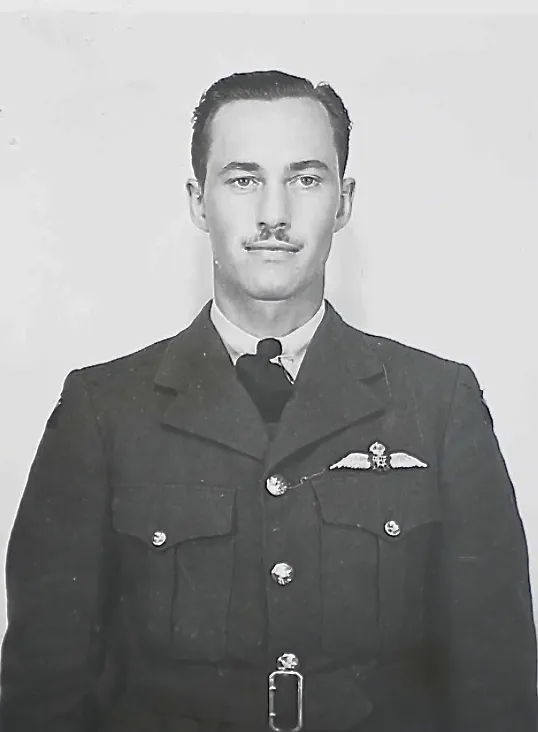
Sepoy Dehru Ram of the Indian Army Service Corps was a passenger aboard Dakota KG 694. After the crash he was pulled from the burning wreckage by Flying Officer John James Baillie GM (RCAF) and survived.
Ram, Dehru ()
Survived 1945-June-14


Birth Date: unkown date
Born:
Parents:
Spouse:
Home:
Enlistment:
Enlistment Date: unkown date
Service
Unit
194 (T) Sqn- Squadron (RAF)
Surrigere colligere To rise and to pick up
Base
Akyab Main, Burma (Sittwe, Myanmar)
Rank
Position
Passenger
Service Numbers
182492
Crew or Other Personnel
Dakota KG694



Mission
Dakota Mk. lll KG694
Transport 1945-June-14 to 1945-June-14
194 (T) Sqn (RAF) Akyab Main, Burma (Sittwe, Myanmar)
194 Squadron (Surrigere coligere) Akyab Main, Burma (now Sittwe, Myanmar). Dakota Mk III KG-694 suffered an engine failure on take off for an airborne supply drop flight which resulted in the aircraft crashing and catching fire three miles south of Myingyan Aerodrome, Burma.
Flight Lieutenant James Murray Rice (RCAF), Warrant Officer 2nd Class John Maynard Cox (RCAF), and one passenger, Pioneer Mohi Din of the 1588 Company, Indian Pioneer Corps were killed in action. After the crash, the Navigator, Flying Officer John James Baillie (RCAF), badly injured, regained consciousness to find himself entangled in the wreckage inside the burning aircraft. He somehow managed to work himself free and got out, only to hear the screams of other crew members still trapped inside. Despite his injuries, Flying Officer Baillie re-entered the burning Dakota to pull out the Wireless Operator, Alexander Smith (RAFVR) and two other passengers, Sepoy Dehru Ram and Barber Nawab Ali, both from the Indian Army Service Corps. Smith later succumbed to his injuries but the other two crew members and Flying Officer Baillie survived
In 1946 Flying Officer Baillie was awarded the George Medal for this act of bravery (D Burke www.rafcommands.com)
Seven to One, A Collection of Stories by John James Baillie and Catherine Louise Baillie
 Royal Air Force Serial and Image Database
Dakota serial: KG694
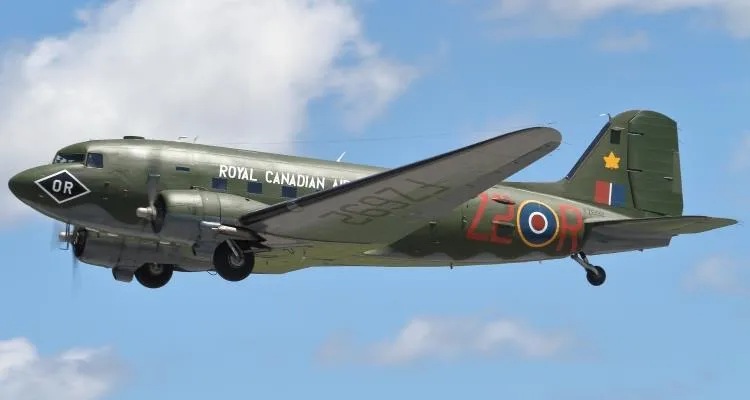
Douglas C-47 Dakota
Canadian Warplane Heritage Museum
Canadian Warplane Heritage Museum
Development of the Douglas DC-3 started in early 1935 with the prototype flying by the end of the year. The first production aircraft was delivered to American Airlines in July 1936 and soon orders were pouring in from US and overseas airlines. The US Air Corps became interested in the DC-3 and ordered a military version, called the C-47 or Dakota. It had many capabilities, including dropping paratroops and supplies, evacuating the wounded, troop transportation and glider towing. Eventually, about 10,000 C-47s were built for the US military.
During WW II, the Royal Air Force received about 1,930 Dakotas and they became the RAF's main wartime transport aircraft. The RCAF took delivery of its first Dakota in March 1943, and at its peak had 169 on strength. Within Canada, they were operated by four transport squadrons and several ferry squadrons.
Overseas, Dakotas equipped RCAF 437 Squadron in Europe and RCAF 435 and 436 Squadrons in South East Asia. 437 Squadron was formed in England September 1944, where it supported the British and Canadian Armies fighting in Europe. Its most important actions involved glider towing for the airborne landings at Arnhem and the Rhine crossing at Wesel.435 and 436 Squadrons were formed in India in October 1944. They flew Dakotas in support of the British 14th Army in Burma where they dropped supplies to the British troops fighting the Japanese in the jungle.
At the end of WW II, all three squadrons were transferred back to England to provide air transport for the Canadian occupation forces in Germany. Dakotas continued in service with the Canadian Armed Forces until 1989, when 402 Squadron, based in Winnipeg, retired the last of them. Of the nearly 13,000 DC-3s built, many are still in service today, over 75 years after the aircraft's first flight.
The Museum's Dakota was built for the USAAF and was delivered to the Royal Air Force in February 1944 as FZ692 and the Royal Canadian Air Force 437 Squadron in September 1944. It was later renumbered as 12945 as part of the Canadian Armed Forces where it served with 424 Squadron for Search & Rescue at CFB Trenton. It performed JATO ignition in flight at the 1970 Canadian National Exhibition Air Show on the Toronto waterfront.
After it was struck off strength by the Canadian Armed Forces in 1973, the aircraft ended up with Environment Canada, where it was used for mineral and environmental surveys. C-GRSB was donated to the Canadian Warplane Heritage Museum in May 2014.
FZ692 has been restored to the paint scheme it would have worn at the end of World War II with 437 Squadron RCAF. FZ692 flew 208 operational trips with 437 Squadron and 16 with 233 Squadron for a total of 224. It ended up flying hundreds of individual legs between airfields in Europe. FZ692 participated in two major airborne operations, Normandy and the Rhine Crossing. It carried 298 casualties to medical aid and repatriated 456 prisoners of war. It carried over 5,100 passengers to destinations around Europe and carried over two hundred tons of freight (414,368 lbs). CWHM
 C-47 Skytrain
 Wikipedia C-47 Skytrain
 CWHM Flightlines
 Dakota Maintenance Manual
Dakota KG694 Mk. lll - Transport - 1945-06-14 to 1945-06-14
Squadron: 194 (T) Sqn (RAF)
Start Date: 1945-06-14
Completion Date: 1945-06-14
Mission: Transport
Operation: unspecified
Target City:
Target Specific:
Base: Akyab Main, Burma (Sittwe, Myanmar)
Take Off Time: 04:45:00
Squadron Code:
Radio Code:
Return Base:
Return Time:
Crash City: Burma (Myanmar)
Crash Specifics: Akyab Main, Burma (now Sittwe, Myanmar)
Crash Latitude: 0.00000000
Crash Longitude: 0.00000000
Crash Reason: engine
Flak Battery:
Enemy Claim:
War Diary Unavailable
6 Group Unavailable
194 Squadron (Surrigere coligere) Akyab Main, Burma (now Sittwe, Myanmar). Dakota Mk III KG-694 suffered an engine failure on take off for an airborne supply drop flight which resulted in the aircraft crashing and catching fire three miles south of Myingyan Aerodrome, Burma.
Flight Lieutenant James Murray Rice (RCAF), Warrant Officer 2nd Class John Maynard Cox (RCAF), and one passenger, Pioneer Mohi Din of the 1588 Company, Indian Pioneer Corps were killed in action. After the crash, the Navigator, Flying Officer John James Baillie (RCAF), badly injured, regained consciousness to find himself entangled in the wreckage inside the burning aircraft. He somehow managed to work himself free and got out, only to hear the screams of other crew members still trapped inside. Despite his injuries, Flying Officer Baillie re-entered the burning Dakota to pull out the Wireless Operator, Alexander Smith (RAFVR) and two other passengers, Sepoy Dehru Ram and Barber Nawab Ali, both from the Indian Army Service Corps. Smith later succumbed to his injuries but the other two crew members and Flying Officer Baillie survived
In 1946 Flying Officer Baillie was awarded the George Medal for this act of bravery (D Burke www.rafcommands.com)
Seven to One, A Collection of Stories by John James Baillie and Catherine Louise Baillie
