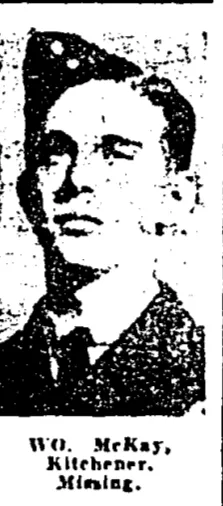
Crew were Flight Lieutenant Hugh Drummond Venables, DFC, Flying Officer H.D. Baker, RCAF and Pilot Officer D.J. McKay, RCAF. See below for more on Venables:
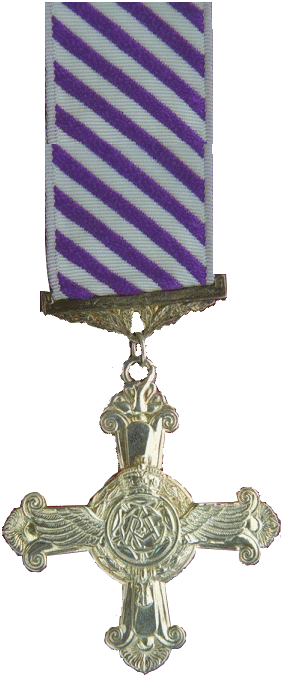
VENABLES, Flight Lieutenant Hugh Drummond (RAF 106029) - Distinguished Flying Cross - No.418 Squadron - awarded as per London Gazette dated 23 March 1943. Born 1915 in Lower Walton, Warrington; educated at Worksop Collegiate, Nottinghamshire; home in Helsby, Cheshire; enlisted 1941 (service number 1032771); commissioned 3 September 1941 (106029) when he qualified as pilot. Promoted Flying Officer, 3 September 1942. Promoted Flight Lieutenant, 19 March 1943, although he was a substantive Squadron Leader when killed in action, 9 April 1943; buried at St. Andre-de-l'Eure, France (killed on Boston W8235). DHist card cites Air Ministry Bulletin 9669.
"This officer has taken part in 29 sorties, including a number of attacks on airfields in Holland, Belgium and France. In attacks on lines of communication and installations Flight Lieutenant Venables has damaged numerous locomotives storage tanks by machine gun fire. His inspiring leadership, great ability and outstanding devotion to duty have contributed materially to the high standard of operational efficiency of his flight (Source Hugh Halliday)
St. Andre-De-L'eure Communal Cemetery, France
Boston Mk. III W8325
Aircraft collided with Do217 night fighter and crashed near Melun-Bretigny, France.
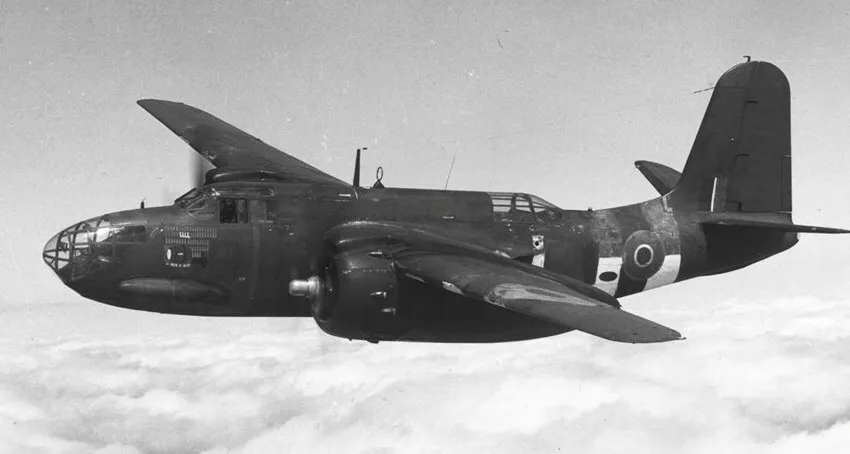
(DND Photo via James Craik) Douglas Boston Mk. III, RAF No. 88 Squadron, c1944
The Douglas A-20 Havoc (company designation DB-7) is an American medium bomber, attack aircraft, night intruder, night fighter, and reconnaissance aircraft of World War II. Designed to meet an Army Air Corps requirement for a bomber, it was ordered by France for their air force before the USAAC decided it would also meet their requirements. French DB-7s were the first to see combat; after the fall of France the bomber, under the service name Boston continued with the Royal Air Force. From 1941, night fighter and intruder versions were given the service name Havoc. In 1942 USAAF A-20s saw combat in North Africa.
In most British Commonwealth air forces, the bomber variants were known as Boston, while the night fighter and intruder variants were named Havoc. The exception was the Royal Australian Air Force, which used the name Boston for all variants.
In March 1936, a design team headed by Donald Douglas, Jack Northrop, and Ed Heinemann produced a proposal for a bomber-reconnaissance aircraft powered by a pair of 450 hp (340 kW) Pratt & Whitney R-985 Wasp Junior radial engines mounted on a shoulder wing. It was estimated to be capable of 250 mph (400 km/h) with a 680 lb (310 kg) bomb load. Reports of aircraft performance from the Spanish Civil War indicated that this design would be seriously underpowered, and it was canceled.
A-20A
In 1937, the United States Army Air Corps (USAAC) issued a new specification for an attack aircraft. To meet this requirement, the Douglas team, now headed by Heinemann, developed the Model 7B, with a similar layout to the 7A, but was powered by 1,100 hp (820 kW) Pratt & Whitney R-1830-S3C3-G Twin Wasp engines, and carried a heavier bombload (up to 2,000 lb (910 kg)). It faced competition from the North American NA-40, Stearman X-100, Martin 167F, and an unbuilt design from Bell Aircraft, the Model 9. The Air Corps invited all five companies to build prototypes at their own expense and to submit sealed bids for production of their aircraft.
The prototype Model 7B made its first flight on 26 October 1938. The model attracted the attention of a French Purchasing Commission visiting the United States. The French discreetly participated in the flight trials, so as not to attract criticism from American isolationists. The Model 7B crashed on 23 January 1939 while demonstrating single-engine performance, killing the test pilot and seriously injuring a French observer aboard the aircraft. The presence of a foreigner on a test flight for an aircraft still under development caused a scandal in the press. Despite the crash, the French were impressed enough to place an order for 100 production aircraft on 15 February 1939, following this up with an order for 170 more in October 1939.
As a result of the French order, Heinemann carried out another major redesign of the aircraft. While the design's wings were largely unchanged, the revised design had a new deeper but narrower fuselage, which accommodated a crew of three, a pilot, bombardier and a gunner. The wing was mounted lower than on the Model 7B, while the engines, 1,000 hp (750 kW) R-1830-SC3-Gs, were mounted in nacelles slung under the wings. Normal bomb load was 1,410 lb (640 kg), or 1,800 lb (800 kg) in overload conditions, with a defensive armament of single 7.5mm MAC 1934 machine guns in dorsal and ventral mounts and four fixed forward-firing guns in the nose. The revised aircraft, the DB-7, first flew on 17 August 1939.
In 1939, the USAAC decided that the new bomber was best placed to meet its requirements for an attack bomber, which had been updated in 1938 from those that gave rise to the Model 7B, and in June 1939, it ordered 186 aircraft powered by Wright R-2600 engines, under the designations A-20 and A-20A (with the A-20s having 1,700 hp (1,300 kW) turbosupercharged R-2600-7 engines and the A-20As having 1,600 hp (1,200 kW) supercharged R-2600-3 or -11 engines. These had a larger vertical tail to cope with the increased power of the Wright engines, had a longer nose to give more room for the bombardier/navigator, and carried more fuel. R-2600 powered aircraft also proved popular for export, with France ordering 100 DB-7As powered by the R-2600 but with the short nose of the DB-7 in October 1939, and 480 long-nosed DB-73s, equivalent to the A-20A, in April 1940 and Great Britain ordering 300 DB-7Bs, again equivalent to the A-20A in February and April 1940.
In a report to the British Aeroplane and Armament Experimental Establishment (AAEE) at RAF Boscombe Down, test pilots summed it up as: "has no vices and is very easy to take off and land ... The aeroplane represents a definite advantage in the design of flying controls ... extremely pleasant to fly and manoeuvre." Ex-pilots often consider it their favorite aircraft of the war due to the ability to toss it around like a fighter. The Douglas bomber/night fighter was found to be extremely adaptable and found a role in every combat theater of the war, and excelled as a true "pilot's aeroplane".
When DB-7 series production finally ended on 20 September 1944, a total of 7,098 had been built by Douglas and a further 380 by Boeing. Douglas redesigned its Santa Monica plant to create a mechanized production line to produce A-20 Havocs. The assembly line was over a mile long (6,100 feet), but by looping back and forth, fitted into a building that was only 700 feet long. Man-hours were reduced by 70% for some operations while production tripled. October of 1940, the USAAC adopted converted Douglas A-20 Havocs as P-70 night fighters. The RCAF acquired three Douglas A-20 Bostons for "special" research operations at Suffield, Alberta, from 1941 to 1946.
No. 418 "City of Edmonton" (Intruder) Squadron, RCAF, was formed overseas at Debden, Essex, England on 15 Nov 1941. It was the RCAF's only Intruder squadron and flew the Douglas Boston and de Havilland Mosquito on day and night-intruder operations deep into enemy territory. No. 418 (Intruder) Squadron claimed 178 enemy aircraft and 79-1/2 V-1 flying bombs destroyed, making it the top-scoring unit of the RCAF. The leading individual score was Squadron Leader Russell Bannock, with 11 aircraft and 18-1/2 V-1s. He was also the squadron's CO from 10 Oct - 22 Nov 1944. Wikipedia and Harold A Skaarup web page
On 21 Nov, No. 418 (Intruder) Squadron was transferred to close support work with the Second Tactical Air Force in the Low Countries. The squadron was disbanded at Volkel, in the Netherlands on 7 Sep 1945.
No. 418 (Intruder) Squadron Douglas Boston Mk. III, were flown from Nov 1941 to Jul 1943.
History of the Squadron during World War II (Aircraft: Boston III, Mosquito II, FB Mk VI)
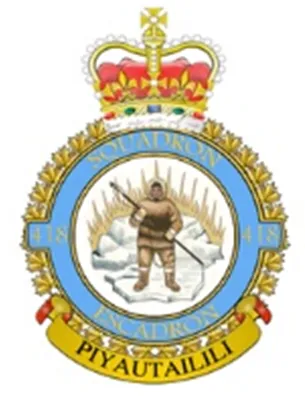
[Note that the squadron crest and motto were not given to the squadron until after WWII. During WWII the squadron had neither crest nor motto.] The squadron was formed at Debden, Essex, UK in November 1941as the RCAF's only Intruder Squadron. As such, it was attached to 11 Group of Fighter Command (later renamed Air Defence of Great Britain), conducting day and night intruder operations. These involved a variety of targets, strategic attacks and intruder attacks on airfields. Originally the squadron flew Douglas Boston Mk. III, with the squadron code letters being TH. They flew from a number of airfields in the south of England from 1942 to 1944, namely Debden, Bradwell Bay, Ford, Holmsley South, Hurn, Middle Wallop and Hunsdon. In March 1943 the squadron re-equipped with de Havilland Mosquito Mks. II and F.B. VI aircraft., with a marked increase in their successes in destroying enemy aircraft. The squadron claimed its hundredth victory in May 1944. After D-Day the squadron was involved in the campaign against V-1 and V-2 weapons.
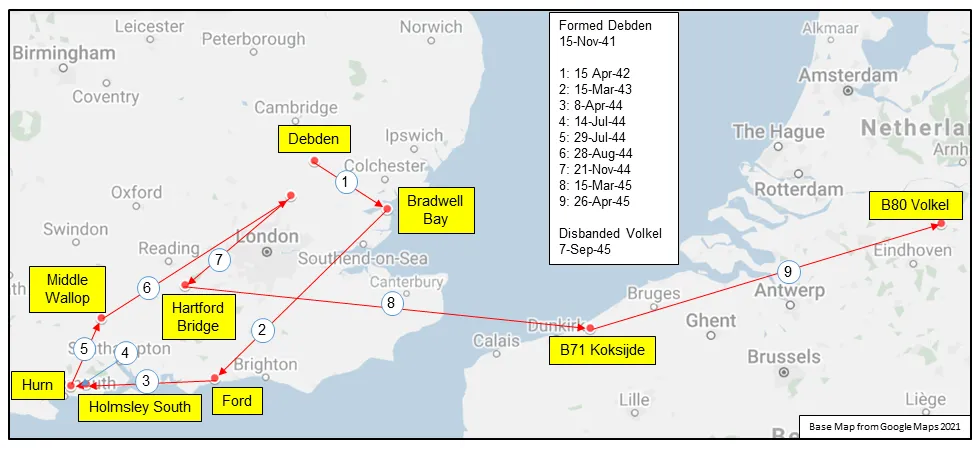
On November 21, 1944 the squadron was transferred from Fighter Command to the 2nd Tactical Air Force in No. 136 (RAF) Wing and operated from Hartford Bridge, Hampshire, UK. before moving to Base 71 at Coxyde, Belgium, and then finally moving to Base 80 at Volkel, the Netherlands . The squadron was disbanded there on September 7th 1945.
The squadron was the most high-scoring unit of the RCAF in WWII. It claimed 178 aircraft and 79 and a half V-1 Flying Bombs. There were a number of aces, among them Wing Commander R. Bannock, DFC and Bar, Squadron Leader R. Gray, DFC, Flying Officer S.P. Reid DFC, Squadron Leader H.D. Cleveland DFC, Flight Lieutenant C.M. Jasper DFC, Flight Lieutenant J. Evans, Flight Lieutenant S.H.R. Cotterill DFC, Flight Lieutenant D.E. Forsyth, Squadron Leader J.B. Kerr, Flight Lieutenant H.E. Miller and Flight Lieutenant P.S. Leggatt. The squadron won 3 DSO's, 42 DFC's, 9 Bars to DFC's, 1 Second Bar to DFC, 5 DFM's, 1 DFC(USA) and 1 Air Medal (USA). Overall, 3492 sorties were flown, 402 of which were on anti-V-1 patrols. 11,248 hours were flown operationally for the loss of 59 aircraft. The squadron was credited with destroying 178 aircraft, 17 locomotives destroyed and 59 damaged, with other destruction of rolling stock and motor vehicles. Battle Honours were: Defence of Britain 1944, Fortress Europe 1942-44, Dieppe, France and Germany 1944-45, Normandy 1944, Rhine. Wikipedia, Kostenuk and Griffin
Map for Movements of 418 Squadron 1941-45
MAP 1: 418 Squadron Movements 1941-45 (right-click on image to display enlarged in new tab)
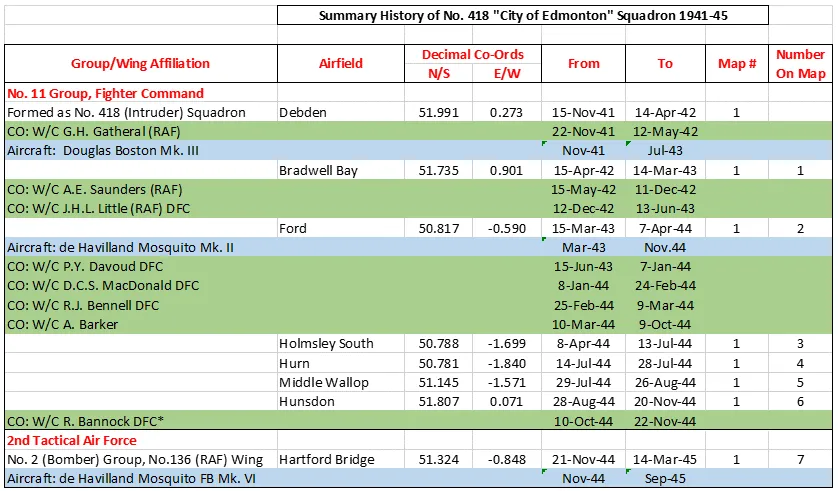
418 Squadron History Summary 1941-45
418 Squadron History Summary 1941-45 Page 2
History of the Squadron Post-WWII (Aircraft: Harvard II, Mitchell, Expeditor, Silver Star, Otter, Twin Otter, Kingfisher)
The squadron re-formed at Edmonton, Alberta on 15 April 1946, flying North American B-5 Mitchell aircraft in a light bomber role. It moved to RCAF Station Namao, Alberta in 1955. In March 1958 it was reassigned to a light transport and emergency rescue role and was re-equipped with Beechcraft Expeditor and de Havilland Otter aircraft. Its duties ranged from aid to the civil power to aerial resupply. On 27 May 1967 it received a Squadron Standard for 25 years’ service. On 1 February 1968 the squadron was integrated into the Canadian Armed Forces as No. 418 “City of Edmonton” Air Reserve Squadron, and acquired de Havilland Twin Otter aircraft The squadron was disbanded in 1994, its aircraft being transferred to No 440 Transport Squadron.
418 Squadron was re-formed on March 13, 2019, The unit is based at 19 Wing Comox, British Columbia as 418 Search and Rescue Operational Training Squadron, training aircrew and maintenance personnel on the CC-295 Kingfisher, using simulators and aircraft, when the aircraft are delivered.
Specifications
In 1939, the USAAC decided that the new bomber was best placed to meet its requirements for an attack bomber, which had been updated in 1938 from those that gave rise to the Model 7B, and in June 1939, it ordered 186 aircraft powered by Wright R-2600 engines, under the designations A-20 and A-20A (with the A-20s having 1,700 hp (1,300 kW) turbosupercharged R-2600-7 engines and the A-20As having 1,600 hp (1,200 kW) supercharged R-2600-3 or -11 engines. These had a larger vertical tail to cope with the increased power of the Wright engines, had a longer nose to give more room for the bombardier/navigator, and carried more fuel. R-2600 powered aircraft also proved popular for export, with France ordering 100 DB-7As powered by the R-2600 but with the short nose of the DB-7 in October 1939, and 480 long-nosed DB-73s, equivalent to the A-20A, in April 1940 and Great Britain ordering 300 DB-7Bs, again equivalent to the A-20A in February and April 1940
https://en.wikipedia.org/wiki/Douglas_A-20_Havoc


 Helsby, Cheshire England (parents)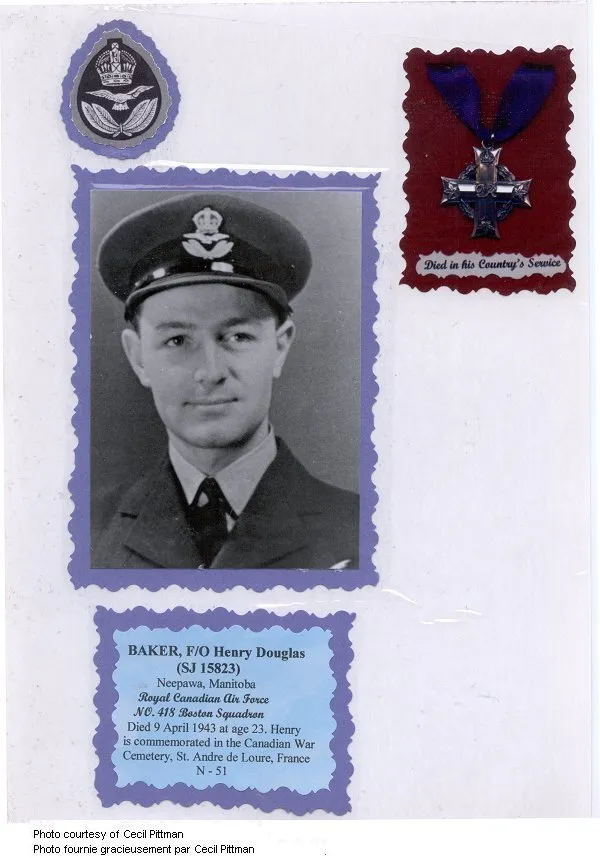

 Douglas A-20 Havoc
 Harold A Skaarup Web Page