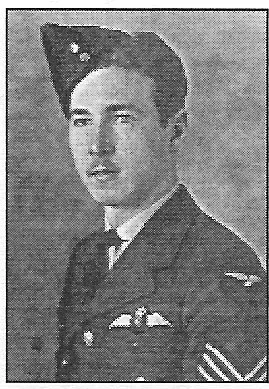
Warrant Officer Class 2 WA MacDonald (RCAF) had previously survived the crash of 405 Squadron Halifax BII aircraft W 1096 LQ-O, 1942-11-17 on a routine cross country flight while the Squadron was attached to RAF Coastal Command. The Mid-Upper Gunner accidentally fired his guns into the port-inner engine of his aircraft, causing a fire and hydraulic failure and resulted in a crash
Footprints on the Sands of Time, RAF Bomber Command Prisoners of War in Germany 1939-45 by Oliver Clutton-Brock, page 349MacDonald, William Alexander (Warrant Officer 1st Class)
Prisoner of War 1943-March-12


Birth Date: unkown date
Born:
Parents:
Spouse:
Home: Sydney, Nova Scotia
Enlistment:
Enlistment Date: unkown date
Service
RCAF
Unit
405 (B) Sqn- Squadron
Ducimus We Lead
Base
RAF Topcliffe
Rank
Warrant Officer 1st Class
Position
Bomb Aimer
Service Numbers
R/76136
PoW: 1014
Crew or Other Personnel
Halifax DT745
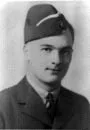


Mission
Halifax B/GR.Mk.II DT745
Bombing Stuttgart Germany 1943-March-11 to 1943-March-12
405 (B) Sqn (RCAF) RAF Topcliffe
Battle of the Ruhr
405 Vancouver Squadron (Ducimus) RAF Topcliffe. Halifax BII aircraft DT 745 LQ-V was attacked at 15,000 feet and shot down by night fighter pilot Lt Jakob Schaus of the 4/NJG 4, flying a Bf 110 from Saint-Dizier airfield, during an attack on targets in Stuttgart , Germany. The Halifax crashed near Chlons-sur-Marne, France
This was the first loss from 405 Squadron after it returned to Bomber Command from a five month attachment to Coastal Command
Pilot Officer HD Rea (RCAF), Flying Officer WA MacDonald (RCAF), Flight Sergeant JJ Maguire (RAAF), (2nd Pilot) Sergeant HJ Mason (RAF), Pilot Officer KPC Money (RAF) and Flight Sergeant P Johnston (RAF) survived and all were taken as Prisoners of War
Flight Sergeant P Dmytruk (RCAF) and Pilot Officer KW Elt (RAF) survived and evaded. Pilot officer Elt, with the aid of an escape organization, made his way to Gibraltar and eventually back to the UK. Flight Sergeant Dmytruk joined the French Resistance but was captured and shot after an ambush 1943-12-09
 [Royal Air Force serial and Image Database]...
Halifax serial: DT745
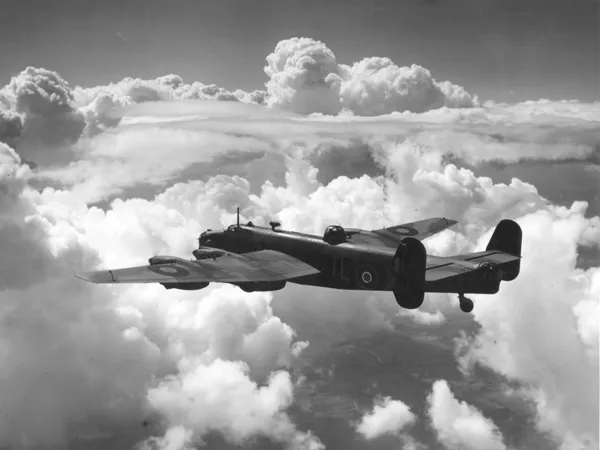
(RAF Photo, 1942)(Source Harold A Skaarup Web Page)
A Royal Air Force Handley Page Halifax Mk. II Series I (Serial No. W7676), coded TL-P, of No. 35 Squadron, RAF, based at Linton-on-Ouse, Yorkshire in the UK, being piloted by Flight Lieutenant Reginald Lane, (later Lieutenant-General, RCAF), over the English countryside. Flt Lt Lane and his crew flew twelve operations in W7676, which failed to return from a raid on Nuremberg on the night of 28/29 August 1942, when it was being flown by Flt Sgt D. John and crew.
The Handley Page Halifax is a British Royal Air Force (RAF) four-engined heavy bomber of the Second World War. It was developed by Handley Page to the same specification as the contemporary twin-engine Avro Manchester.
The Halifax has its origins in the twin-engine HP56 proposal of the late 1930s, produced in response to the British Air Ministry's Specification P.13/36 for a capable medium bomber for "world-wide use." The HP56 was ordered as a backup to the Avro 679, both aircraft being designed to use the underperforming Rolls-Royce Vulture engine. The Handley Page design was altered at the Ministry to a four-engine arrangement powered by the Rolls-Royce Merlin engine; the rival Avro 679 was produced as the twin-engine Avro Manchester which, while regarded as unsuccessful mainly due to the Vulture engine, was a direct predecessor of the famed Avro Lancaster. Both the Lancaster and the Halifax would emerge as capable four-engined strategic bombers, thousands of which would be built and operated by the RAF and several other services during the War.
On 25 October 1939, the Halifax performed its maiden flight, and it entered service with the RAF on 13 November 1940. It quickly became a major component of Bomber Command, performing routine strategic bombing missions against the Axis Powers, many of them at night. Arthur Harris, the Air Officer Commanding-in-Chief of Bomber Command, described the Halifax as inferior to the rival Lancaster (in part due to its smaller payload) though this opinion was not shared by many of the crews that flew it, particularly for the MkIII variant. Nevertheless, production of the Halifax continued until April 1945. The operational statistics from the Bomber Command War Room Manual, state 82,773 operational sorties 2,232 aircraft lost of which 1,833 were missing, in addition there were 365 anti submarine patrols with 4 aircraft lost. Halifax laid 9,572 mines according to the war manual, daily reports total 9,550 being 851x1000, 6,450x1500 and 2,248x1850 pound mines.. The Halifax was also flown in large numbers by other Allied and Commonwealth nations, such as the Royal Canadian Air Force (RCAF), Royal Australian Air Force (RAAF), Free French Air Force and Polish forces. Wikipedia
 Halifax Heavy Bomber WWII
 Wikipedia Halifax Bomber
 National Air Force Museum of Canada
Unit Desciption
405 (B) Sqn Ducimus ("Vancouver")
Group
Squadron
Base
County
Arrived
Comments
4
405
Driffield
Yorkshire
1941-April-23
Formed. Wellington II, 05/41.
4
405
Pocklington
Yorkshire
1941-June-20
Halifax II, 04/42.
4
405
Beaulieu
Hampshire
1942-October-25
4
405
Beaulieu
Yorkshire
1943-March-01
Detached Coastal Command.
6
405
Topcliffe
Yorkshire
1943-March-01
Rejoined from Coastal Command.
6
405
Leeming
Yorkshire
1943-March-14
To 8 Group, 18/04/43.
8
405
Gransden Lodge
Bedfordshire
1943-April-18
Ex-6 Group. Lancaster I, 08/43. Lancaster III, 08/43. Lancaster X, 05/45. To 6 Group, 26/05/45.
6
405
Linton-On-Ouse
Yorkshire
1945-May-26
Ex-8 Group. To Canada 16/06/45.
History of the Squadron during World War II (Aircraft: Wellington II, Halifax II, Lancaster I, III & X)
This was the first RCAF bomber squadron to be activated at Driffield, Yorkshire, England  and flew its first mission on 12/13 June 1941. At that time it was a member of 4 Group of Bomber Command, and flew successively from Driffield, Pocklington and Topcliffe, Yorkshire, England. With Code Letters LQ It flew Wellington Mk II aircraft until converting to Halifax II in April 1942, in time for the first 1000-bomber raid on Cologne. In October 1942 it was transferred to Coastal Command No 18 Group, flying over the Bay of Biscay from Beaulieu, Hampshire. Returning to Bomber Command, the squadron joined No 6 (RCAF) Group and flew from Topcliffe and Leeming, Yorkshire in March and April 1943. It was then seconded to No. 8 (Pathfinder) Group and for the rest of the war flew from Grandsen Lodge, Bedfordshire, UK . Its first Pathfinder mission was on 26th April 1943, and its last on 25th April 1945. It was slated to become part of the "Tiger Force" to attack Japan, but the surrender of Japan precluded that, and the Squadron was disbanded at Greenwood, Nova Scotia on September 5th, 1945. One of the aircraft that flew briefly with the squadron was the first Canadian-built Lancaster Mk. X, KB700, christened the "Ruhr Express", which was subsequently transferred to 419 Sqn RCAF in December 1943.
Overall, the squadron flew 4427 sorties, of which 349 were with Coastal Command and 41 were in Operation Exodus, the repatriation of POWs. Nearly 25000 operational hours were logged together with 12,000 non-operational, and 12,856 tons of bombs were dropped. In the course of operations, 167 aircraft were lost with 937 aircrew. In the course of its history, squadron members were awarded 9 DSO's, 161 DFC's and 24 Bars to DFC's, 38 DFM's, 2 CGM's 2 BEM's and 11 MiD's. Battle Honours were: Fortress Europe 1941-44, France and Germany 1944-45, Biscay Ports 1941-45, Ruhr 1941-45, Berlin 1941; 1943-44, German Ports 1941-45, Normandy 1944, Walcheren, Rhine; Biscay 1942-43.Moyes, Kostenuk and Griffin
and flew its first mission on 12/13 June 1941. At that time it was a member of 4 Group of Bomber Command, and flew successively from Driffield, Pocklington and Topcliffe, Yorkshire, England. With Code Letters LQ It flew Wellington Mk II aircraft until converting to Halifax II in April 1942, in time for the first 1000-bomber raid on Cologne. In October 1942 it was transferred to Coastal Command No 18 Group, flying over the Bay of Biscay from Beaulieu, Hampshire. Returning to Bomber Command, the squadron joined No 6 (RCAF) Group and flew from Topcliffe and Leeming, Yorkshire in March and April 1943. It was then seconded to No. 8 (Pathfinder) Group and for the rest of the war flew from Grandsen Lodge, Bedfordshire, UK . Its first Pathfinder mission was on 26th April 1943, and its last on 25th April 1945. It was slated to become part of the "Tiger Force" to attack Japan, but the surrender of Japan precluded that, and the Squadron was disbanded at Greenwood, Nova Scotia on September 5th, 1945. One of the aircraft that flew briefly with the squadron was the first Canadian-built Lancaster Mk. X, KB700, christened the "Ruhr Express", which was subsequently transferred to 419 Sqn RCAF in December 1943.
Overall, the squadron flew 4427 sorties, of which 349 were with Coastal Command and 41 were in Operation Exodus, the repatriation of POWs. Nearly 25000 operational hours were logged together with 12,000 non-operational, and 12,856 tons of bombs were dropped. In the course of operations, 167 aircraft were lost with 937 aircrew. In the course of its history, squadron members were awarded 9 DSO's, 161 DFC's and 24 Bars to DFC's, 38 DFM's, 2 CGM's 2 BEM's and 11 MiD's. Battle Honours were: Fortress Europe 1941-44, France and Germany 1944-45, Biscay Ports 1941-45, Ruhr 1941-45, Berlin 1941; 1943-44, German Ports 1941-45, Normandy 1944, Walcheren, Rhine; Biscay 1942-43.Moyes, Kostenuk and Griffin
Squadron History (Bomber Command Museum PDF)
Maps for Movements of 405 Squadron 1941-45
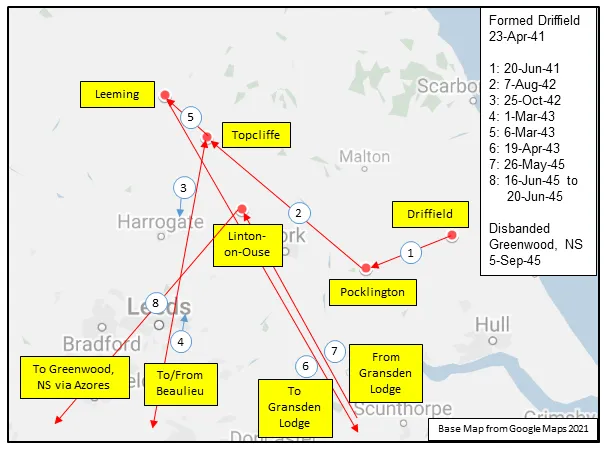
MAP 1: 405 Squadron Movements in Yorkshire 1941-45 (right-click on image to display enlarged in new tab)
|
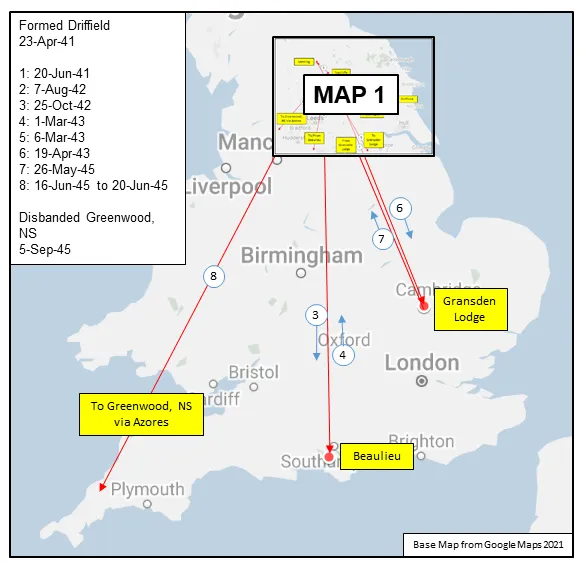
MAP 2: 405 Squadron Movements in England 1941-45
|
405 Sqn History Summary 1941-45
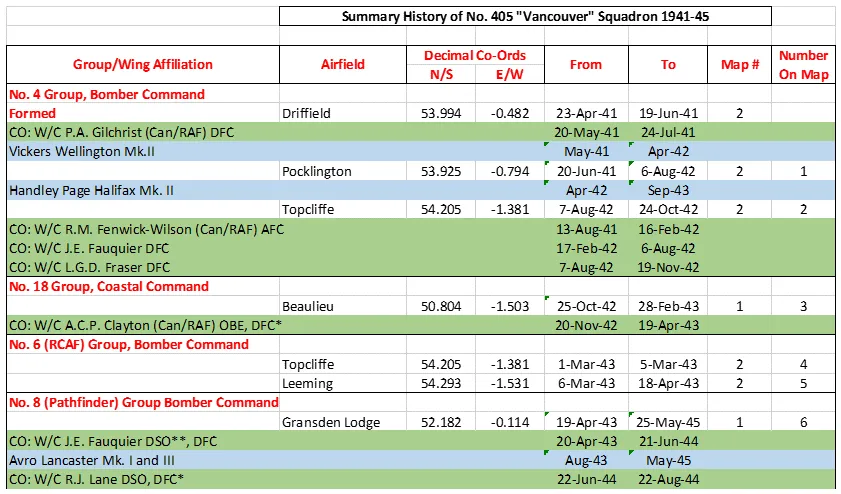
405 Sqn History Summary 1941-45 Page 2
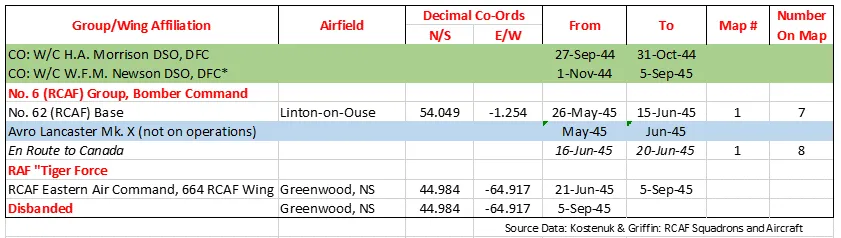
History of the Squadron Post-WWII (Aircraft: Lancaster X, Neptune, Argus I & II, Aurora)
The squadron was re-formed as No 405 (Maritime Reconnaissance) Squadron at Greenwood, Nova Scotia on 31 March 1950, and redesignated No 405 (Maritime Patrol) Sqn on 17 July 1956. The squadron was the first of four formed in Maritime Air Command. It flew modified Lancaster Mk. X aircraft until mid-1955, when they were replaced by P2V7 Lockheed Neptunes, which gave an enhanced anti-submarine capability. and the first to fly Lancaster, Neptune and Argus aircraft on East Coast maritime duty. In April 1958 the squadron was given the distinction of being the first to fly the Canadian-built CP-107 Argus. The squadron made its last flight in the Argus on 10 November 1980 before introducing the CP-140 Aurora. On 1 February 1968 the squadron was integrated into the Canadian Armed Forces. It is now designated No 405 Long Range Patrol Squadron, flying from Greenwood, NS.
The squadron’s primary combat functions are Anti-Submarine Warfare (ASW) and Anti-Surface (ASUW). The Squadron regularly trains for its roles by participating in a number of naval exercises at home and abroad. However, most of its time is taken up in a number of non-combat roles, including search and rescue and support to other government departments, including counter-drug operations with the Royal Canadian Mounted Police (RCMP) and fisheries patrols with the Department of Fisheries and Oceans. Year-round, the Squadron carries out sovereignty patrols covering the Canadian Arctic Archipelago and maritime areas of interest . During these patrols, 405 LRPS crews maintain a constant vigil for ships that discharge pollutants illegal at sea. Similarly, its crews verify that foreign and Canadian fishing vessels abide by their Canadian licensing agreements and report suspected violators to DFO patrol boats.
405 LRPS regularly deploys to a number of allied bases for an assortment of exercises and missions. Among its international training sites are US NAS Keflavik (Iceland), US NAS Sigonella (Sicily, Italy), US NAS Oceana (Virginia, USA), US NAS Jacksonville (Florida, USA), US NAS Roosevelt Roads (Puerto Rico), UK RAF Kinloss (Moray, Scotland),UK RAF Station St. Mawgan (Cornwall, England) and NL NAS Valkenburg (Netherlands).
Previous Events
1942-November-17 Sergeant Survived
Halifax B.Mk.IILQ@O |
405 B Sqn RCAF |
Halifax B.Mk.II W1096
Operational 1942-November-17 to 1942-November-17
405 (B) Sqn (RCAF) RAF Coastal Command, Beaulieu
405 City of Vancouver Squadron (Ducimus) RAF Beaulieu. Halifax BII aircraft W 1096 LQ-O, nicknamed "Every Drop Counts" went into a spin and crashed at Wicken Bonhunt, two and one half miles west of Newport, Essex during a routine cross-country flight
The crash was caused when the Mid-Upper gunner accidentally fired his guns and hit the port inner engine even though the guns were not supposed to be able to depress that far. The engine fire and hydraulic failure cause the aircraft to spin out of control and crash
405 Squadron was attached to Coastal Command from late October 1942 until the end of February 1943 before joining 6 Group in March of 1943
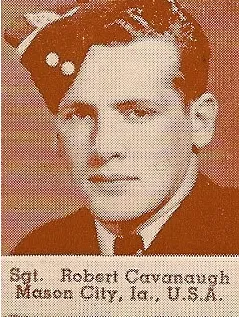
Flight Sergeant AJ DoIding (RCAF), Warrant Officer Class 2 GH Richards (RCAF), Sergeant RJ Cavanaugh (RCAF)(USA) and Flying Officer H Landau (RAFVR) were killed in this flying accident
Sergeant HF Jackson (RCAF) survived, although seriously injured and Sergeant WA MacDonald (RCAF), who managed to bail safely, survived without injury
There were only six aircrew aboard for this flight, no rear air gunner recorded
[Royal Air Force Serial and Image Database]...
405 Squadron Halifax IIB W1096 LQ-O Sgt. Dolding, RAF Beaulieu



Halifax DT745 B/GR.Mk.II - Bombing Stuttgart Germany - 1943-03-11 to 1943-03-12
Squadron: 405 (B) Sqn (RCAF)
Start Date: 1943-03-11
Completion Date: 1943-03-12
Mission: Bombing
Operation: Battle of the Ruhr
Target City: Stuttgart Germany
Target Specific:
Base: RAF Topcliffe
Take Off Time: 19:06
Squadron Code: LQ-V
Radio Code:
Return Base:
Return Time:
Crash City: France
Crash Specifics: near Chlons-sur-Marne
Crash Latitude: 0.00000000
Crash Longitude: 0.00000000
Crash Reason: fighter
Flak Battery:
Enemy Claim: Lt Jakob Schaus of the 4/NJG 4
War Diary Unavailable
6 Bomber Group March 11/12, 1943
35 Halifaxes from 405, 408, and 419 Squadrons were ordered on an attack at Stuttgart. The crews were over the target between 12,000 and 18,000 feet, releasing 195,000 lbs of high explosives. According to reports, this attack was not successful. Richard Koval (6bombergroup.ca)
405 Vancouver Squadron (Ducimus) RAF Topcliffe. Halifax BII aircraft DT 745 LQ-V was attacked at 15,000 feet and shot down by night fighter pilot Lt Jakob Schaus of the 4/NJG 4, flying a Bf 110 from Saint-Dizier airfield, during an attack on targets in Stuttgart , Germany. The Halifax crashed near Chlons-sur-Marne, France
This was the first loss from 405 Squadron after it returned to Bomber Command from a five month attachment to Coastal Command
Pilot Officer HD Rea (RCAF), Flying Officer WA MacDonald (RCAF), Flight Sergeant JJ Maguire (RAAF), (2nd Pilot) Sergeant HJ Mason (RAF), Pilot Officer KPC Money (RAF) and Flight Sergeant P Johnston (RAF) survived and all were taken as Prisoners of War
Flight Sergeant P Dmytruk (RCAF) and Pilot Officer KW Elt (RAF) survived and evaded. Pilot officer Elt, with the aid of an escape organization, made his way to Gibraltar and eventually back to the UK. Flight Sergeant Dmytruk joined the French Resistance but was captured and shot after an ambush 1943-12-09
[Royal Air Force serial and Image Database]...
Daily Operations 6bombergroup.ca
