Trew, Victor George (Sergeant)
Survived 1943-June-12


Birth Date: unkown date
Born:
Parents:
Spouse:
Home:
Enlistment:
Enlistment Date: unkown date
Service
RAFVR
Unit
431 (B) Sqn- Squadron
The Hatiten Ronteriios Warriors of the Air: Iroquois
Base
RAF Burn
Rank
Sergeant
Position
Wireless Operator/Air Gunner
Service Numbers
13281877
Target
 Dusseldorf Germany
Crew or Other Personnel
Wellington HF543
Mission
Wellington B. Mk. X HF543
Bombing Dusseldorf Germany 1943-June-11 to 1943-June-12
431 (B) Sqn (RCAF) RAF Burn
783 aircraft - 326 Lancasters, 202 Halifaxes, 143 Wellingtons, 99 Stirlings, 13 Mosquitoes. This was the first night that more than 200 Halifaxes took part in a raid. 38 aircraft- 14 Lancasters, 12 Halifaxes, 10 Wellingtons, 2 Stirlings - lost, 4.9 per cent of the force.
The Pathfinder marking plan proceeded excellently until an Oboe Mosquito inadvertently released a load of target indicators 14 miles north-east of Dusseldorf. This caused part of the Main Force to waste its bombs on open country. But the main bombing caused extensive damage in the centre of Dusseldorf, where 130 acres were claimed as destroyed, and this proved to be the most damaging raid of the war for this city.
Dusseldorf reports that the fire area measured 8· km by 5 km, covering the city centre - both the old and new parts, the Derendorf district and the south of the city. No less than 8,882 separate fire incidents were recorded of which 11,144 were classified as large. 1,292 people were killed. 140,000 people were bombed out of their homes The list of destroyed and seriously damaged industrial and public buildings coven typed pages in the Dusseldorf report! 42 industries connected with the war effort suffered complete stoppages of production and 35 more suffered a partial reduction. 20 military establishments were hit. 8 ships were sunk or damaged. The Gau (province) local government headquarters was destroyed.
source: The Bomber Command War Diaries, Martin Middlebrook and Chris Everitt
Wellington BX aircraft HF 543 SE-P, after completing an operation against targets in Dusseldorf, Germany, returned to the UK landing at RAF Oulton with battle damage. While on a taxiway, The Wellington collided with 427 Squadron Halifax DK 192 ZL-V, which had also landed at RAF Oulton with battle damage. The crew of Wellington HF 543 all survived unhurt but the aircraft was a write-off. There were some slight injuries to the crew of Halifax DK 192, which was repaired and sent to to 1663 Heavy Conversion Unit
Sergeant NH Apperley (RAFVR), Flying Officer WE Coleman (RAFVR), Flying Officer AM Penman (RAFVR), Sergeant VG Trew (RAFVR) and Sergeant GA Lilley (RAFVR) all survived without injury
Most of this crew, with the exception of Flying Officer Coleman, would be killed in action 1943-07-04 on 431 Squadron Wellington LN 284 SE-Q on an operation to Cologne, Germany
There were three 431 Wellington aircraft lost on this operation. Please see aircraft serials HE 184 SE-M and HE 392 SE-L for additional information
 Wellington X HF543 [Royal Air Force Serial and Image Database]...
Wellington serial: HF543
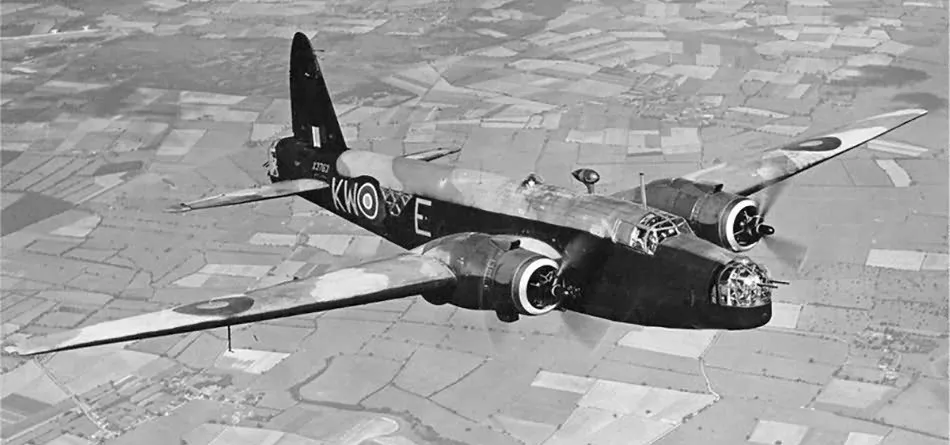
Source: Harold A Skaarup Web Page
Vickers Wellington B. Mk. III (Serial No. X3763), coded KW-E, No. 425 'Alouette' (B) Squadron, RCAF, late summer of 1942
Vickers Wellington B. Mk. III (Serial No. X3763), coded KW-E, No. 425 'Alouette' (B) Squadron, RCAF, late summer of 1942
The Vickers Wellington was a British twin-engined, long-range medium bomber. It was designed during the mid-1930s at Brooklands in Weybridge, Surrey. Led by Vickers-Armstrongs' chief designer Rex Pierson, a key feature of the aircraft is its geodetic airframe fuselage structure, which was principally designed by Barnes Wallis. Development had been started in response to Air Ministry Specification B.9/32, issued in the middle of 1932, for a bomber for the Royal Air Force. This specification called for a twin-engined day bomber capable of delivering higher performance than any previous design.
The Wellington was used as a night bomber in the early years of the Second World War, performing as one of the principal bombers used by Bomber Command. During 1943, it started to be superseded as a bomber by the larger four-engined "heavies" such as the Avro Lancaster. The Wellington continued to serve throughout the war in other duties, particularly as an anti-submarine aircraft.
It holds the distinction of having been the only British bomber that was produced for the duration of the war, and of having been produced in a greater quantity than any other British-built bomber. The Wellington remained as first-line equipment when the war ended, although it had been increasingly relegated to secondary roles. The Wellington was one of two bombers named after Arthur Wellesley, 1st Duke of Wellington, the other being the Vickers Wellesley.
In August 1936, an initial order for 180 Wellington Mk I aircraft, powered by a pair of 1,050 hp (780 kW) Bristol Pegasus radial engines, was received by Vickers; it had been placed so rapidly that the order occurred prior to the first meeting intended to decide the details of the production aircraft. In October 1937, another order for a further 100 Wellington Mk Is, produced by the Gloster Aircraft Company, was issued; it was followed by an order for 100 Wellington Mk II aircraft with Rolls-Royce Merlin X V12 engines. Yet another order was placed for 64 Wellingtons produced by Armstrong Whitworth Aircraft. With this flurry of order and production having been assured by the end of 1937, Vickers set about simplifying the manufacturing process of the aircraft and announced a target of building one Wellington per day.
A total of 180 Wellington Mk I aircraft were built; 150 for the RAF and 30 for the Royal New Zealand Air Force (RNZAF) (which were transferred to the RAF on the outbreak of war and used by 75 Squadron). In October 1938, the Mk I entered service with 9 Squadron. The Wellington was initially outnumbered by the Handley Page Hampden (also ordered by the Ministry to B.9/32) and the Armstrong Whitworth Whitley (to B.34/3 for a 'night' bomber) but outlasted both rival aircraft in service. The Wellington went on to be built in 16 separate variants, in addition to two training conversions after the war. The number of Wellingtons built totalled 11,462 of all versions, a greater quantity produced than any other British bomber. On 13 October 1945, the last Wellington to be produced rolled out. Wikipedia
 Wikipedia Vickers Wellington
 YouTube Vickers Wellington documentary
Unit Desciption
431 (B) Sqn The Hatiten Ronteriios ("Iroquois")
History of the Squadron during World War II (Aircraft: Wellington X, Halifax V, III, Lancaster X)
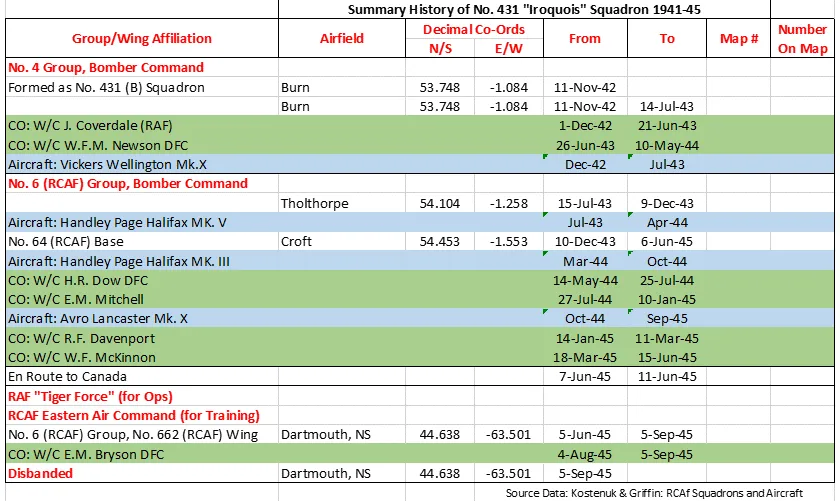
The Squadron was formed in November 1942 as the RCAF's 11th bomber squadron to be formed overseas, at Burn, Yorkshire, UK , as a bomber unit of No 4 Group of RAF Bomber Command. With squadron code letters SE it flew Vickers Wellington Mk X aircraft. In July 1943 it moved to Tholthorpe, Yorkshire , to become part of No 6 (RCAF) Group, at the same time re-equipping with Handley Page Halifax Mk V bombers. It moved again in December 1943 to become part of No 64 (RCAF) Base at Croft, Yorkshire , where it remained until the end of the war. Another change of aircraft, to Halifax Mk. III was made in March of 1944, and finally the squadron was equipped with Canadian-built Avro Lancaster Mk X aircraft from October 1944. After the termination of hostilities in Europe, it was earmarked to form part of the Tiger Force to attack Japan and left for Canada in June 1945. The Japanese surrender following the dropping of the atomic bombs made Tiger Force redundant, and the squadron was disbanded at Dartmouth, Nova Scotia in September of 1945.
In the course of operations the squadron flew 2584 sorties (including 11 bringing PoWs back to England) at a cost of 72 aircraft destroyed. Approximately 14000 tons of bombs were dropped. Aircrew awards were 1 DSO, 63 DFCs, 10 DFMs, 2 CGMs and 1 MiD. Battle Honours were: English Channel and North Sea 1943-44, Baltic 1943-44, Fortress Europe 1943-44, France and Germany 1944-45, Biscay Ports 1943-44, Ruhr 1943-45, Berlin 1943-44, German Ports 1943-45, Normandy 1944, Rhine, Biscay 1944.Moyes, Kostenuk and Griffin
Squadron History (Bomber Command Museum PDF)
Maps for Movements of 431 Squadron 1942-45
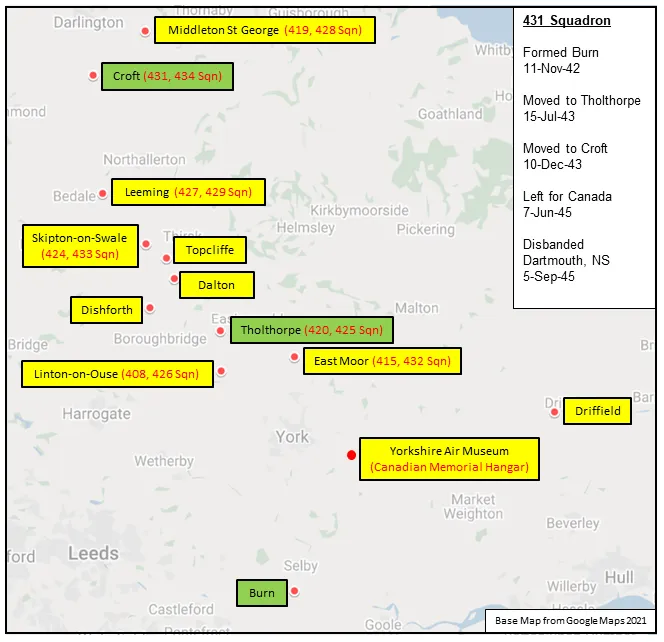
MAP 1: 431 Squadron Bases 1942-45 (marked in green). Right-click on image to display enlarged in new tab
431 Squadron History Summary 1942-45
History of the Squadron Post-WWII (Aircraft: Tutor)
No. 431 (Fighter) Squadron re-formed at RCAF Station Bagotville, Quebec on 18 January 1954, using the new Canadair Sabre. The squadron was formed on a temporary basis until there were enough new CF-100s available to fulfill RCAF squadron needs. No. 431's duties included aerial combat training and displaying the capabilities of jet operations to the public at air shows: the team from No. 431 Squadron consisted of four Sabres and a solo aircraft. This was the first Sabre team to be authorized to perform formation aerobatics in Canada. 431 squadron was disbanded on 1 October 1954.
In 1969, Colonel O.B. Philp, base commander of CFB Moose Jaw and former leader of the defunct Golden Centennaires aerobatic team, considered using several of the leftover Golden Centennaire CT-114 Tutor aircraft for another team. These Tutors were still fitted for aerobatic flying. Philp, at this point, did not receive approval to form the new team; however, approval had been given for single Tutors to provide simple flypasts at local football games. To further the cause of an aerobatic team, Philp began informal enhanced formation practice for the instructors at 2 Canadian Forces Flying Training School with the aim of providing multi-aircraft flypasts at special events. In 1970, four-aircraft formations began providing flypasts at fairs and festivals, as well as Armed Forces Day at CFB Moose Jaw . In July 1970, a white Tutor was introduced to the formation for flypasts. Four white Tutors were finally flown together at the Abbotsford Air Show, followed by a flypast in Winnipeg. Known as the "2 Canadian Forces Flying Training School Formation Team", or informally as the "Tutor Whites", the team grew in size to seven aircraft in 1971 using eleven pilots, and gradually gained recognition. Formation flypasts were replaced with more complicated manoeuvres, and more aircraft were added as the team matured. A contest to give the air demonstration team a formal name was held at Bushell Park Elementary School at CFB Moose Jaw, and resulted in the name "Snowbirds”, which was formally adopted on 25 June 1971. The Snowbirds were officially authorized to be designated the "Canadian Forces Air Demonstration Team" on 15 January 1975, and were formed into their own squadron by reactivating 431 Squadron (renamed 431 Air Demonstration Squadron) on 1 April 1978. .Wikipedia
And the rest is history……………………
Wellington HF543 B. Mk. X - Bombing Dusseldorf Germany - 1943-06-11 to 1943-06-12
Squadron: 431 (B) Sqn (RCAF)
Start Date: 1943-06-11
Completion Date: 1943-06-12
Mission: Bombing
Operation: unspecified
Target City: Dusseldorf Germany
Target Specific:
Base: RAF Burn
Take Off Time: 23:25
Squadron Code: SE-P
Radio Code:
Return Base: RAF Oulton
Return Time: 4:25
Crash City: England
Crash Specifics: Aylsham, Norfolk, England
Crash Latitude: 0.00000000
Crash Longitude: 0.00000000
Crash Reason:
Flak Battery:
Enemy Claim:
War Diary Unavailable
6 Bomber Group June 11/12, 1943
51 Halifaxes from 408, 419, and 427 Squadrons were joined by 63 Wellingtons from 426, 428, 429, 431, and 432 Squadrons on an attack at Dusseldorf. The crews were over the target at between 12,000 and 15,000 feet, releasing 145,000 lbs of high explosives and 275,000 lbs of incendiaries. According to reports, severe damage was caused to this target. Richard Koval (6bombergroup.ca)
783 aircraft - 326 Lancasters, 202 Halifaxes, 143 Wellingtons, 99 Stirlings, 13 Mosquitoes. This was the first night that more than 200 Halifaxes took part in a raid. 38 aircraft- 14 Lancasters, 12 Halifaxes, 10 Wellingtons, 2 Stirlings - lost, 4.9 per cent of the force.
The Pathfinder marking plan proceeded excellently until an Oboe Mosquito inadvertently released a load of target indicators 14 miles north-east of Dusseldorf. This caused part of the Main Force to waste its bombs on open country. But the main bombing caused extensive damage in the centre of Dusseldorf, where 130 acres were claimed as destroyed, and this proved to be the most damaging raid of the war for this city.
Dusseldorf reports that the fire area measured 8· km by 5 km, covering the city centre - both the old and new parts, the Derendorf district and the south of the city. No less than 8,882 separate fire incidents were recorded of which 11,144 were classified as large. 1,292 people were killed. 140,000 people were bombed out of their homes The list of destroyed and seriously damaged industrial and public buildings coven typed pages in the Dusseldorf report! 42 industries connected with the war effort suffered complete stoppages of production and 35 more suffered a partial reduction. 20 military establishments were hit. 8 ships were sunk or damaged. The Gau (province) local government headquarters was destroyed.
source: The Bomber Command War Diaries, Martin Middlebrook and Chris Everitt
Wellington BX aircraft HF 543 SE-P, after completing an operation against targets in Dusseldorf, Germany, returned to the UK landing at RAF Oulton with battle damage. While on a taxiway, The Wellington collided with 427 Squadron Halifax DK 192 ZL-V, which had also landed at RAF Oulton with battle damage. The crew of Wellington HF 543 all survived unhurt but the aircraft was a write-off. There were some slight injuries to the crew of Halifax DK 192, which was repaired and sent to to 1663 Heavy Conversion Unit
Sergeant NH Apperley (RAFVR), Flying Officer WE Coleman (RAFVR), Flying Officer AM Penman (RAFVR), Sergeant VG Trew (RAFVR) and Sergeant GA Lilley (RAFVR) all survived without injury
Most of this crew, with the exception of Flying Officer Coleman, would be killed in action 1943-07-04 on 431 Squadron Wellington LN 284 SE-Q on an operation to Cologne, Germany
There were three 431 Wellington aircraft lost on this operation. Please see aircraft serials HE 184 SE-M and HE 392 SE-L for additional information
Wellington X HF543 [Royal Air Force Serial and Image Database]...
