Most of this crew , including FS Garvey, had survived with minor injuries the crash at East Moor of 432 Squadron Lancaster aircraft DS 851 QO-D 1943-12-03 on return from an operation to Berlin, Germany
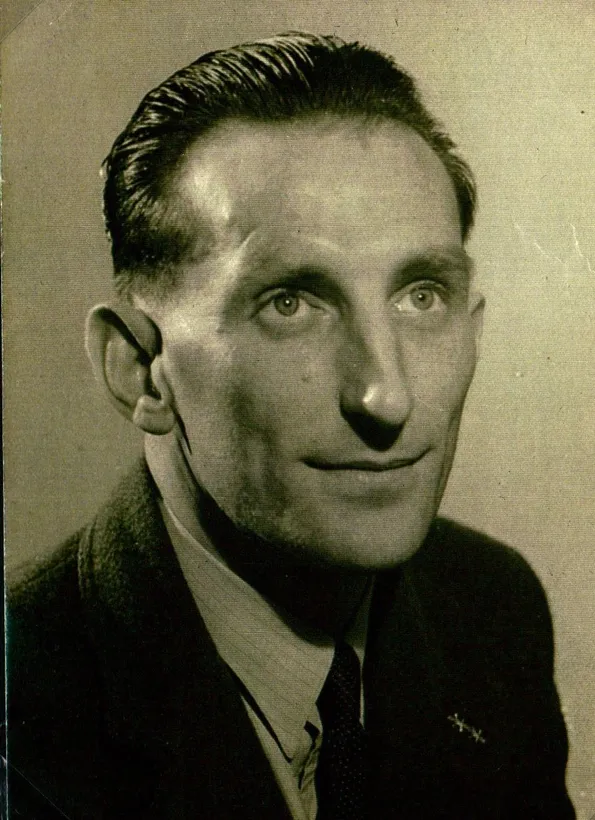
Garvey, William John Thomas (Flight Sergeant)
Prisoner of War 1944-January-14


Birth Date: unkown date
Born:
Parents:
Spouse:
Home:
Enlistment:
Enlistment Date: unkown date
Service
RAFVR
Unit
432 (B) Sqn- Squadron
Saeviter Ad Lucem Ferociously toward the light
Base
East Moor
Rank
Flight Sergeant
Position
Bomb Aimer
Service Numbers
1445910
Target
 Brunswick Germany
Crew or Other Personnel
Lancaster DS850


Mission
Lancaster Mk.II DS850
Bombing Brunswick Germany 1944-January-14 to 1944-January-14
432 (B) Sqn (RCAF) East Moor
Battle of Berlin
496 Lancasters and 2 Halifaxes on the first major raid to Brunswick of the war. 38 Lancasters Jost, 7·6 per cent of the force. The German running commentary was heard following the progress of the bomber force from a position only 40 miles from the English coast and many German fighters entered the bomber stream soon after the German frontier was crossed near Bremen. The German fighters scored steadily until the Dutch coast was crossed on the return flight. Ir of the lost aircraft were Pathfinders.
Brunswick was smaller than Bomber Command's usual targets and this raid was not a success. The city report describes this only as a 'light' raid, with bombs in the south of the city which had only ro houses destroyed and 14 people killed. Most of the attack fell either in the countryside or in Wolfenbiittel and other small towns and villages well to the south of Brunswick.
source: The Bomber Command War Diaries, Martin Middlebrook and Chris Everitt
Lancaster DS850 (QO-M), target Brunswick, 14/15 January 1944. This aircraft was delivered to No.432 Squadron in October 1943. It took part in the following operations; Berlin, 2/3 December 1943; Berlin, 1-2 January 1944; Berlin, 2/3 January 1944; Brunswick, 14/15 January 19 when lost, as was Lancaster DS740. Airborne at 1703 hours, 14 January 1944 from East Moor. Hit by flak over the target which severely wounded Sergeant J.H. Aplin and caused much structural damage. Petrol tanks were ruptured and the order to bale out was given in the vicinity of Rheine, the Lancaster crashing on the Engdener Wuste, east of Nordhorn. Crew were F/L C.V.Wales, RCAF (POW); Flight Sergeant G.C.Pike, RCAF (POW); Sergeant A.L.Thomas (wounded); Flight Sergeant J.S.Evans (POW); Flight Sergeant W.J.T.Garvey (wounded); Sergeant J.H.Aplin (killed); Sergeant R.A.Hutchinson (killed); F/L G.H.Rainville. DFM, RCAF (Squadron Gunnery Leader, POW, subsequently held in Camp L3, POW number 3386.
Rainville subsequently filed a “Loss of Bomber Aircraft’ report, stating he had flown 50 sorties and that his position on this night was rear gunner. He was interrogated on 10 April 1945.
We were on the bombing run when a flak shell exploded very near the aircraft. I immediately opened the rear turret doors in order to get out because I thought we had been seriously hit. The aircraft was shuddering violently and skidding for a minute or so. Almost at the same time an incendiary bomb dropped from above crashed through the astro hatch and the WOP who was standing there was fatally wounded in the head. Pilot gave order to second pilot and engineer to look after WOP after our bombs had been dropped. Soon after this a strong smell of petrol enveloped the aircraft, which I reported to pilot who immediately asked engineer if he could find the leak and stop it. From the answer given by engineer I gathered he could not reach the location of leak owing to the wounded WOP who was lying down in the passage. A check of the petrol gauges revealed we were losing a great amount of petrol and after 50 minutes on the return journey the engineer stated he had ten minutes left. The pilot gave the order to get ready to abandon aircraft. I came out of the turret, as I found there was not enough room to maneuver quickly and safely. I put my chute on and plugged the intercom in standing near the rear door and waiting for orders. Meanwhile the mid-upper had been ordered out of his turret and asked to try and move the WOP to either front or rear exit with the help of second pilot. This had already been found impossible to do owing to lack of room and the condition of the wounded. While standing by I heard engineer say he had only four minutes or so to go. The bomb aimer asked permission to bale out and half a minute later I made the same request which was granted immediately by pilot. Opening the rear door I jumped out from 11,000 feet and a few minutes later hit a ploughed field near the Osnabruck-Rheine road approximately 15 miles from Rheine.
Details: The incendiary bomb did not explode; it tore a big gap in the WOP’s head and his brains could be seen. He regained consciousness now and again. In Dulag Luft (cooler) the navigator told me he had been informed by the Germans that the WOP and mid-upper had been found dead in aircraft. The aircraft did not climb above 18 or 19,000 feet. According to later information given by pilot, most of his instruments were faulty. Dropped height gradually on return trip.
 Aviation Safety Network
Lancaster serial: DS850
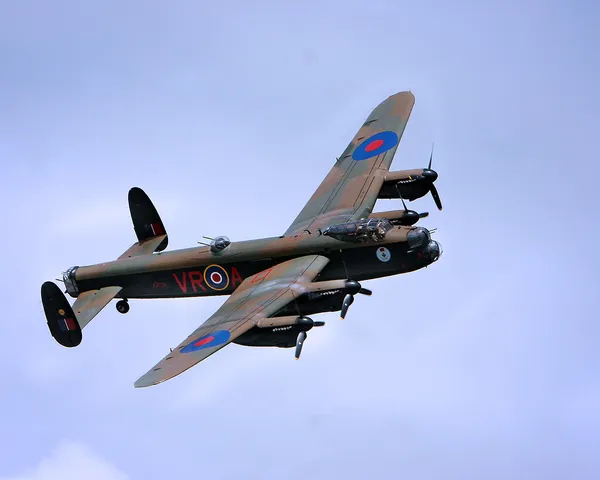
Avro Lancaster Mk. X RCAF Serial FM 213
Canadian Warplane Heritage Museum
Canadian Warplane Heritage Museum
The Avro Lancaster is a British Second World War heavy bomber. It was designed and manufactured by Avro as a contemporary of the Handley Page Halifax, both bombers having been developed to the same specification, as well as the Short Stirling, all three aircraft being four-engined heavy bombers adopted by the Royal Air Force (RAF) during the same wartime era.
The Lancaster has its origins in the twin-engine Avro Manchester which had been developed during the late 1930s in response to the Air Ministry Specification P.13/36 for a capable medium bomber for "world-wide use". Originally developed as an evolution of the Manchester (which had proved troublesome in service and was retired in 1942), the Lancaster was designed by Roy Chadwick and powered by four Rolls-Royce Merlins and in one version, Bristol Hercules engines. It first saw service with RAF Bomber Command in 1942 and as the strategic bombing offensive over Europe gathered momentum, it was the main aircraft for the night-time bombing campaigns that followed. As increasing numbers of the type were produced, it became the principal heavy bomber used by the RAF, the Royal Canadian Air Force (RCAF) and squadrons from other Commonwealth and European countries serving within the RAF, overshadowing the Halifax and Stirling. Wikipedia
 Lancaster Bomber
 Wikipedia
Unit Desciption
432 (B) Sqn Saeviter Ad Lucem ("Leaside")
History of the Squadron during World War II (Aircraft: Wellington X, Lancaster II, Halifax III, VII)
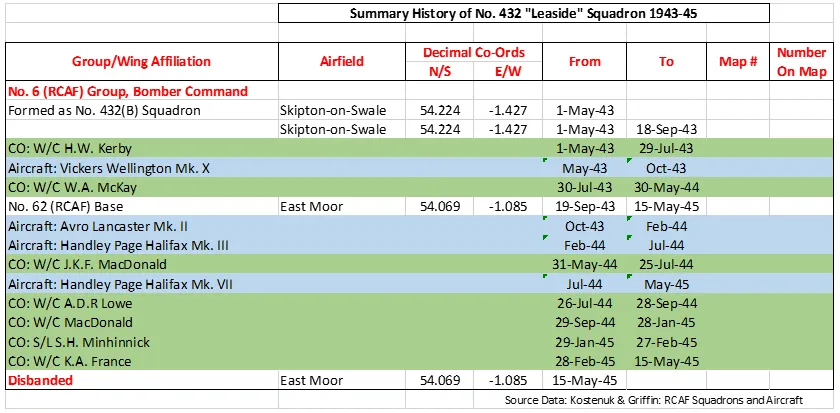
The Squadron was the twelfth RCAF bomber squadron to be formed overseas in WWII. It was formed on May 1, 1943 at Skipton-on-Swale, Yorkshire, UK as a unit of No 6 (RCAF) Group of RAF Bomber Command: indeed, it was the first bomber squadron to be formed directly into No 6 Group. Using the squadron identification letters QO it flew Vickers Wellington Mk X medium bombers until it moved to East Moor, Yorkshire on 19th September 1943, when it re-equipped with Avro Lancaster Mk II aircraft. East Moor was part of No 62 (RCAF) Base. The squadron re-equipped with Handley Page Halifax Mk III aircraft in February 1944, and with Halifax Mk VII in July of that year, and continued with them until the squadron was disbanded at East Moor on May 15, 1945.
In the course of operations the squadron flew 246 missions, involving 3130 individual sorties, for the loss of 73 aircraft. 8980 tons of bombs were dropped. Awards to squadron members included 2 DSOs, 119 DFCs,1 Bar to DFC, 1 CGM, 20 DFMs and 1 Croix de Guerre (France). Battle Honours were: English Channel and North Sea 1943, Fortress Europe 1943-44, France and Germany 1944-45, Biscay Ports 1944, Ruhr 1943-45, Berlin 1943-44, German Ports 1943-45, Normandy 1944, Rhine, Biscay 1943.Moyes, Kostenuk and Griffin
Squadron History (Bomber Command Museum PDF)
Maps for Movements of 432 Squadron 1943-45
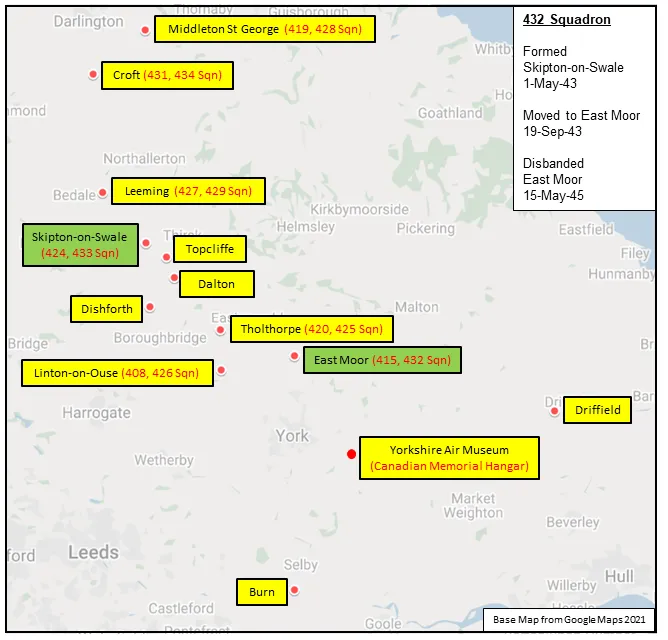
MAP 1: 432 Squadron Bases 1943-45 (marked in green). Right-click on image to display enlarged in new tab
432 Squadron History Summary 1943-45
History of the Squadron Post-WWII (Aircraft: Canuck)
The squadron was re-formed at Bagotville, Quebec as an All-Weather Fighter unit on 1 October 1954. The squadron flew Avro CF-100 Canuck aircraft on North American Air Defence until it was disbanded on 15 October 1961.
Lancaster DS850 Mk.II - Bombing Brunswick Germany - 1944-01-14 to 1944-01-14
Squadron: 432 (B) Sqn (RCAF)
Start Date: 1944-01-14
Completion Date: 1944-01-14
Mission: Bombing
Operation: Battle of Berlin
Target City: Brunswick Germany
Target Specific:
Base: East Moor
Take Off Time: 17.03
Squadron Code: QO M
Radio Code:
Return Base:
Return Time:
Crash City: Engdener Wuste, Moor east of Nordhorn, Lower Saxony, Germany
Crash Specifics:
Crash Latitude: 0.00000000
Crash Longitude: 0.00000000
Crash Reason: flak
Flak Battery:
Enemy Claim:
War Diary Unavailable
6 Group Unavailable
496 Lancasters and 2 Halifaxes on the first major raid to Brunswick of the war. 38 Lancasters Jost, 7·6 per cent of the force. The German running commentary was heard following the progress of the bomber force from a position only 40 miles from the English coast and many German fighters entered the bomber stream soon after the German frontier was crossed near Bremen. The German fighters scored steadily until the Dutch coast was crossed on the return flight. Ir of the lost aircraft were Pathfinders.
Brunswick was smaller than Bomber Command's usual targets and this raid was not a success. The city report describes this only as a 'light' raid, with bombs in the south of the city which had only ro houses destroyed and 14 people killed. Most of the attack fell either in the countryside or in Wolfenbiittel and other small towns and villages well to the south of Brunswick.
source: The Bomber Command War Diaries, Martin Middlebrook and Chris Everitt
Lancaster DS850 (QO-M), target Brunswick, 14/15 January 1944. This aircraft was delivered to No.432 Squadron in October 1943. It took part in the following operations; Berlin, 2/3 December 1943; Berlin, 1-2 January 1944; Berlin, 2/3 January 1944; Brunswick, 14/15 January 19 when lost, as was Lancaster DS740. Airborne at 1703 hours, 14 January 1944 from East Moor. Hit by flak over the target which severely wounded Sergeant J.H. Aplin and caused much structural damage. Petrol tanks were ruptured and the order to bale out was given in the vicinity of Rheine, the Lancaster crashing on the Engdener Wuste, east of Nordhorn. Crew were F/L C.V.Wales, RCAF (POW); Flight Sergeant G.C.Pike, RCAF (POW); Sergeant A.L.Thomas (wounded); Flight Sergeant J.S.Evans (POW); Flight Sergeant W.J.T.Garvey (wounded); Sergeant J.H.Aplin (killed); Sergeant R.A.Hutchinson (killed); F/L G.H.Rainville. DFM, RCAF (Squadron Gunnery Leader, POW, subsequently held in Camp L3, POW number 3386.
Rainville subsequently filed a “Loss of Bomber Aircraft’ report, stating he had flown 50 sorties and that his position on this night was rear gunner. He was interrogated on 10 April 1945.
We were on the bombing run when a flak shell exploded very near the aircraft. I immediately opened the rear turret doors in order to get out because I thought we had been seriously hit. The aircraft was shuddering violently and skidding for a minute or so. Almost at the same time an incendiary bomb dropped from above crashed through the astro hatch and the WOP who was standing there was fatally wounded in the head. Pilot gave order to second pilot and engineer to look after WOP after our bombs had been dropped. Soon after this a strong smell of petrol enveloped the aircraft, which I reported to pilot who immediately asked engineer if he could find the leak and stop it. From the answer given by engineer I gathered he could not reach the location of leak owing to the wounded WOP who was lying down in the passage. A check of the petrol gauges revealed we were losing a great amount of petrol and after 50 minutes on the return journey the engineer stated he had ten minutes left. The pilot gave the order to get ready to abandon aircraft. I came out of the turret, as I found there was not enough room to maneuver quickly and safely. I put my chute on and plugged the intercom in standing near the rear door and waiting for orders. Meanwhile the mid-upper had been ordered out of his turret and asked to try and move the WOP to either front or rear exit with the help of second pilot. This had already been found impossible to do owing to lack of room and the condition of the wounded. While standing by I heard engineer say he had only four minutes or so to go. The bomb aimer asked permission to bale out and half a minute later I made the same request which was granted immediately by pilot. Opening the rear door I jumped out from 11,000 feet and a few minutes later hit a ploughed field near the Osnabruck-Rheine road approximately 15 miles from Rheine.
Details: The incendiary bomb did not explode; it tore a big gap in the WOP’s head and his brains could be seen. He regained consciousness now and again. In Dulag Luft (cooler) the navigator told me he had been informed by the Germans that the WOP and mid-upper had been found dead in aircraft. The aircraft did not climb above 18 or 19,000 feet. According to later information given by pilot, most of his instruments were faulty. Dropped height gradually on return trip.
