Footprints on the Sands of Time, RAF Bomber Command Prisoners of War in Germany 1939-45 by Oliver Clutton-Brock page 403
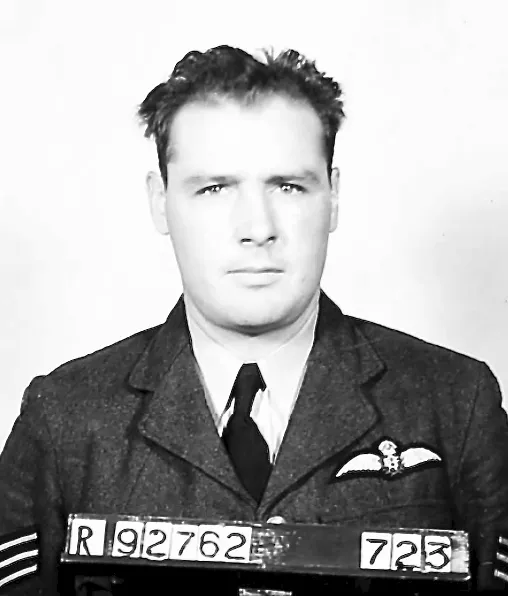
Sinclair, Sidney Alfred (Flight Lieutenant)
Prisoner of War 1944-March-19


Birth Date: 1919-January-01
Born:
Parents:
Spouse:
Home:
Enlistment:
Enlistment Date: unkown date
Service
RCAF
Unit
433 (B) Sqn- Squadron
Qui S'y Frotte S'y Pique Who opposes it gets pricked
Base
RAF Skipton-on-Swale
Rank
Flight Lieutenant
Position
Bomb Aimer
Service Numbers
J/21169
PoW: 3617
Target
 Frankfurt Germany
Crew or Other Personnel
Halifax HX282

Mission
Halifax B/GR.Mk.III HX282
Bombing Frankfurt Germany 1944-March-18 to 1944-March-19
433 (B) Sqn (RCAF) RAF Skipton-on-Swale
433 Porcupine Squadron (Qui S'y Frotte S'y Pique) RAF Skipton-on-Swale. Halifax BIII aircraft HX 282 BM-K failed to return from a raid on targets in Frankfurt, Germany. Homeward-bound, the bomber was shot down by night fighter pilot Ofw Karl-Heinz Scherfling of the 12/NJG 1, who was flying a Bf 110 G-4 and crashed at Krov, Rheinland-Pfalz on the Moselle River, Germany
Pilot Officer DE James (RCAF) and Pilot Officer JPOV Levesque (RCAF) were killed in action
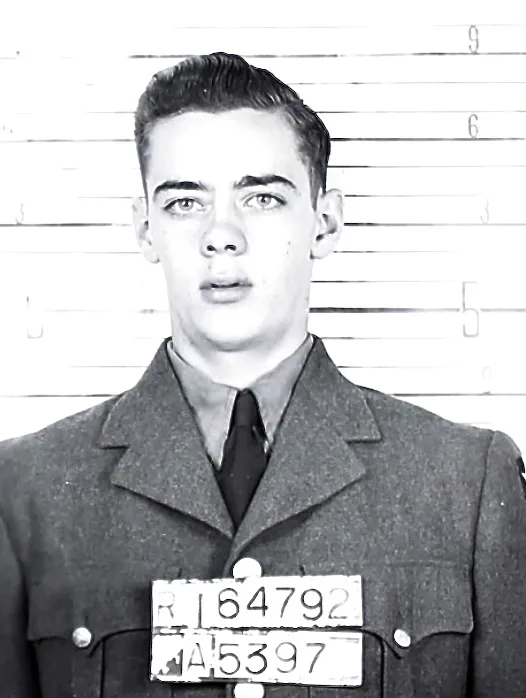
Flight Lieutenant SA Sinclair (RCAF), Pilot Officer AG Sharpe (RCAF), Sergeant RT Stinson (RCAF), Group Commander LE Wray AFC (RCAF), Sergeant RD Green (RAF) and Sergeant RE Pearce (RAF) survived and were all taken as Prisoners of War
Nachjagtd Combat Archive 1944 Part Two 16 March - 11 May by Theo Boiten, page 7On VE Day, 1945-05-08, Squadron Leader A. Ross Dawson, the Chief Technical Officer with 424/433 Sqds at Skipton on Swale, went to Brussels as part of a fleet of 26 aircraft to pick up released POW's. He wrote in his diary: "The war is definitely over now with complete surrender all round " cease fire is at 1 minute after midnight tonight. . . Got everything organised for the other kites to take off at 12:40 & we got airborne at 10:30 am . . we finally found our aerodrome B58 at a little town called Melsbrock . . . We reached our parking strip & got out to be confronted with approx.. 3000 POWs of all nationalities. . . There were Assies & New Zealanders, Canadians & Americans, English, Poles, Russians etc. Several Canadians came up to speak to us having recognised our a/c letters. Even some from our own Sqdn were there with a Nav [Navigator] from G/C Wray's crew [HX282} & a F/Eng from W/C Blane's crew [LV997]. Also one from 433 "M" which was shot down in February when I was there. . . The POWs all had marvellous experiences to relate."
 Diary of A Ross Dawson, courtesy CWM
 [Royal Air Force Serial and Image Database]...
Halifax serial: HX282
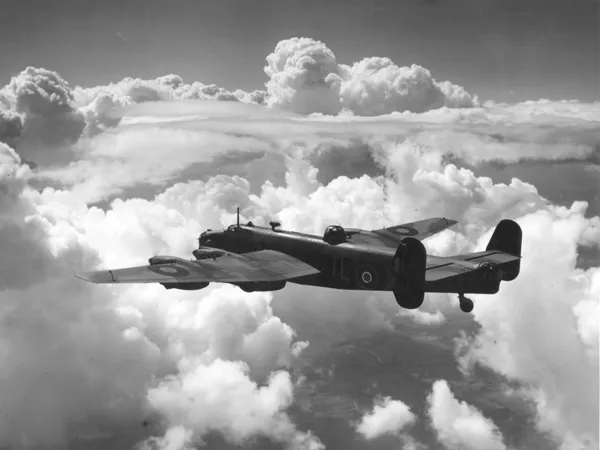
(RAF Photo, 1942)(Source Harold A Skaarup Web Page)
A Royal Air Force Handley Page Halifax Mk. II Series I (Serial No. W7676), coded TL-P, of No. 35 Squadron, RAF, based at Linton-on-Ouse, Yorkshire in the UK, being piloted by Flight Lieutenant Reginald Lane, (later Lieutenant-General, RCAF), over the English countryside. Flt Lt Lane and his crew flew twelve operations in W7676, which failed to return from a raid on Nuremberg on the night of 28/29 August 1942, when it was being flown by Flt Sgt D. John and crew.
The Handley Page Halifax is a British Royal Air Force (RAF) four-engined heavy bomber of the Second World War. It was developed by Handley Page to the same specification as the contemporary twin-engine Avro Manchester.
The Halifax has its origins in the twin-engine HP56 proposal of the late 1930s, produced in response to the British Air Ministry's Specification P.13/36 for a capable medium bomber for "world-wide use." The HP56 was ordered as a backup to the Avro 679, both aircraft being designed to use the underperforming Rolls-Royce Vulture engine. The Handley Page design was altered at the Ministry to a four-engine arrangement powered by the Rolls-Royce Merlin engine; the rival Avro 679 was produced as the twin-engine Avro Manchester which, while regarded as unsuccessful mainly due to the Vulture engine, was a direct predecessor of the famed Avro Lancaster. Both the Lancaster and the Halifax would emerge as capable four-engined strategic bombers, thousands of which would be built and operated by the RAF and several other services during the War.
On 25 October 1939, the Halifax performed its maiden flight, and it entered service with the RAF on 13 November 1940. It quickly became a major component of Bomber Command, performing routine strategic bombing missions against the Axis Powers, many of them at night. Arthur Harris, the Air Officer Commanding-in-Chief of Bomber Command, described the Halifax as inferior to the rival Lancaster (in part due to its smaller payload) though this opinion was not shared by many of the crews that flew it, particularly for the MkIII variant. Nevertheless, production of the Halifax continued until April 1945. The operational statistics from the Bomber Command War Room Manual, state 82,773 operational sorties 2,232 aircraft lost of which 1,833 were missing, in addition there were 365 anti submarine patrols with 4 aircraft lost. Halifax laid 9,572 mines according to the war manual, daily reports total 9,550 being 851x1000, 6,450x1500 and 2,248x1850 pound mines.. The Halifax was also flown in large numbers by other Allied and Commonwealth nations, such as the Royal Canadian Air Force (RCAF), Royal Australian Air Force (RAAF), Free French Air Force and Polish forces. Wikipedia
 Halifax Heavy Bomber WWII
 Wikipedia Halifax Bomber
Unit Desciption
433 (B) Sqn Qui S'y Frotte S'y Pique ("Porcupine")
History of the Squadron during World War II (Aircraft: Halifax III, Lancaster I, III)
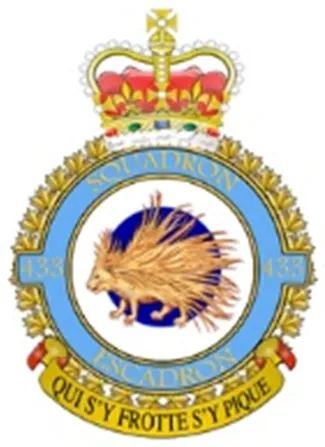
433 Squadron was the 14th and last bomber squadron of the RCAF to be formed overseas in WWII. It was formed in September 1943 as a unit of No 6 (RCAF) Group of Bomber Command. It flew from Skipton-on-Swale, Yorkshire, UK for the whole of its operational career. With the squadron code letters BM, it originally flew Handley Page Halifax Mk III heavy bombers on its bombing missions, but these were replaced by Lancaster Mks I and III in January 1945. After the cessation of hostilities the squadron was retained in England as a unit of No 1 Group RAF from August 1945, and took part in the airlift of PoWs back to England (Operation EXODUS) and the bringing back of troops from Italy (Operation DODGE). The squadron was disbanded at Skipton in October 1945.
In the course of its operations, the squadron flew 209 missions involving 2316 individual sorties for the loss of 38 aircraft , dropping 7486 tons. Awards to crew members included 132 DFCs, 2 Bars to DFC, 9 DFMs, 1 BEM, 14 MiDs and 1 Air Medal (USA). Battle Honours were: English Channel and North Sea 1944-45, Baltic 1944-45, Fortress Europe 1944, France and Germany 1944-45, Biscay Ports 1944, Ruhr 1944-45, Berlin 1944, German Ports 1944-45, Normandy 1944, Rhine, Biscay 1944.Wikipedia, Kostenuk and Griffin
Squadron History (Bomber Command Museum PDF)
Maps for Movements of 433 Squadron 1943-45
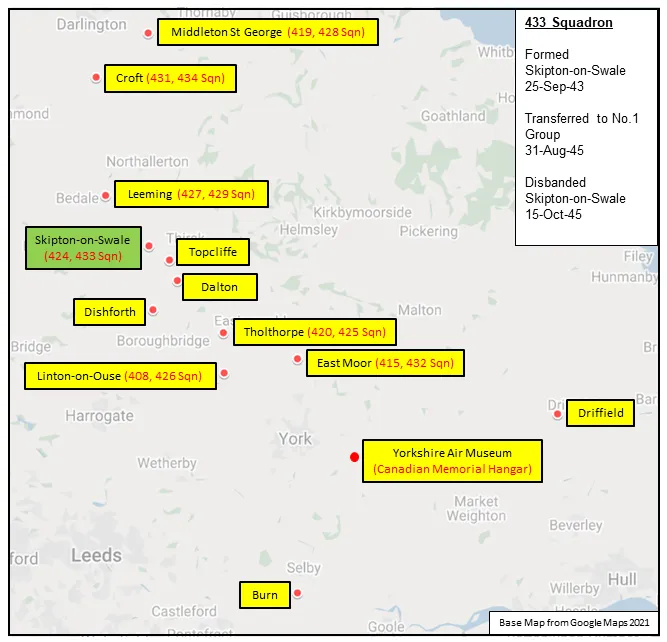
MAP 1: 433 Squadron Bases 1943-45 (marked in green). Right-click on image to display enlarged in new tab
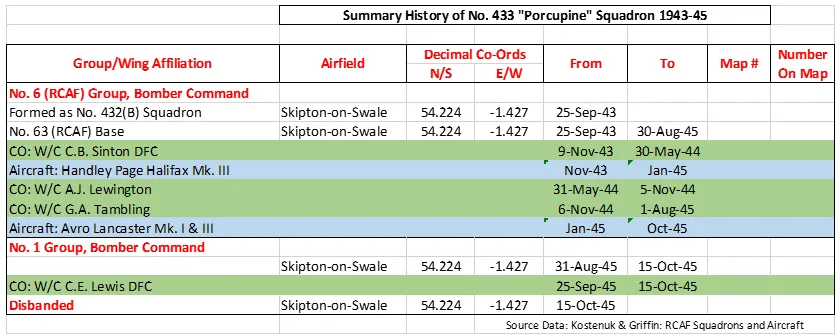
433 Squadron History Summary 1943-45
History of the Squadron Post-WWII (Aircraft: Canuck, Freedom Fighter, Hornet)
The squadron re-formed as an All-Weather (Fighter) unit at CFB Cold Lake, Alberta , on 15 November 1954, as one of nine CF-100 squadrons to defend Canadian airspace. It moved to CFB North Bay, Ontario , in October 1955, the squadron flew CF-100 Canuck aircraft on North American air defence. However, in 1961 the Government decided to reduce the number of CF-100 squadrons from nine to five and 433 Squadron was dissolved for a second time on July 31st, 1961.
Reformed post-unification on 15 August 1968, as No. 433 Escadrille tactique de combat it was a French language squadron of Mobile Command based at CFB Bagotville, Quebec . The squadron flew the CF-5 Freedom Fighter in the tactical and reconnaissance role until it converted to the CF-188 Hornet fighter jets in 1984. The squadron was deactivated in 2005, and its assets and personnel amalgamated into 425 Tactical Fighter Squadron. Besides being originally designated as one of two bases of NATO's Rapid Reaction Force, the 433 Squadron was entrusted a NORAD role in December 1988. The 433 Squadron members in Bagotville played an important role in the Gulf War conflicts, better known under the names Operation FRICTION in 1991 and Operation ECHO in 1999. By September 2001, the Squadron was actively participating with NORAD in the fight against terrorism through Operation NOBLE EAGLE. On July 14th, 2005, the standards of the Squadron were once again laid aside almost 62 years after its initial formation. .Wikipedia
The squadron was reactivated on 9 June 2015, and celebrated its 75th anniversary on 15 September 2018.
Halifax HX282 B/GR.Mk.III - Bombing Frankfurt Germany - 1944-03-18 to 1944-03-19
Squadron: 433 (B) Sqn (RCAF)
Start Date: 1944-03-18
Completion Date: 1944-03-19
Mission: Bombing
Operation: unspecified
Target City: Frankfurt Germany
Target Specific:
Base: RAF Skipton-on-Swale
Take Off Time:
Squadron Code: BM-K
Radio Code:
Return Base:
Return Time:
Crash City: Germany
Crash Specifics: Krov, Rheinland-Pfalz on the Moselle River
Crash Latitude: 0.00000000
Crash Longitude: 0.00000000
Crash Reason: fighter
Flak Battery:
Enemy Claim: Ofw Karl-Heinz Scherfling of the 12/NJG 1
FRANKFURT
{{webimage,wardiaries.jpg,float:right;width:150px;,Book no longer in print}}846 aircraft - 620 Lancasters, 209 Halifaxes, 17 Mosquitoes. The German fighter force was again split. One part was lured north by the Heligoland mining operation but the second. part waited in Germany and met the bomber stream just before the target was reached, although cloud made it difficult for these fighters to achieve much success. 22 aircraft- 12 Halifaxes, IO Lancasters -were lost, 2·6 per cent of the force.
The Pathfinders marked the target accurately and this led to heavy bombing of eastern, central and western districts of Frankfurt. The later phases of the bombing were scattered but this was almost inevitable with such a large force; new crews were usually allocated to the final waves. Extensive destruction was caused in Frankfurt. The local report gives a long list of 'cultural buildings', including the Opera House and the preserved medieval quarter, destroyed. Most of the report consists of statistics: 5,495 houses, 99 industrial firms, 412 small businesses, 56 public buildings= all destroyed or seriously damaged; many other buildings were lightly damaged. 421 civilians were killed and 55,500 were bombed out. A military train was hit and 20 soldiers in it were killed and 80 wounded but this may have been by the action of a Fighter Command Intruder aircraft; the Frankfurt report says that the train was shot up by cannon-fire.
6 Bomber Group March 18/19, 1944
25 Lancasters from 408 and 426 Squadrons were joined by 94 Halifaxes from 420, 424, 425, 427, 429, 432, and 433 Squadrons on an attack at Frankfurt. The crews were over the target at between 18,000 and 23,000 feet, releasing 73,000 lbs of high explosives and 411,000 lbs of incendiaries. According to reports, target marking was accurate and serious damage was caused.
While the Frankfurt attack was taking place, 39 Halifaxes from 419,428, 431 and 434 squadrons were ordered on a mining operation to Heligoland. The crews were over the garden at between 11,000 and 12,000 feet, sowing74@1500 lb mines. Richard Koval (6bombergroup.ca)
433 Porcupine Squadron (Qui S'y Frotte S'y Pique) RAF Skipton-on-Swale. Halifax BIII aircraft HX 282 BM-K failed to return from a raid on targets in Frankfurt, Germany. Homeward-bound, the bomber was shot down by night fighter pilot Ofw Karl-Heinz Scherfling of the 12/NJG 1, who was flying a Bf 110 G-4 and crashed at Krov, Rheinland-Pfalz on the Moselle River, Germany
Pilot Officer DE James (RCAF) and Pilot Officer JPOV Levesque (RCAF) were killed in action
Flight Lieutenant SA Sinclair (RCAF), Pilot Officer AG Sharpe (RCAF), Sergeant RT Stinson (RCAF), Group Commander LE Wray AFC (RCAF), Sergeant RD Green (RAF) and Sergeant RE Pearce (RAF) survived and were all taken as Prisoners of War
Nachjagtd Combat Archive 1944 Part Two 16 March - 11 May by Theo Boiten, page 7On VE Day, 1945-05-08, Squadron Leader A. Ross Dawson, the Chief Technical Officer with 424/433 Sqds at Skipton on Swale, went to Brussels as part of a fleet of 26 aircraft to pick up released POW's. He wrote in his diary: "The war is definitely over now with complete surrender all round " cease fire is at 1 minute after midnight tonight. . . Got everything organised for the other kites to take off at 12:40 & we got airborne at 10:30 am . . we finally found our aerodrome B58 at a little town called Melsbrock . . . We reached our parking strip & got out to be confronted with approx.. 3000 POWs of all nationalities. . . There were Assies & New Zealanders, Canadians & Americans, English, Poles, Russians etc. Several Canadians came up to speak to us having recognised our a/c letters. Even some from our own Sqdn were there with a Nav [Navigator] from G/C Wray's crew [HX282} & a F/Eng from W/C Blane's crew [LV997]. Also one from 433 "M" which was shot down in February when I was there. . . The POWs all had marvellous experiences to relate."
[Royal Air Force Serial and Image Database]...
