Nesbitt, Earl Doran (Flying Officer)
Prisoner of War 1944-January-29
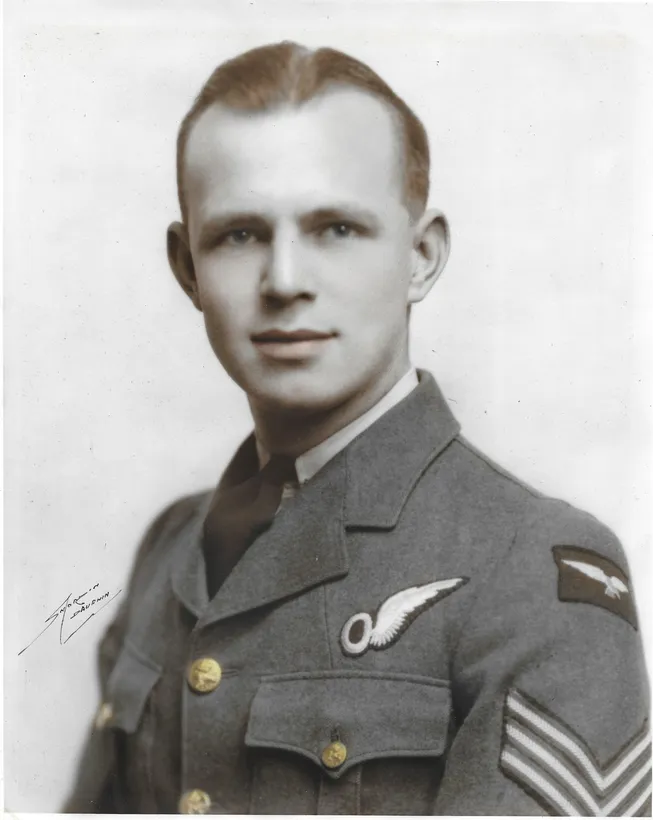

Birth Date: 1920-September-19
Born: Winnipeg Manitoba
Parents: Lorne and Edna Nesbitt
Spouse: Dorothy Mary Cordukes Cottrell
Home: Vancouver, British Columbia
Enlistment:
Enlistment Date: 1941
Service
RCAF
Unit
166 (B) Sqn- Squadron (RAF)
Tenacity
Base
Kirmington
Rank
Flying Officer
Position
Navigator
Service Numbers
J/19481
Prev: R/58622
PoW: 3497
 Vancouver, British Columbia
Crew or Other Personnel
Lancaster DV180



Mission
Lancaster Mk.I/III DV180
Bombing Berlin Germany 1944-January-29 to 1944-January-29
166 (B) Sqn (RAF) Kirmington
677 aircraft - 432 Lancasters, 241 Halifaxes, 4 Mosquitoes. Part of the German fighter force was drawn up by the early diversions and the bomber approach route over Northern Denmark proved too distant for some of the other German fighters. The German controller was, however, able to concentrate his fighters over the target and many aircraft were shot down there. 46 aircraft - 26 Halifaxes, 20 Lancasters - lost, 6·8 per cent of the force.
The cloud over Berlin was broken and some ground-marking was possible but the Bomber Command claim that this was the most concentrated attack of this period is not quite fully confirmed by German records. The western and southern districts were hit but so too were 77 places outside the city. The Berlin recording system was now showing an increasing deterioration. No overall figure for property damage was recorded; approximately 180,000 people were bombed out on this night. Although many industrial firms were again hit, the feature of this night is the unusually high proportion of administrative and public buildings appearing in the lists of buildings hit: the new Chancellery, 4 theatres, the 'French' cathedral, 6 hospitals, 5 embassies, the State Patent Office, etc. The report concludes with this entry: 'The casualties are still not known but they are bound to be considerable. It is reported that a vast amount of wreckage must still be cleared; rescue workers are among the mountains of it.The Bomber Command War Diaries, Martin Middlebrook and Chris Everitt
Lancaster DV 180 Took off from Kirmington at 00:12 in Lancaster Mk III (Sqn code: AS-W Bomber Command) on an operation to Berlin.
Homebound and while altering course NE of Berlin at 18000 feet collided with another aircraft. Two crewmen were thrown clear of AS-W. The others went down with the aircraft
Killed: Sergeant William Harold Clarke RAF KIA Berlin 1939-1945 War Cemetery Collective grave 4. E. 23-25. Sergeant Homfray Reece Gibbon RAF KIA Berlin 1939-1945 War Cemetery Coll. grave 4. E. 23-25. Sergeant Edward Peter Hillyard RAF KIA Berlin 1939-1945 War Cemetery grave 4. E. 27. Sergeant Roland Winder RAF KIA Berlin 1939-1945 War Cemetery Coll. grave 4. E. 23-25. Master Sergeant William Mitchell USAAF burial location unknown,
POWs: Pilot Officer Earl Doran Nesbitt RCAF J/19481 POW Stalag Luft L3 Sagan and Belaria. Pilot Officer Colin Gregory Phelps RAF POW Stalag Luft L3 Sagan and Belaria.
Lancaster serial: DV180
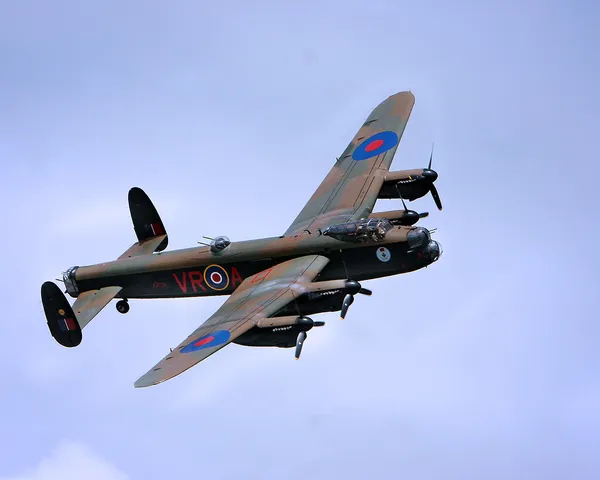
Avro Lancaster Mk. X RCAF Serial FM 213
Canadian Warplane Heritage Museum
Canadian Warplane Heritage Museum
The Avro Lancaster is a British Second World War heavy bomber. It was designed and manufactured by Avro as a contemporary of the Handley Page Halifax, both bombers having been developed to the same specification, as well as the Short Stirling, all three aircraft being four-engined heavy bombers adopted by the Royal Air Force (RAF) during the same wartime era.
The Lancaster has its origins in the twin-engine Avro Manchester which had been developed during the late 1930s in response to the Air Ministry Specification P.13/36 for a capable medium bomber for "world-wide use". Originally developed as an evolution of the Manchester (which had proved troublesome in service and was retired in 1942), the Lancaster was designed by Roy Chadwick and powered by four Rolls-Royce Merlins and in one version, Bristol Hercules engines. It first saw service with RAF Bomber Command in 1942 and as the strategic bombing offensive over Europe gathered momentum, it was the main aircraft for the night-time bombing campaigns that followed. As increasing numbers of the type were produced, it became the principal heavy bomber used by the RAF, the Royal Canadian Air Force (RCAF) and squadrons from other Commonwealth and European countries serving within the RAF, overshadowing the Halifax and Stirling. Wikipedia
 Lancaster Bomber
 Wikipedia
 Harold A Skaarup Web Page
Unit Desciption
166 (B) Sqn Tenacity (Huddersfield's Own)
No 166 Squadron RAF was originally formed at Bircham Newton, Norfolk on June 13, 1918, designed as a heavy bomber unit, to fly the Handley Page V/1500 aircraft. The squadron was never fully mobilized because the Armistice intervened. The squadron was re-formed in November 1936 as a heavy bomber unit, flying Handley Page Heyfords, later equipping with Armstrong Whitworth Whitleys. It was based at Boscombe Down, Wiltshire from November 1936 to January 1937, when it moved to Leconfield, Yorkshire. The squadron became part of an air observer's school on June 7, 1938, and then became a 1 Group pool squadron in May 1939. From September 1939 it was based at Abingdon, Berkshire until April 1940. In that month the squadron merged with no. 97 Squadron to form No. 10 OTU.
In January 1943 the squadron was re-formed at Kirmington, Yorkshire (53.578,-0.344, now Humberside Airport), from flights of Nos. 150 and 170 squadrons, when parts of these squadrons were posted to the Middle East. It was again bomber squadron, flying Vickers Wellingtons in No. 1 Group of Bomber Command. It remained at Kirmington until the end of WWII, later re-equipping with Avro Lancasters. In the period 27/28 January 1943 and 25 April 1945, it dropped 27,287 tons of bombs and laid 333 tons of mines. The squadron won "at least" 2 DSOs, 2 CGMs, 117 DFCs and 108 DFMs in the course of WWII. The squadron was disbanded on November 18, 1945.
Lancaster DV180 Mk.I/III - Bombing Berlin Germany - 1944-01-29 to 1944-01-29
Squadron: 166 (B) Sqn (RAF)
Start Date: 1944-01-29
Completion Date: 1944-01-29
Mission: Bombing
Operation: unspecified
Target City: Berlin Germany
Target Specific:
Base: Kirmington
Take Off Time: 00:12:00
Squadron Code: AS W
Radio Code:
Return Base:
Return Time:
Crash City:
Crash Specifics:
Crash Latitude: 0.00000000
Crash Longitude: 0.00000000
Crash Reason: midair
Flak Battery:
Enemy Claim:
War Diary Unavailable
6 Group Unavailable
677 aircraft - 432 Lancasters, 241 Halifaxes, 4 Mosquitoes. Part of the German fighter force was drawn up by the early diversions and the bomber approach route over Northern Denmark proved too distant for some of the other German fighters. The German controller was, however, able to concentrate his fighters over the target and many aircraft were shot down there. 46 aircraft - 26 Halifaxes, 20 Lancasters - lost, 6·8 per cent of the force.
The cloud over Berlin was broken and some ground-marking was possible but the Bomber Command claim that this was the most concentrated attack of this period is not quite fully confirmed by German records. The western and southern districts were hit but so too were 77 places outside the city. The Berlin recording system was now showing an increasing deterioration. No overall figure for property damage was recorded; approximately 180,000 people were bombed out on this night. Although many industrial firms were again hit, the feature of this night is the unusually high proportion of administrative and public buildings appearing in the lists of buildings hit: the new Chancellery, 4 theatres, the 'French' cathedral, 6 hospitals, 5 embassies, the State Patent Office, etc. The report concludes with this entry: 'The casualties are still not known but they are bound to be considerable. It is reported that a vast amount of wreckage must still be cleared; rescue workers are among the mountains of it.The Bomber Command War Diaries, Martin Middlebrook and Chris Everitt
Lancaster DV 180 Took off from Kirmington at 00:12 in Lancaster Mk III (Sqn code: AS-W Bomber Command) on an operation to Berlin.
Homebound and while altering course NE of Berlin at 18000 feet collided with another aircraft. Two crewmen were thrown clear of AS-W. The others went down with the aircraft
Killed: Sergeant William Harold Clarke RAF KIA Berlin 1939-1945 War Cemetery Collective grave 4. E. 23-25. Sergeant Homfray Reece Gibbon RAF KIA Berlin 1939-1945 War Cemetery Coll. grave 4. E. 23-25. Sergeant Edward Peter Hillyard RAF KIA Berlin 1939-1945 War Cemetery grave 4. E. 27. Sergeant Roland Winder RAF KIA Berlin 1939-1945 War Cemetery Coll. grave 4. E. 23-25. Master Sergeant William Mitchell USAAF burial location unknown,
POWs: Pilot Officer Earl Doran Nesbitt RCAF J/19481 POW Stalag Luft L3 Sagan and Belaria. Pilot Officer Colin Gregory Phelps RAF POW Stalag Luft L3 Sagan and Belaria.
