Masdin, Thomas (Pilot Officer)
Prisoner of War 1944-June-17


Birth Date: unkown date
Born:
Parents:
Spouse:
Home:
Enlistment:
Enlistment Date: unkown date
Service
RCAF
Unit
431 (B) Sqn- Squadron
The Hatiten Ronteriios Warriors of the Air: Iroquois
Base
RAF Croft
Rank
Pilot Officer
Position
Wireless Operator/Air Gunner
Service Numbers
J/90296
PoW: 470
Target
 Sterkrade Germany
Crew or Other Personnel
Halifax NA514

Mission
Halifax B/A.Mk.III NA514
Bombing Sterkrade Germany 1944-June-16 to 1944-June-17
(B) Sqn (RCAF) Croft
Battle of Normandy
321 aircraft- 162 Halifaxes, 147 Lancasters, 12 Mosquitoes - of 1, 4, 6 and 8 Groups to attack the synthetic-oil plant despite a poor weather forecast.
The target was found to be covered by thick cloud and the Pathfinder markers quickly disappeared. The Main Force crews could do little but bomb on to the diminishing glow of the markers in the cloud. R.A.F. photographic reconnaissance and German reports agree that most of the bombing was scattered, although some bombs did fall in the plant area, but with little effect upon production. 21 Germans and 6 foreigners were killed and 18 houses in the vicinity were destroyed
.Unfortunately, the route of the bomber stream passed near a German night-fighter beacon at Bocholt, only 30 miles from Sterkrade. The German controller had chosen this beacon as the holding point for his night fighters. Approximately 21 bombers were shot down by fighters and a further Io by Flak. 22 of the lost aircraft were Halifaxes, these losses being 13 ·6 per cent of the 162 Halifaxes on the raid. 77 Squadron, from Full Sutton near York, lost 7 of its 23 Halifaxes taking part in the raid.
source: The Bomber Command War Diaries, Martin Middlebrook and Chris Everitt
Halifax III aircraft NA 514 SE-B was intercepted and shot down by night fighter pilot Oberleutnant Josef Nabrich of the 3/NJG 1, (flying a Heinkel He 219 A-O from Venlo airfield, Netherlands) during an operation to bomb the synthetic-oil plants at Sterkrade and Holden, GermanyThe Halifax crashed at Grote Heide, Nistelrode, Noord-Brabant, Netherlands
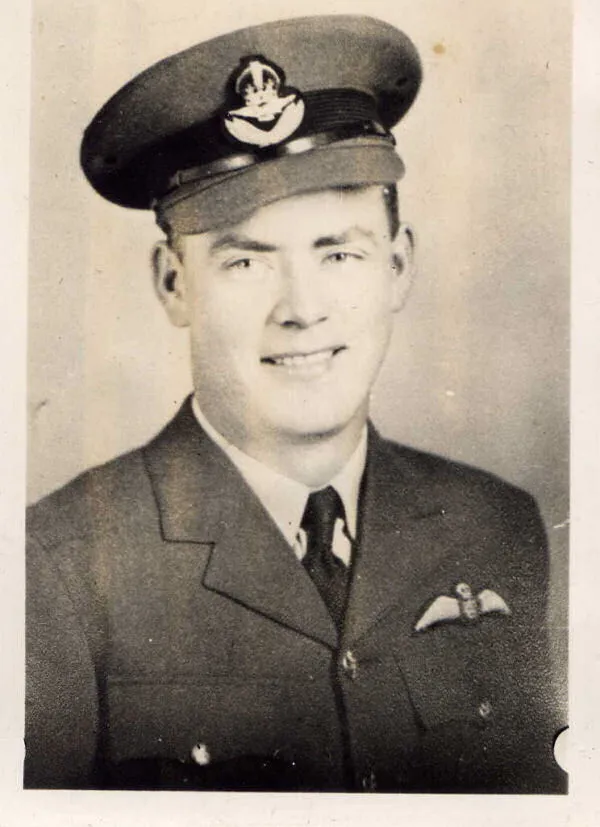
Flying Officer GH Blatchford (RCAF), Flying Officer ILE "Harry" Gould (RCAF) and Flying Officer SW Lough (RCAF) were killed in action
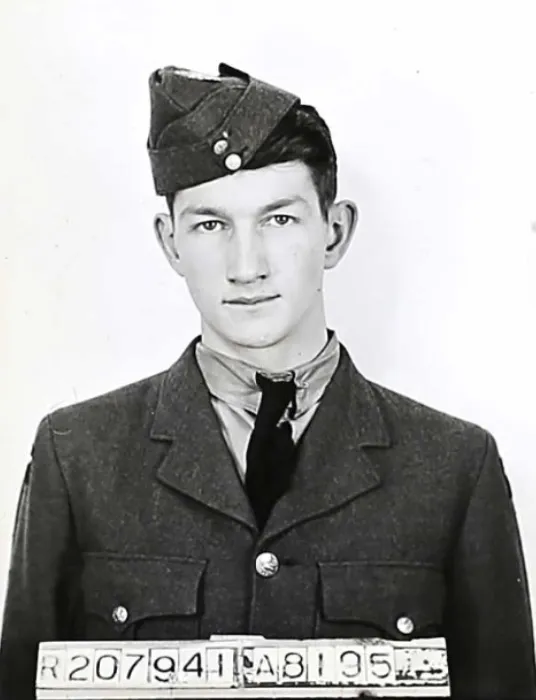
Sergeant T "Moose" Masdin (RCAF), Sergeant DH "Panama" Hattey (RCAF) and Sergeant J Kennedy (RAFVR) survived and were taken as Prisoners of War
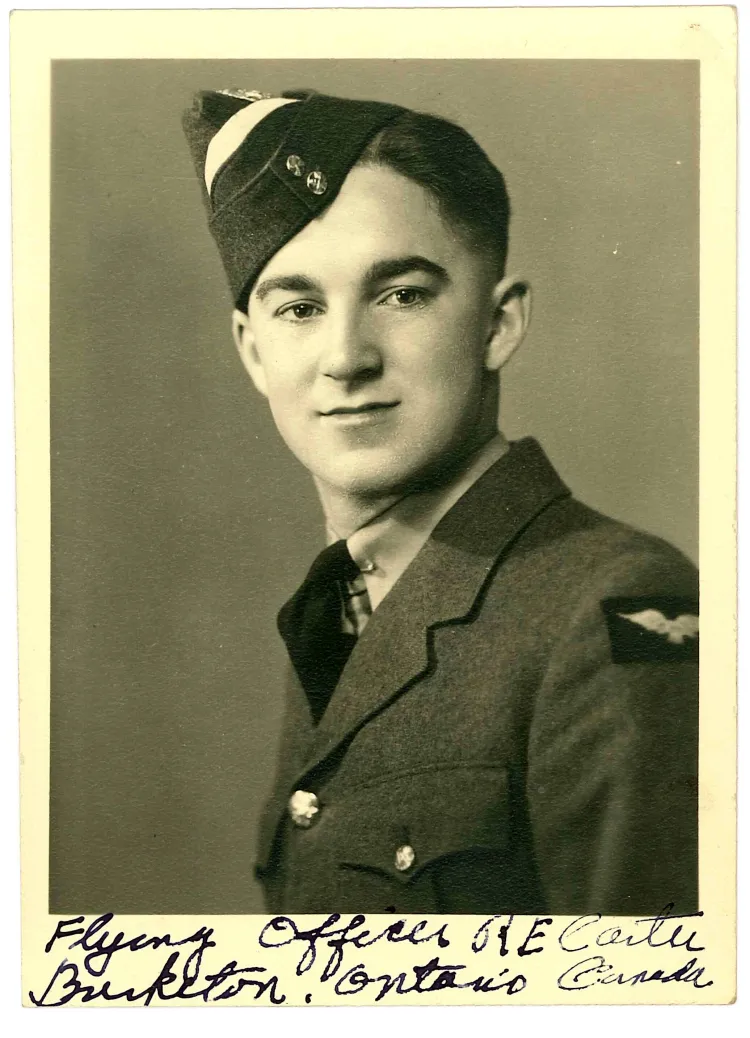
Flying Officer RE Carter MiD (RCAF) survived and evaded with the assistance of the Dutch underground but he, as well as two other evaders, Flight Lieutenant RA Walker DFC (RAF) and Flying Officer JS Nott (RAAF) were caught by the Nazi SD (an agency of the SS) and murdered on July 9,1944 at Tilburg in the Netherlands
A British Military Court charged 10 individuals with this war crime in 1946 and four were hanged September 5, 1947
The remains of these three airmen were never recovered. Flying Officer Carter has no known grave and he is commemorated on the Runnymede War Memorial
Mention in Despatches - 431 Squadron (deceased) - Award effective 13 June 1946 as per London Gazette of that date and AFRO 726/46 dated 26 July 1946. Detail provided by H Halliday, Orleans, Ontario
There were four 431 Squadron Halifax aircraft lost on this operation on this date. Please see Fairless, AG for Halifax MZ 520 SE-O, Johnson, EO for Halifax LK 837 SE-L and Johnstone, MM for Halifax MZ 537 SE-L
Footprints on the Sands of Time, RAF Bomber Command Prisoners of War in Germany 1939-45 by Oliver Clutton-Brock, pages 202, 262, 507 16/17.06.1944 431 Squadron Halifax III NA514 Fg. Off...
Halifax serial: NA514
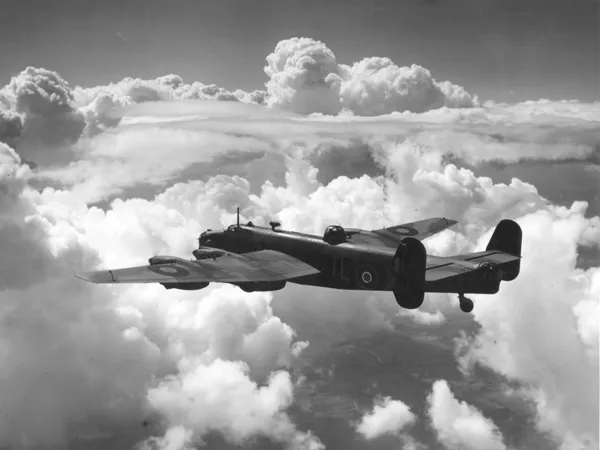
(RAF Photo, 1942)(Source Harold A Skaarup Web Page)
A Royal Air Force Handley Page Halifax Mk. II Series I (Serial No. W7676), coded TL-P, of No. 35 Squadron, RAF, based at Linton-on-Ouse, Yorkshire in the UK, being piloted by Flight Lieutenant Reginald Lane, (later Lieutenant-General, RCAF), over the English countryside. Flt Lt Lane and his crew flew twelve operations in W7676, which failed to return from a raid on Nuremberg on the night of 28/29 August 1942, when it was being flown by Flt Sgt D. John and crew.
The Handley Page Halifax is a British Royal Air Force (RAF) four-engined heavy bomber of the Second World War. It was developed by Handley Page to the same specification as the contemporary twin-engine Avro Manchester.
The Halifax has its origins in the twin-engine HP56 proposal of the late 1930s, produced in response to the British Air Ministry's Specification P.13/36 for a capable medium bomber for "world-wide use." The HP56 was ordered as a backup to the Avro 679, both aircraft being designed to use the underperforming Rolls-Royce Vulture engine. The Handley Page design was altered at the Ministry to a four-engine arrangement powered by the Rolls-Royce Merlin engine; the rival Avro 679 was produced as the twin-engine Avro Manchester which, while regarded as unsuccessful mainly due to the Vulture engine, was a direct predecessor of the famed Avro Lancaster. Both the Lancaster and the Halifax would emerge as capable four-engined strategic bombers, thousands of which would be built and operated by the RAF and several other services during the War.
On 25 October 1939, the Halifax performed its maiden flight, and it entered service with the RAF on 13 November 1940. It quickly became a major component of Bomber Command, performing routine strategic bombing missions against the Axis Powers, many of them at night. Arthur Harris, the Air Officer Commanding-in-Chief of Bomber Command, described the Halifax as inferior to the rival Lancaster (in part due to its smaller payload) though this opinion was not shared by many of the crews that flew it, particularly for the MkIII variant. Nevertheless, production of the Halifax continued until April 1945. The operational statistics from the Bomber Command War Room Manual, state 82,773 operational sorties 2,232 aircraft lost of which 1,833 were missing, in addition there were 365 anti submarine patrols with 4 aircraft lost. Halifax laid 9,572 mines according to the war manual, daily reports total 9,550 being 851x1000, 6,450x1500 and 2,248x1850 pound mines.. The Halifax was also flown in large numbers by other Allied and Commonwealth nations, such as the Royal Canadian Air Force (RCAF), Royal Australian Air Force (RAAF), Free French Air Force and Polish forces. Wikipedia
 Halifax Heavy Bomber WWII
 Wikipedia Halifax Bomber
 National Air Force Museum of Canada
Unit Desciption
431 (B) Sqn The Hatiten Ronteriios ("Iroquois")
History of the Squadron during World War II (Aircraft: Wellington X, Halifax V, III, Lancaster X)
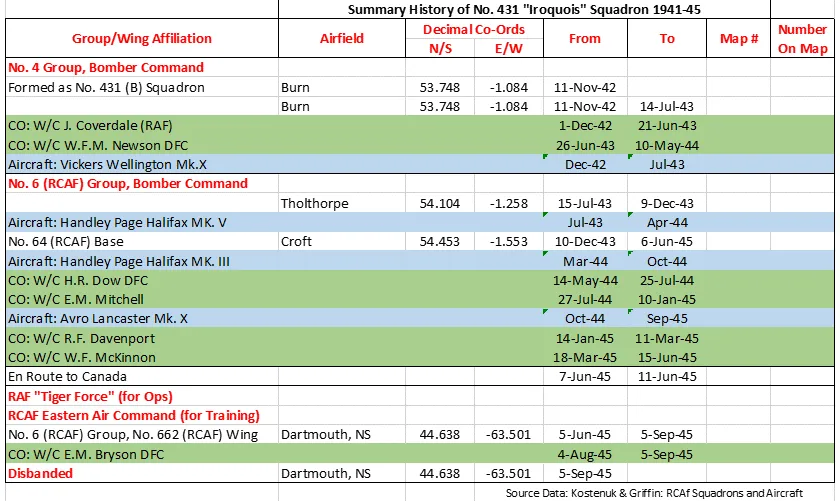
The Squadron was formed in November 1942 as the RCAF's 11th bomber squadron to be formed overseas, at Burn, Yorkshire, UK , as a bomber unit of No 4 Group of RAF Bomber Command. With squadron code letters SE it flew Vickers Wellington Mk X aircraft. In July 1943 it moved to Tholthorpe, Yorkshire , to become part of No 6 (RCAF) Group, at the same time re-equipping with Handley Page Halifax Mk V bombers. It moved again in December 1943 to become part of No 64 (RCAF) Base at Croft, Yorkshire , where it remained until the end of the war. Another change of aircraft, to Halifax Mk. III was made in March of 1944, and finally the squadron was equipped with Canadian-built Avro Lancaster Mk X aircraft from October 1944. After the termination of hostilities in Europe, it was earmarked to form part of the Tiger Force to attack Japan and left for Canada in June 1945. The Japanese surrender following the dropping of the atomic bombs made Tiger Force redundant, and the squadron was disbanded at Dartmouth, Nova Scotia in September of 1945.
In the course of operations the squadron flew 2584 sorties (including 11 bringing PoWs back to England) at a cost of 72 aircraft destroyed. Approximately 14000 tons of bombs were dropped. Aircrew awards were 1 DSO, 63 DFCs, 10 DFMs, 2 CGMs and 1 MiD. Battle Honours were: English Channel and North Sea 1943-44, Baltic 1943-44, Fortress Europe 1943-44, France and Germany 1944-45, Biscay Ports 1943-44, Ruhr 1943-45, Berlin 1943-44, German Ports 1943-45, Normandy 1944, Rhine, Biscay 1944.Moyes, Kostenuk and Griffin
Squadron History (Bomber Command Museum PDF)
Maps for Movements of 431 Squadron 1942-45
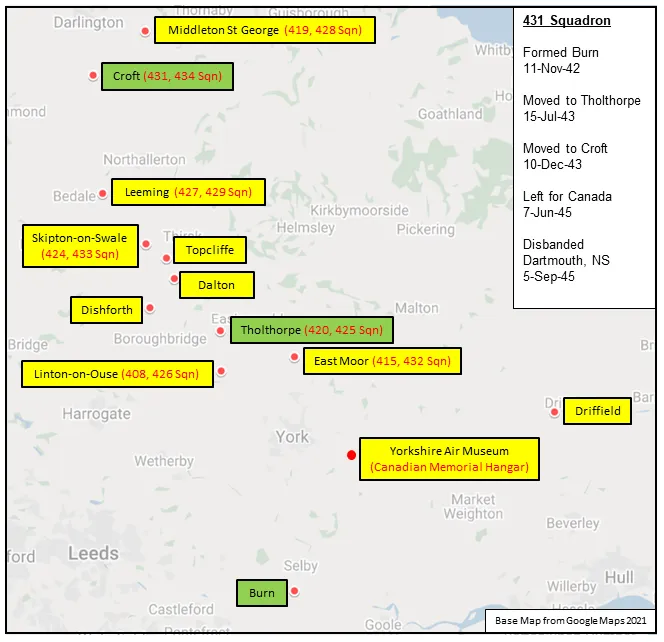
MAP 1: 431 Squadron Bases 1942-45 (marked in green). Right-click on image to display enlarged in new tab
431 Squadron History Summary 1942-45
History of the Squadron Post-WWII (Aircraft: Tutor)
No. 431 (Fighter) Squadron re-formed at RCAF Station Bagotville, Quebec on 18 January 1954, using the new Canadair Sabre. The squadron was formed on a temporary basis until there were enough new CF-100s available to fulfill RCAF squadron needs. No. 431's duties included aerial combat training and displaying the capabilities of jet operations to the public at air shows: the team from No. 431 Squadron consisted of four Sabres and a solo aircraft. This was the first Sabre team to be authorized to perform formation aerobatics in Canada. 431 squadron was disbanded on 1 October 1954.
In 1969, Colonel O.B. Philp, base commander of CFB Moose Jaw and former leader of the defunct Golden Centennaires aerobatic team, considered using several of the leftover Golden Centennaire CT-114 Tutor aircraft for another team. These Tutors were still fitted for aerobatic flying. Philp, at this point, did not receive approval to form the new team; however, approval had been given for single Tutors to provide simple flypasts at local football games. To further the cause of an aerobatic team, Philp began informal enhanced formation practice for the instructors at 2 Canadian Forces Flying Training School with the aim of providing multi-aircraft flypasts at special events. In 1970, four-aircraft formations began providing flypasts at fairs and festivals, as well as Armed Forces Day at CFB Moose Jaw . In July 1970, a white Tutor was introduced to the formation for flypasts. Four white Tutors were finally flown together at the Abbotsford Air Show, followed by a flypast in Winnipeg. Known as the "2 Canadian Forces Flying Training School Formation Team", or informally as the "Tutor Whites", the team grew in size to seven aircraft in 1971 using eleven pilots, and gradually gained recognition. Formation flypasts were replaced with more complicated manoeuvres, and more aircraft were added as the team matured. A contest to give the air demonstration team a formal name was held at Bushell Park Elementary School at CFB Moose Jaw, and resulted in the name "Snowbirds”, which was formally adopted on 25 June 1971. The Snowbirds were officially authorized to be designated the "Canadian Forces Air Demonstration Team" on 15 January 1975, and were formed into their own squadron by reactivating 431 Squadron (renamed 431 Air Demonstration Squadron) on 1 April 1978. .Wikipedia
And the rest is history……………………
Halifax NA514 B/A.Mk.III - Bombing Sterkrade Germany - 1944-06-16 to 1944-06-17
Squadron: (B) Sqn (RCAF)
Start Date: 1944-06-16
Completion Date: 1944-06-17
Mission: Bombing
Operation: Battle of Normandy
Target City: Sterkrade Germany
Target Specific:
Base: Croft
Take Off Time: 22.24
Squadron Code: SE B
Radio Code:
Return Base:
Return Time:
Crash City: Grote Heide, Nistelrode, Noord-Brabant, Netherlands
Crash Specifics:
Crash Latitude: 0.00000000
Crash Longitude: 0.00000000
Crash Reason: fighter
Flak Battery:
Enemy Claim:
War Diary Unavailable
6 Bomber Group June 16/17, 1944
63 Halifaxes from 426, 431, 432, and 434 squadrons were joined by 37 Lancasters from 408, 419, and 428 squadrons on an attack of the oil plant at Sterkrade-Holten. The crews were over the target between17,000 and 20,000 feet, releasing 878,000 lbs of high explosives through thick cloud. This attack was not very successful due to the cloud cover and the fact that the German fighter controller had his fighters orbit a beacon not far from the flight path. Many crews failed to return for that reason.
While part of the group went to Sterkrade, 101 Halifaxes from 420, 424, 425, 427, 429, and 433 squadrons were ordered to attack a V-1 site in the Pas de Calais area called Sautrecourt. The crews were over the target between 14,000 and 17,000 feet, releasing 760,000 lbs of high explosives. According to reports, the target was well hit. Richard Koval (6bombergroup.ca)
321 aircraft- 162 Halifaxes, 147 Lancasters, 12 Mosquitoes - of 1, 4, 6 and 8 Groups to attack the synthetic-oil plant despite a poor weather forecast.
The target was found to be covered by thick cloud and the Pathfinder markers quickly disappeared. The Main Force crews could do little but bomb on to the diminishing glow of the markers in the cloud. R.A.F. photographic reconnaissance and German reports agree that most of the bombing was scattered, although some bombs did fall in the plant area, but with little effect upon production. 21 Germans and 6 foreigners were killed and 18 houses in the vicinity were destroyed
.Unfortunately, the route of the bomber stream passed near a German night-fighter beacon at Bocholt, only 30 miles from Sterkrade. The German controller had chosen this beacon as the holding point for his night fighters. Approximately 21 bombers were shot down by fighters and a further Io by Flak. 22 of the lost aircraft were Halifaxes, these losses being 13 ·6 per cent of the 162 Halifaxes on the raid. 77 Squadron, from Full Sutton near York, lost 7 of its 23 Halifaxes taking part in the raid.
source: The Bomber Command War Diaries, Martin Middlebrook and Chris Everitt
Halifax III aircraft NA 514 SE-B was intercepted and shot down by night fighter pilot Oberleutnant Josef Nabrich of the 3/NJG 1, (flying a Heinkel He 219 A-O from Venlo airfield, Netherlands) during an operation to bomb the synthetic-oil plants at Sterkrade and Holden, GermanyThe Halifax crashed at Grote Heide, Nistelrode, Noord-Brabant, Netherlands
Flying Officer GH Blatchford (RCAF), Flying Officer ILE "Harry" Gould (RCAF) and Flying Officer SW Lough (RCAF) were killed in action
Sergeant T "Moose" Masdin (RCAF), Sergeant DH "Panama" Hattey (RCAF) and Sergeant J Kennedy (RAFVR) survived and were taken as Prisoners of War
Flying Officer RE Carter MiD (RCAF) survived and evaded with the assistance of the Dutch underground but he, as well as two other evaders, Flight Lieutenant RA Walker DFC (RAF) and Flying Officer JS Nott (RAAF) were caught by the Nazi SD (an agency of the SS) and murdered on July 9,1944 at Tilburg in the Netherlands
A British Military Court charged 10 individuals with this war crime in 1946 and four were hanged September 5, 1947
The remains of these three airmen were never recovered. Flying Officer Carter has no known grave and he is commemorated on the Runnymede War Memorial
Mention in Despatches - 431 Squadron (deceased) - Award effective 13 June 1946 as per London Gazette of that date and AFRO 726/46 dated 26 July 1946. Detail provided by H Halliday, Orleans, Ontario
There were four 431 Squadron Halifax aircraft lost on this operation on this date. Please see Fairless, AG for Halifax MZ 520 SE-O, Johnson, EO for Halifax LK 837 SE-L and Johnstone, MM for Halifax MZ 537 SE-L
Footprints on the Sands of Time, RAF Bomber Command Prisoners of War in Germany 1939-45 by Oliver Clutton-Brock, pages 202, 262, 507 16/17.06.1944 431 Squadron Halifax III NA514 Fg. Off...
